
Penny Dreadfuls, 1857 · page 61 of 394
Agnes, or, Beauty and Pleasure — page 61: what you’re looking at
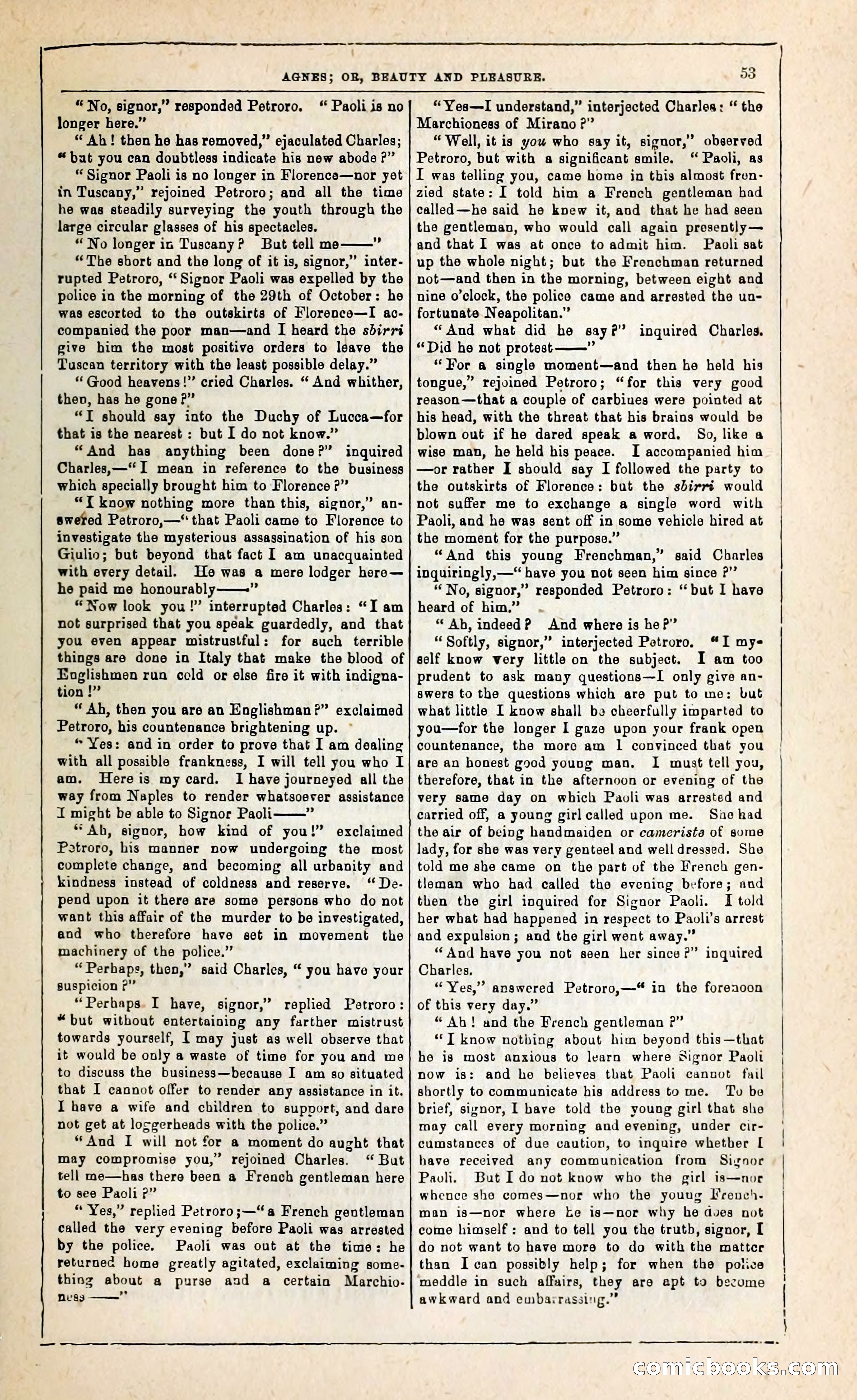
A restored page from Penny Dreadfuls, 1857. Page through the whole issue in the reader above.
📄 Transcribed text from this page (OCR, searchable)
Machine-transcribed from the original scan — historical spelling and the odd misread are preserved.
“No, signor,” responded Petroro. “ Paoli is no longer here.” “Ah! then he has removed,” ejaculated Charles; “bat you can doubtless indicate his new abode P” “Signor Paoli is no longer in Florence—nor yet in Tuscany,” rejoined Petroro; and all the time he was steadily surveying the youth through the large circular glasses of his spectacles. “No longer in Tuscany? But tell me “The short and the long of it is, signor,” inter- rupted Petroro, ‘‘ Signor Paoli was expelled by the police in the morning of the 29th of October: he was escorted to the outskirts of Florence—I ac- companied the poor man—and I heard the sbirré give him the most positive orders to leave the Tuscan territory with the least possible delay.” “Good heavens!” cried Charles. “ And whither, then, has he gone ?” “TI should say into the Duchy of Lucca—for that is the nearest : but I do not know.” “And has anything been done?” inquired Charles,—‘“ I mean in reference to the business which specially brought him to Florence P” *{ know nothing more than this, signor,” an- swefed Petroro,— that Paoli came to Florence to investigate the mysterious assassination of his son Giulio; but beyond that fact I am unacquainted with every detail. He was a mere lodger here— he paid me honourably——~” “Now look you!” interrupted Charles: “I am not surprised that you speak guardedly, and that you even appear mistrustful: for such terrible things are done in Italy that make the blood of Englishmen run ccld or else fire it with indigna- tion !” “ Ah, then you are an Englishman ?” exclaimed Petroro, his countenance brightening up. ~ * Yes: and in order to prove that I am dealing with all possible frankness, I will tell you who I am. Hereis mycard. I have journeyed all the way from Naples to render whatsoever assistance I might be able to Signor Paoli Ks “Ah, signor, how kind of you!” exclaimed Patroro, his manner now undergoing the most complete change, and becoming all urbanity and kindness instead of coldness and reserve. “ De- pend upon it there are some persons who do not want this affair of the murder to be investigated, and who therefore have set in movement the machinery of the police.” “Perhaps, then,” said Charles, “ you have your Suspicion ?” “Perhaps. I have, signor,” replied Petroro: “but without entertaining any farther mistrust towards yourself, I may just as well observe that it would be only a waste of time for you and me to discuss the business—because I am so situated that I cannot offer to render any assistance in it. I have a wife and children to support, and dare not get at locgerheads with the police.” “And I will not for a moment do aught that may compromise you,” rejoined Charles. “ But tell me—has there been a French gentleman here to see Paoli P” “ Yes,” replied Petroro;—“a French gentleman called the very evening before Paoli was arrested by the police. Paoli was out at the time: he returnec home greatly agitated, exclaiming some- thing about a purse and a certain Marchio- nvss ——”’ AGNES; OR, BEAUTY AND PLEASURE. od “Yes—I understand,” interjected Charles: “ the Marchioness of Mirano ?” “Well, it is you who say it, signor,” observed Petroro, but with a significant smile. “ Paoli, as I was telling you, came home in this almost fren- zied state: I told him a French gentleman had called—he said he knew it, and that he had seen the gentleman, who would call again presently— and that I was at once to admit him. Paoli sat up the whole night; but the Frenchman returned not—and then in the morning, between eight and nine o’clock, the police came and arrested the un- fortunate Neapolitan.” “And what did he say?” inquired Charles. “Did he not protest a “For a single moment—and then he held his tongue,” rejoined Petroro; “for this very good reason—that a couple of carbiues were pointed at his head, with the threat that his brains would be blown out if he dared speak a word. So, like a wise man, he held his peace. I accompanied him —or rather I should say I followed the party to the outskirts of Florence: but the sdirré would not suffer me to exchange a single word with Paoli, and he was sent off in some vehicle hired at the moment for the purpose.” “And this young Frenchman,” said Charles inquiringly,—“ have you not seen him since ?” ‘No, signor,” responded Petroro: “but I have heard of him.” . “Ah, indeed? And where is heP” “Softly, signor,” interjected Petroro, “I mye self know very little on the subject. I am too prudent to ask many questions—I only give an- swers to the questions which are put to me: but what little I know shall bo cheerfully imparted to you—for the longer I gaze upon your frank open countenance, the moro am I convinced that you | are an honest good young man. I must tell you, therefore, that in the afternoon or evening of the very same day on which Paoli was arrested and carried off, a young girlcalled upon me. Sae had the air of being handmaiden or cameriste of sume lady, for she was very genteel and well dressed. She told me she came on the part of the French gen- tleman who had called the evening before; and then the girl inquired for Signor Paoli. I told her what had happened in respect to Paoli’s arrest and expulsion; and the girl went away.” “‘And have you not seen her since?” inquired | Charles, | “Yes,” answered Petroro,—* in the forenoon of this very day.” “ Ah! and the French gentleman P” “T know nothing about him beyond this—that | he is most anxious to learn where Signor Paoli now is: and he believes that Paoli cannot fail shortly to communicate his address tome. Tv be brief, signor, I have told the young girl that she may call every morning and evening, under cir- cumstances of due caution, to inquire whether [ | have received any communication from Sirnor Paoli. But I do not know who the girl is—nor whence she comes—nor who the youug French. man is—nor where Le is—nor why he dves not come himself: and to tell you the truth, signor, I do not want to have more to do with the mattcr than Ican possibly help; for when the police meddle in such affairs, they are apt to become awkward and embarrassing.” ee COMmicloOoks.c© nn