
Penny Dreadfuls, 1857 · page 62 of 394
Agnes, or, Beauty and Pleasure — page 62: what you’re looking at
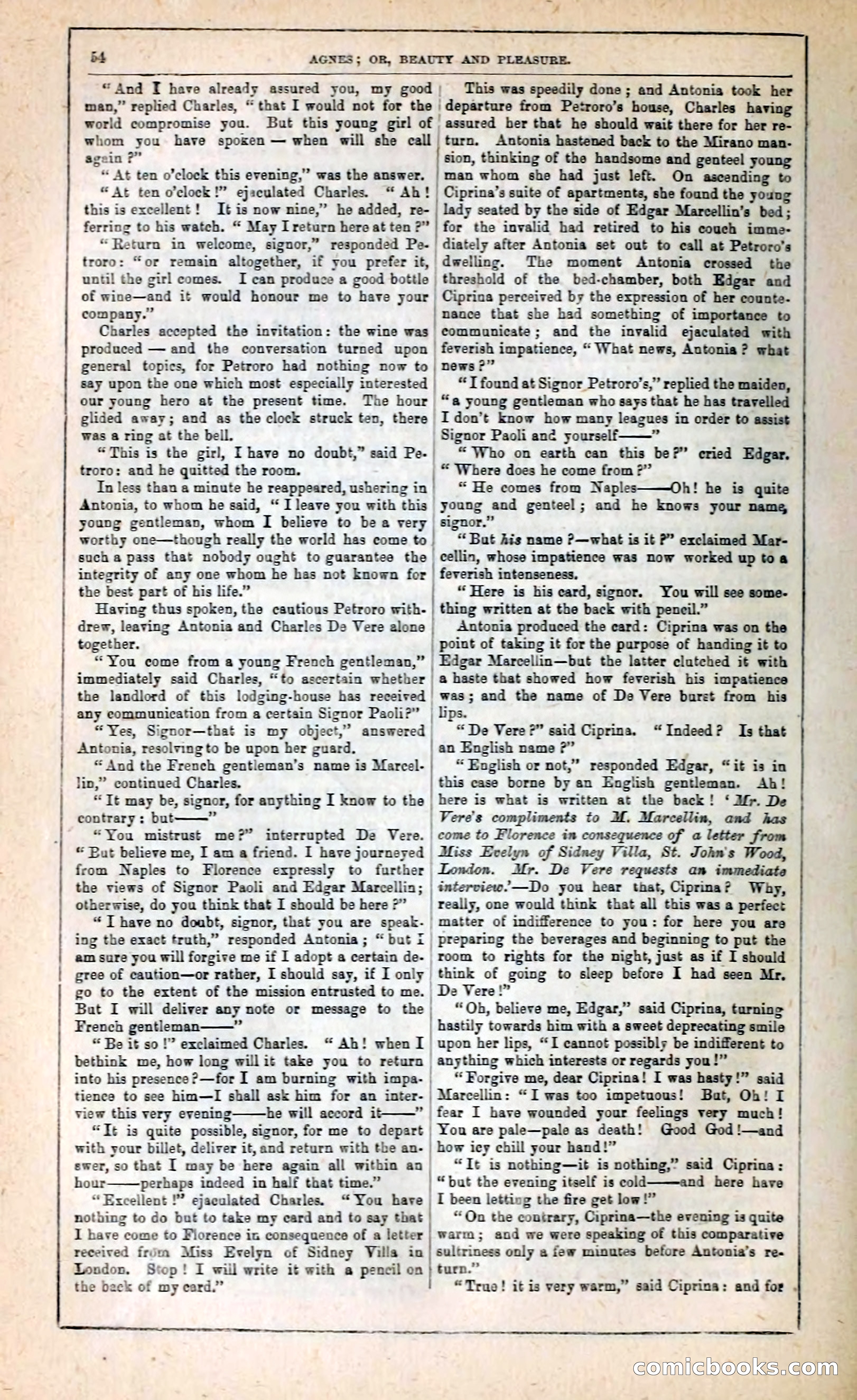
A restored page from Penny Dreadfuls, 1857. Page through the whole issue in the reader above.
📄 Transcribed text from this page (OCR, searchable)
Machine-transcribed from the original scan — historical spelling and the odd misread are preserved.
a ee ee b4 AGNES; OR, BEAUTY AND PLEASURE. “And T have already assured you, my good; This was speedily done; and Antonia took her man,” replied Charles, “that I would not for the | departure from Petroro’s house, Charles having world compromise you. But this young girl of assured her that he should wait there for her re- whom you have spoken — when will she call| turn. Antonia hastened back to the Mirano man- agein ?” sion, thinking of the handsome and genteel young “ At ten o’clock this evening,” was the answer. | man whom she had just left. On ascending to “At ten o’clock !” ejaculated Charles. “ Ah! | Ciprina’s suite of apartments, she found the young this is excellent! It is now mine,” he added, re- | lady seated by the side of Edgar Marcellin’s bed; ferring to his watch. “ May I return here atten ?” | for the invalid had retired to his couch imme- “Return in welcome, signor,” responded Pe- | diately after Antonia set out to call at Petroro’s troro: “or remain altogether, if you prefer it,' dwelling. The moment Antonia crossed the until the girl comes. I can produce a good bottle | threshold of the bed-chamber, both Edgar and of wine—and it would honour me to have your Ciprina perceived by the expression of her counte- company.” mance that she had something of importance to Charles accepted the invitation: the wine was commanicate; and the invalid ejaculated with produced — and the conversation turned upon | feverish impatience, “ What news, Antonia? what general topics, for Petroro had nothing now to | news?” say upon the one which most especially interested| “I found atSignor Petroro’s,” replied the maiden, our young hero at the present time. The hour “a young gentleman who says that he has travelled glided away; and as the clock struck ten, there I don’t know how many leagues in order to assist was a ring at the bell. Signor Paoli ane yourself. e “This is the girl, I have no doubt,” said Pe. | troro: and he quitted the room. | “Where does he come from ?” In less than a minute he reappeared, ushering in| “He comes from Naples——Oh! he is quite Antonia, to whom he said, “ I leave you with this young and genteel; and he knows your name young gentleman, whom [I believe to be a very | signor.” worthy one—though really the world has eome to, “But Ais name ?—what is it ?” exclaimed Mar- such a pass that nobody ought to guarantee the cellin, whose impatience was now worked up toa “ Who on earth can this be?” cried Edgar, integrity of any one whom he has not known for the best part of his life.” Having thus spoken, the cautious Petroro with- drew, leaving Antonia and Charles De Vere alone | | point of taking it for the purpose of _ Edgar Marcellin—but the latter clutched it with a haste that showed how feverish his impatience was; and the name of De Vere buret from his Te Gat | together. “You come from a young French gentleman,” immediately said Charles, “to ascertain whether the landlord of this lodging-house has received any communication from a certain Signor Paoli?” | lips. _ “De Vere 2” said Ciprina. | an English name ?” “Yes, Signor—that is my object,” answered Antonia, resolving to be upon her guard. “And the French gentleman’s name is Marcel- lin,” continued Charles. * Tt may be, signor, for anything I know to the contrary: but = “You mistrust me?” interrupted De Vere. * But believe me, I am a friend. I have journeyed from Naples to Florence expressly to further the views of Signor Paoli and Edgar Marcellin; otherwise, do you think that I should be here >” “ ] have no doubt, signor, that you are speak- ing the exact truth,” responded Antonia; “but i am sure you will forgive me if I adopt a certain de- gree of caution—or rather, I should say, if I only go to the extent of the mission entrusted to me. Bat I will deliver any note or message to the | French gentleman “ Be it so!” exclaimed Charles. “Ah! when I bethink me, how long willit take you to return into his presence ?—for I am burning with impa- tienee to see him—I shall ask him for an inter- view this very evening he will aecord it——” “Tt is quite possible, signor, for me to depart with your billet, deliver it, and return with the an- ewer, so that I may be here again all within an hour perhaps indeed in half that time.” “Excellent !” ejaculated Charles. “You have nothing to do but to take my card and to say that I have come to Florence in consequence of a letter received frdm Miss Evelyn of Sidney Villa in London. Stop! I will write it with a pencil on the beck of my card.” Se ee ee =—_eo Sse «=|. — feverish intenseness, “Here is his card, signor. You will see some- thing written at the back with pencil.” Antonia produced the card: Ciprina was on the handing it to “ Indeed ? “English or not,” responded Edgar, “it is in this case borne by an English gentleman. Ah! _here is what is written at the back! ‘ Mr. De | Vere's compliments to M. Marcellin, and has come to Florence in consequence of a letter from Miss Evelyn of Sidney Villa, St. John's Wood, London. Mr. De Vere requests an immediate | interview.—Do you hear that, Ciprina? Why, really, one would think that all this was a perfect / matter of indifference to you: for here you are preparing the beverages and beginning to put the room to rights for the night, just as if I should think of going to sleep before I had seen Mr, De Vere!” ' | hastily towards him with a sweet deprecating smile upon her lips, “I cannot possibly be indifferent to anything which interests or regards you!” _ Forgive me, dear Ciprina! I was hasty!” said | Marcellin: “I was too impetuous! Bat, Oh! I fear I have wounded your feelings very much! You are pale—pale as death! Good God !—and how icy chill your hand!” _ “It is nothing—it is nothing,” said Ciprina: “but the evening itself is cold———and here have I been letting the fire get low!” "ec On the contrary, Ciprina—the evening is quite |warm; and we were speaking of this comparative sultriness only a few minutes before Antonia’s re- turn.” “Truo! it is very warm,” said Ciprina: and for “Oh, believe me, Edgar,” said Ciprina, tarnine MICLOO© (E(0)