
Penny Dreadfuls, 1857 · page 85 of 394
Agnes, or, Beauty and Pleasure — page 85: what you’re looking at
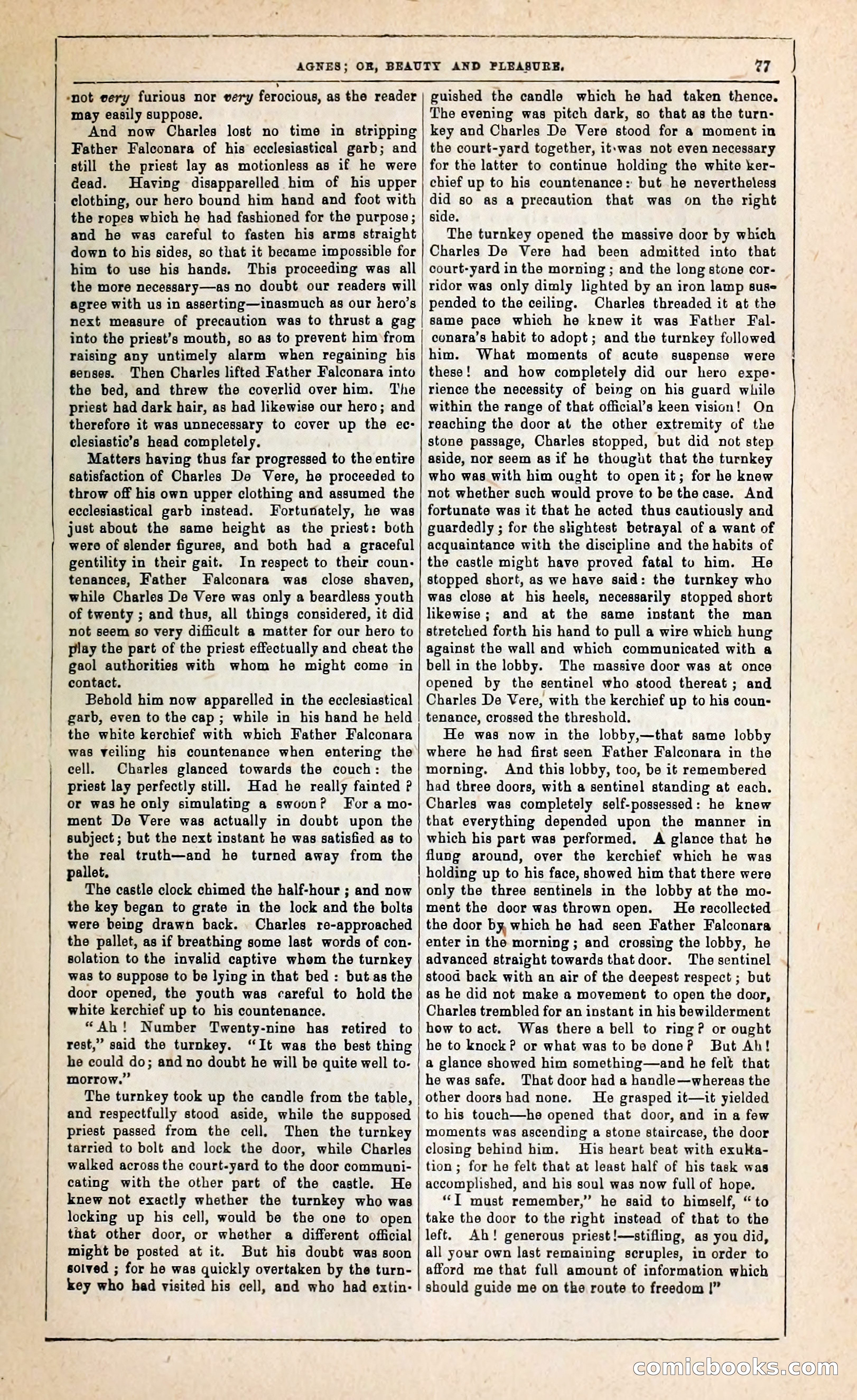
A restored page from Penny Dreadfuls, 1857. Page through the whole issue in the reader above.
📄 Transcribed text from this page (OCR, searchable)
Machine-transcribed from the original scan — historical spelling and the odd misread are preserved.
AGNES; OR, BEAUTY AND PLEASURE, ‘not very furious nor very ferocious, as the reader may easily suppose. And now Charles lost no time in stripping Father Falconara of his ecclesiastical garb; and still the priest lay as motionless as if he were Gead. Having disapparelled him of his upper clothing, our hero bound him hand and foot with the ropes which he had fashioned for the purpose ; and he was careful to fasten his arms straight down to his sides, so that it became impossible for him to use his hands. This proceeding was all the more necessary—as no doubt our readers will agree with us in asserting—inasmuch as our hero’s next measure of precaution was to thrust a gag into the priest’s mouth, so as to prevent him from raising any untimely alarm when regaining his senses. Then Charles lifted Father Falconara into the bed, and threw the coverlid over him. The priest had dark hair, as had likewise our hero; and therefore it was unnecessary to cover up the ec: clesiastic’s head completely. Matters having thus far progressed to the entire satisfaction of Charles De Vere, he proceeded to throw off his own upper clothing and assumed the ecclesiastical garb instead. Fortunately, he was just about the same height as the priest: both wero of slender figures, and both had a graceful gentility in their gait. In respect to their coun- tenances, Father Falconara was close shaven, while Charles De Vere was only a beardless youth of twenty ; and thus, all things considered, it did not seem so very difficult a matter for our hero to play the part of the priest effectually and cheat the gaol authorities with whom he might come in contact. Behold him now apparelled in the ecclesiastical garb, even to the cap; while in his hand he held the white kerchief with which Father Falconara was veiling his countenance when entering the cell. Charles glanced towards the couch: the priest lay perfectly still, Had he really fainted ? or was he only simulating a swoun? Fora mo- ment De Vere was actually in doubt upon the subject; but the next instant he was satisfied as to the real truth—and he turned away from the pallet. The castle clock chimed the half-hour ; and now the key began to grate in the lock and the bolts were being drawn back. Charles re-approached the pallet, as if breathing some last words of con- solation to the invalid captive whom the turnkey was to suppose to be lying in that bed : but.as the door opened, the youth was careful to hold the white kerchief up to his countenance. “Ah! Number Twenty-nine has retired to rest,” said the turnkey. “It was the best thing he could do; and no doubt he will be quite well to- morrow.” The turnkey took up the candle from the table, and respectfully stood aside, while the supposed priest passed from the cell, Then the turnkey tarried to bolt and lock the door, while Charles walked across the court-yard to the door communi- cating with the other part of the castle. He knew not exactly whether the turnkey who was locking up his cell, would be the one to open that other door, or whether a different official might be posted at it. But his doubt was soon solved ; for he was quickly overtaken by the turn- key who had visited his cell, and who had extin- ee a 27 guished the candle which he had taken thence. The evening was pitch dark, so that as the turn- key and Charles De Vere stood for a moment in the court-yard together, it-was not even necessary for the latter to continue holding the white ker- chief up to his countenance: but he nevertheless did so as a precaution that was on the right side. The turnkey opened the massive door by which Charles De Vere had been admitted into that court-yard in the morning; and the long stone cor- ridor was only dimly lighted by an iron lamp suse pended to the ceiling. Charles threaded it at the same pace which he knew it was Father Fal- conara’s habit to adopt; and the turnkey followed him. What moments of acute suspense were these! and how completely did our hero expe- rience the necessity of being on his guard while within the range of that official’s keen vision! On reaching the door at the other extremity of the stone passage, Charles stopped, but did not step aside, nor seem as if he thougut that the turnkey who was with him oucht to open it; for he knew not whether such would prove to be the case. And fortunate was it that he acted thus cautiously and guardedly ; for the slightest betrayal of a want of acquaintance with the discipline and the habits of the castle might have proved fatal tu him. He stopped short, as we have said: the turnkey who was close at his heels, necessarily stopped short likewise; and at the same instant the man stretched forth his hand to pull a wire which hung against the wall and which communicated with a bell in the lobby. The massive door was at once opened by the sentinel who stood thereat ; and Charles De Vere, with the kerchief up to his coun- tenance, crossed the threshold. He was now in the lobby,—that same lobby where he had first seen Father Falconara in the morning. And this lobby, too, be it remembered had three doors, with a sentinel standing at each. Charles was completely self-possessed: he knew that everything depended upon the manner in which his part was performed. A glance that he flung around, over the kerchief which he was holding up to his face, showed him that there were only the three sentinels in the lobby at the mo- ment the door was thrown open. He recollected the door by, which he had seen Father Falconara enter in the morning ; and crossing the lobby, he advanced straight towards thatdoor. The sentinel stood back with an air of the deepest respect ; but as he did not make a movement to open the door, Charles trembled for an instant in his bewilderment how to act. Was there a bell to ring? or ought he to knock? or what was to bo done? But Ah! a glance showed him something—and he felt that he was safe. That door had a handle—whereas the other doorshad none. He grasped it—it yielded to his touch—he opened that door, and in a few moments was ascending a stone staircase, the door closing behind him. His heart beat with exuMa- tion ; for he felt that at least half of his task was accomplished, and his soul was now full of hope. ‘‘T must remember,” he said to himself, “to take the door to the right instead of that to the left. Ah! generous priest!—stifling, as you did, all your own last remaining scruples, in order to afford me that full amount of information which should guide me on the route to freedom |” lNOOLK co 5}