
Penny Dreadfuls, 1857 · page 86 of 394
Agnes, or, Beauty and Pleasure — page 86: what you’re looking at
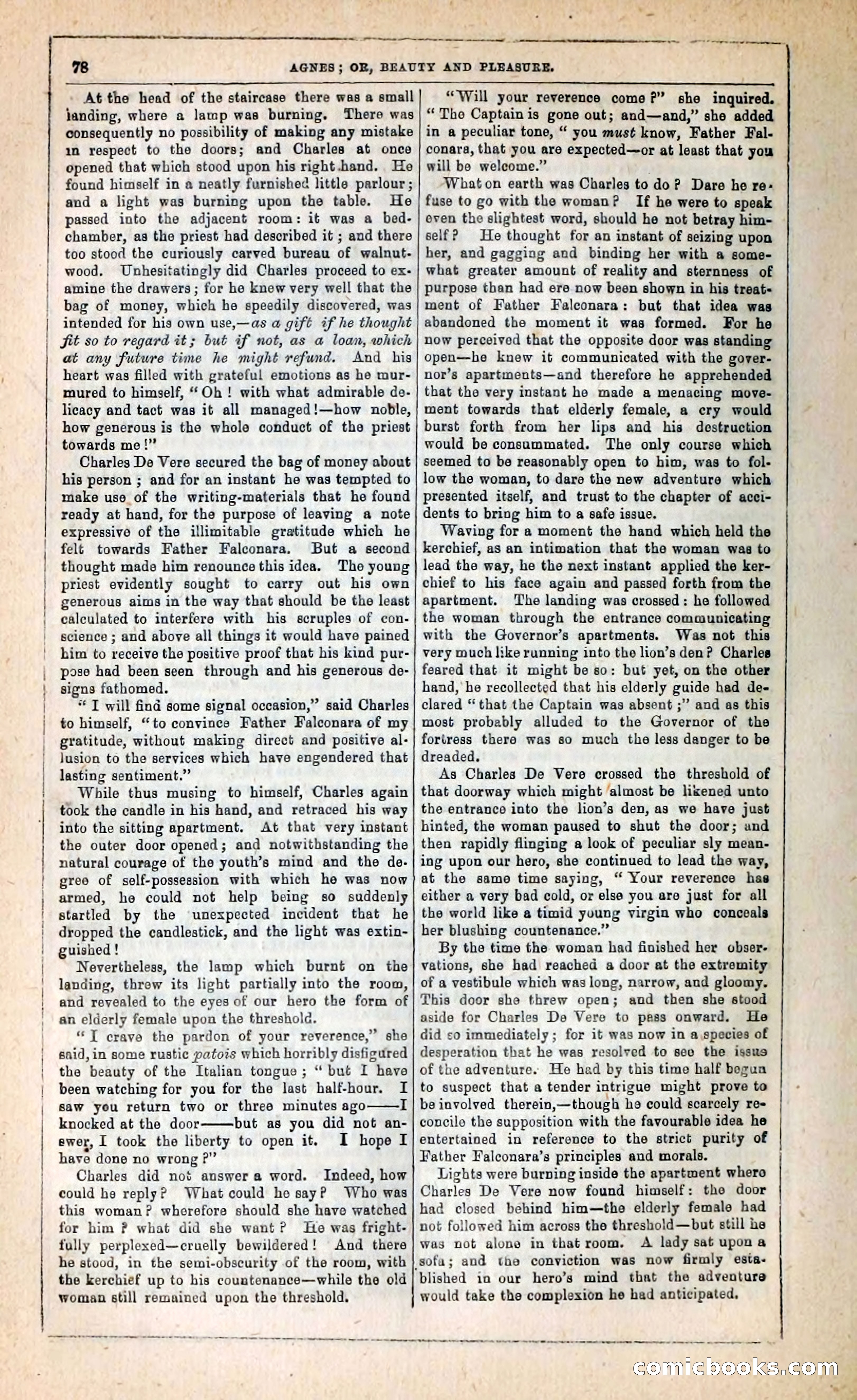
A restored page from Penny Dreadfuls, 1857. Page through the whole issue in the reader above.
📄 Transcribed text from this page (OCR, searchable)
Machine-transcribed from the original scan — historical spelling and the odd misread are preserved.
tg Ee 78 AGNES; OR, BEAUTY AND PLEASURE. - At the head of the staircase there was a small janding, where a lamp was burning, There was consequently no possibility of making any mistake in respect to the doors; and Charles at once opened that which stood upon his right.hand. He found himself in a neatly furnished little parlour; and a light was burning upon the table. He passed into the adjacent room: it was a bed- chamber, as the priest had described it ; and there too stood the curiously carved bureau of walnut- wood. Unhesitatingly did Charles proceed to ex- amine the drawers ; for he knew very well that the bag of money, which he speedily discovered, was intended for his own use,—as @ gift if he thought jit so to regard it; but if not, as a loan, which at any future time he might refund. And his heart was filled with grateful emotions as he mur- mured to himself, “Oh! with what admirable de- licacy and tact was it all managed!—how noble, how generous is the whole conduct of the priest towards me!” Charles De Vere secured the bag of money about his person ; and for an instant he was tempted to make use of the writing-materials that he found ready at hand, for the purpose of leaving a note expressive of the illimitable gratitude which he felt towards Father Falconara. But a second thought made him renounce this idea. The young priest evidently sought to carry out his own generous aims in the way that should be the least calculated to interfere with his scruples of con- science ; and above all things it would have pained him to receive the positive proof that his kind pur- pose had been seen through and his generous de- signs fathomed. **T will find some signal occasion,” said Charles to himself, “to convince Father Falconara of my gratitude, without making direct and positive al- lusion to the services which have engendered that lasting sentiment.” While thus musing to himself, Charles again took the candle in his hand, and retraced his way into the sitting apartment. At that very instant the outer door opened; and notwithstanding the natural courage of the youth’s mind and the de- gree of self-possession with which he was now armed, he could not help being so suddenly startled by the ‘unexpected incident that he dropped the candlestick, and the light was extin- guished! Nevertheless, the lamp which burnt on the landing, threw its light partially into the room, and revealed to the eyes of our hero the form of an elderly female upon the threshold. “T crave the pardon of your reverence,” she nid, in some rustic patois which horribly disfigured the beauty of the Italian tongue; “ bué I have been watching for you for the last half-hour. I saw you return two or three minutes ago I knocked at the door but as you did not an- ewer, I took the liberty to open it. I hope I have done no wrong P” Charles did not answera word. Indeed, how could he reply? What could he say? Who was this woman? wherefore should she have watched for him ? what did she want? He was fright- fully perplexed—cruelly bewildered! And there he stood, in the semi-obscurity of the room, with }, the kerchief up to his couatenance—while the old woman still remained upon the threshold. SN 0 ewe er re we ee ee we — - re rr ee ee ee oe ee Re ee ee “Will your reverence come?” she inquired. “ Tho Captain is gone out; and—and,” she added in a peculiar tone, “ you must know, Father Fal- conara, that you are expected—or at least that you will be welcome.” . What on earth was Charles to do? Dare he re- fuse to go with the woman? If he were to speak even the slightest word, should he not betray him- self? He thought for an instant of seizing upon her, and gagging and binding her with a some- what greater amount of reality and sternness of purpose than had ere now been shown in his treat< ment of Father Faleonara: but that idea was abandoned the moment it was formed. For he now perceived that the opposite door was standing open—he knew it communicated with the gover- nor’s apartments—and therefore he apprehended that the very instant he made a menacing move- ment towards that elderly female, a ery would burst forth from her lips and his destruction would be consummated. The only course which seemed to be reasonably open to him, was to fol- low the woman, to dare the new adventure which presented itself, and trust to the chapter of acci- dents to bring him to a safe issue. Waving for a moment the hand which held the kerchief, as an intimation that the woman was to lead the way, he the next instant applied the ker- chief to his face again and passed forth from the apartment. The landing was crossed: he followed the woman through the entrance communicating with the Governor’s apartments. Was not this very much like running into the lion’s den? Charles feared that it might be so: but yet, on the other hand, he recollected that his elderly guide had de- clared “that the Captain was absent ;” and as this most probably alluded to the Governor of the fortress there was so much the less danger to be dreaded. As Charles De Vere crossed the threshold of that doorway which might ‘almost be likened unto the entranco iuto the lion’s den, as we have just hinted, the woman paused to shut the door; and then rapidly flinging a look of peculiar sly mean- ing upon our hero, she continued to lead the way, at the same time saying, “ Your reverence has either a very bad cold, or else you are just for all the world like a timid young virgin who conceals her blushing countenance.” By the time the woman had finished her obser- vations, she had reached a door at the extremity of a vestibule which was long, narrow, and gloomy. This door she threw open; and then she stood aside for Charles De Vere to pass onward. He did cso immediately; for it was now in a species of desperation that he was resolved to see the issus of the adventure. He had by this time half begun to suspect that a tender intrigue might prove to be involved therein,—though he could scarcely re- concile the supposition with the favourable idea he entertained in reference to the strict purity of Father Falconara’s principles and morals. Lights were burning inside the apartment whero Charles De Vere now found himself: the door had closed behind him—the elderly female had not followed him across the threshold—but still he was not alone in that room. A lady sat upon a sofa; and the conviction was now firmly esta- blished in our hero’s mind that the adventure would take the complexion he had anticipated, Se Oe ome Ore © Se Ee SES SSSUD Me Be ee ee eee; Comichboo oO S