
Penny Dreadfuls, 1881 · page 12 of 38
Alice Bridge of Norwich — page 12: what you’re looking at
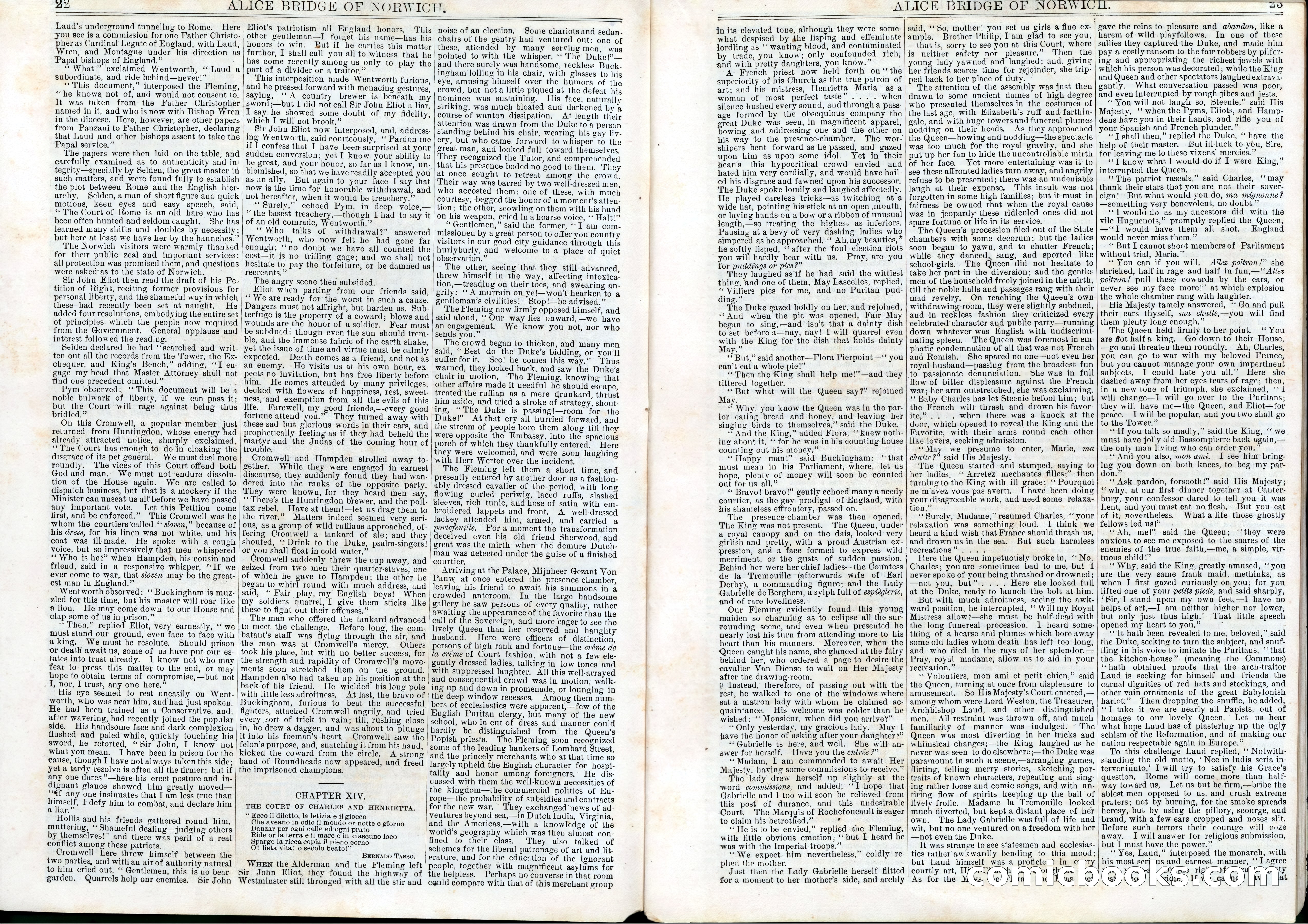
A restored page from Penny Dreadfuls, 1881. Page through the whole issue in the reader above.
📄 Transcribed text from this page (OCR, searchable)
Machine-transcribed from the original scan — historical spelling and the odd misread are preserved.
a4 ALICK BRIDGE OF NORWICH, Laud’s underground tunneling to Rome. Here Eliot’s patriotism all Ergland honors, This’ noise of an election. Some chariots and sedan- you see is a commission for one Father Christo- | other gentleman—I forget his name—has his! chairs of the gentry had ventured out: one of pher as Cardinal Legate of England, with Laud, | honors to win. But if he carries this matter these, atiended by many serving men, wag Wren, and Montague under his direction as/| further, I shall call you all to witness that he | pointed to with the whisper, ‘‘ The Duke! Papal bishops of England.” has come recently among us only to play the |and there surely was handsome, reckles Buck- “What!” exclaimed Wentworth, ‘‘Laud a/ part of a divider or a traitor.” Ps ingham Rattan his chair, with beds cL. ALICE BRIDGE OF NORWICH. : i i = i like a in i { although they were some-| said, ‘‘So, mother! you set us girls 4 fine ex-| gave the reins to pleasure and abandon, ee ae’ eke Taerg aia effeminate|ample. Brother Philip, 1am glad to see you, | harem of wild ak ote : ses of ties Jordling as ‘‘ wanting blood, and contaminated | —that is, sorry to see you at this Court, where | sallies they capture t ne e, and ma cs by trade, you know; only confounded rich, |is neither safety nor pleasure.” Then the) pay a costly ransom to t 4 air robbers by pilfer- Pee with pretty daughiters, you know.” young lady yawned and laughed ; and, giving | ing and eres the richest jewels with A French priest now held forth on “the| her friends scarce time for rejoinder, she trip- which his person was decorated ; while the King subordinate, and ride behind—never!” “This document,” interposed the Fleming, “he knows not of, and would not consent to. It was taken from the Father Christopher named in it, and who is now with Bishop Wren in the diocese. Here, however, are other papers from Panzani to Father Christopher, declaring that Laud and other bishops assent to take the Papal service.” The papers were then laid on the table, and carefully examined as to authenticity and in: tegrity—speciully by Selden, the great master in such matters, and were found fully to establish the plot between Rome and the English hier- archy. Selden, a man of short figure and quick motions, keen eyes and easy speech, said, “The Court of Rome is an old hare who has been often hunted and seldom caught. She has learned many shifts and doubles by necessity ; but here at least we have her by the haunches,” The Norwich visitors were warmly thanked for their public zeal and important services: all protection was promised them, and questions were asked as to the state of Norwich, Sir John Eliot then read the draft of his Pe. tition of Right, reciting former provisions for personal liberty, and the shameful way in which these had recently been set at naught, He added four resolutions, embodying the entire set of principles which the people now required from the Government. General applause and interest followed the reading. Selden declared he had ‘‘searched and writ- ten out all the records from the Tower, the Ex- chequer, and King’s Bench,” adding, ‘I en- gage my head that Master Attorney shall not find one precedent omitted.” i Pym observed: ‘This document will be a noble bulwark of liberty, if we can pass it; but the Court will rage against being thus bridled.” On this Cromwell, a popular member just returned from Huntingdon, whose energy had already attracted notice, sharply exclaimed, ‘‘The Court has enough to do in cloaking the disgrace of its pet general. We must deal more roundly, The vices of this Court offend both God and man.- We must not endure dissolu- tion of the House again. We are called to dispatch business, but that is a mockery if the Minister can unseat us alt before we have passed any important vote. Let this Petition come first, and be enforced.” This Cromwell was he whom the courtiers ‘called ‘‘ sloven,” because of his dress, for his linen was not white, and his coat was illmade. He spoke wilh a rough voice, but so impressively that men whispered ““Who is he?” when Hampden, his cousin and friend, said in a responsive whicper, “If we ever come to war, that sloven may be the great- | of which he gave to Hampden; the other he est man in England.” Wentworth observed: ‘‘ Buckingham is muz- zled for this time, but his master will roar like | alion. He may come down to our House and clap some of us in prison,” Then,” replied Eliot, very earnestly, ‘ we | must stand our ground, even face to face with aking. We must be resolute. Should prison or death await us, some of us have put our es- tates into trust already. 1 know not who may fear to press this matter to the end, or may hope to obtain terms of compromise,—but not I, nor, I trust, any one here.” His eye seemed to rest uneasily on Went- worth, who was near him, and had just spoken. He had been trained as a Conservative, and, after wavering, had recently joined the popular side. His handsome face and dark complexion flushed and paled while, quickly touching his sword, he retorted, “Sir John, I know not what you mean. T have been in prison for the cause, though I have not always taken this side; yet a tardy resolve is often all the firmer; but if any one dares”—here his erect posture and in- dignant glance showed him greatly moved— “aif any one insinuates that I am less true than ced Idefy him to combat, and declare him iar, Hollis and his friends gathered round him, muttering, “ Shameful dealing—judging others by themselves!” and there was peril of a real conflict among these patriots, Cromwell here threw himself between the This interposition made Wentworth furious, and he pressed forward with menacing gestures, saying, ‘A country brewer is beneath my sword ;—but I did not call Sir John Eliot a liar, |I say he showed some doubt of my fidelity, which I will not brook.” : Sir John Eliot now interposed, and, address- ing Wentworth, said courteously, ‘‘ Pardon me if I confess that I have been surprised at your sudden conversion; yet I know your ability to be great, and your honor, so far as I know, un- blemished, so that we have readily accepted you as anally. But again to your face I say that now is the time for honorable withdrawal, and not hereafter, when it would be treachery.” “Surely,” echoed Pym, in deep voice,— | “the basest treachery,—though I had to say it of an old comrade, Wentworth.” ‘““Who talks of withdrawal?” answered | Wentworth, who now felt he had gone far ,enough; ‘‘no doubt we have all counted the cost—it is no trifling gage; and we shall not hesitate to pay the forfeiture, or be damned as recreants.” ; The angry scene then subsided. Eliot when parting from our friends said, ‘We are ready for the worst in such a cause. | Dangers must not affright, but harden us, Sub- terfuge is the property of a coward; blows and | wounds are the honor of a soldier. Fear must be subdued: though even the sun should trem- ble, and the immense fabric of the earth shake, yet the issue of time and virtue must be calmly expected. Death comes as a friend, and not as an enemy, He visits us at his own hour, ex- pects no invitation, but has free liberty before him, He comes attended by many privileges, decked with flowers of happiness, rest, sweet- hess, and exemption from all the evils of this life. Farewell, my good friends,—every good fortune attend you.” They turned away with these sad but glorious words in their ears, and prophetically feeling as if they had beheld the martyr and the Judas of the coming hour of trouble. Cromwell and Hampden strolled away to- gether. While they were engaged in earnest discourse, they suddenly found they had wan- dered into the ranks of the opposite party. They were known, for they heard men say, ‘‘There’s the Huntingdon brewer, and the poll- tax rebel. Have at them!—let us drag them to the river.” Matters indeed seemed very seri- ous, as a group of wild ruffians approached, of- fering Cromwell a tankard of ale; and they shouted, ‘“‘ Drink to the Duke, psalm-singers! or you shall float in cold water.” Cromwell suddenly threw the cup away, and seized from two men their quarter-staves, one began to whirl round with much address, and said, ‘Fair play, my English boys! When my soldiers quarrel, I give them sticks like these to fight out their offenses.” to meet the challenge. Before long, the com- the man was at Cromwell’s mercy. Others took his place, but with no better success, for the strength and rapidity of Cromwell’s move- Ments soon stretched them on the ground. | Hampden also had taken up his position at the | back of his friend. He wielded his long pole with little less adroitness, At last, the bravo of | Buckingham, furious to beat the successful | fighters, attacked Cromwell angrily, and tried | every sort of trick in vain; till, rushing close | in, he drew a dagger, and was about to plunge it into his foeman’s heart. Cromwell saw the felon’s purpose, and, snatching it from his hand, kicked the coward from the circle. A strong} band of Roundheads now appeared, and freed | the imprisoned champions. CHAPTER XIy. THE COURT OF CHARLES AND HENRIETTA. “ Ecco il diletto, la letizia e il giocco Che aveano in odio il mondo or notte e giorno Danzar ee ogni calle ed ogni prato Ride or la terra e il mare e in ciascuno loco Sparge la ricca copia il pieno corno O! lieta vita! o secolo beato!” BmRNADO TASSO. two parties, and with an airof authority natural | The man who offered the tankard advanced | batant’s staff was flying through the air, and | husband. ‘eye, amusing himself over the humors of the crowd, but nota little piqued at the defeat his nominee was sustaining. His face, naturally striking, was much bloated and darkened by a course of wanton dissipation. At length their attention was drawn from the Duke toa person standing behind his chair, wearing his gay liv- ery, but who came forward to whisper to the great man, and looked full toward themselves, They recognized the Tutor, and comprehended that his presence boded no good to them. They at once sought to retreat among the crowd. Their way was barred by two well-dressed men, who accosted them: one of these, with much courtesy, begged the honor of a moment’s atten- tion; the other, scowling on them with his hand on his weapon, cried in a hoarse voice, ‘‘ Halt!” “ Gentlemen,” said the former, ‘‘I am com- , missioned by a great person to offer you country visitors in our good city guidance through this hurlyburly, and welcome to a place of quiet observation.” The other, seeing that they still advanced, threw himself in the way, affecting intoxica- tion,—treading on their toes, and swearing an- grily: ‘A murrain on ye!—won’t hearken to a gentleman’s civilities! Stop!—be advised,” The Fleming now firmly opposed himself, and said aloud, ‘‘Our way lies onward, —we have an engagement, We know you not, nor who sends you.” The crowd began to thicken, and many men said, ‘Best do the Duke’s bidding, or you'll suffer for it. See! he comes this way.” "Thus warned, they looked back, and saw the Duke’s chair in motion, The Fleming, knowing that , other affairs made it needful he should escape, treated the ruffian as a mere drunkard, thrust him asice, and tried a stroke of strategy, shout: ing, ‘‘The Duke is passing!—room for the Duke!” Atthat cry all hurried forward, and the stream of people bore them along tiil they were opposile the Embassy, into the spacious porch of which they thankfully entered. Here they were welcomed, and were soon laughing with Herr Werter over the incident. The Fleming left them a short time, and presently entered by another door as a fashion- jably dressed cavalier of the period, with long |flowing curled periwig, laced ruffs, slashed ‘sleeves, rich tunic, and hose of satin with em- broidered lappets and front. A well-dressed lackey attended him, armed, and carried a portefeuille, For a moment the transformation deceived even his old friend Sherwood, and | great was the mirth when the demure Dutch- man was detected under the guise of a finished courtier, Arriving at the Palace, Mijnheer Gezant Von Pauw at once entered the presence chamber, leaving his friend to await his summons in a crowded anteroom. In the large handsome gallery he saw persons of every quality, rather awaiting the appearance of the favorite than the call of the Sovereign, and more eager to see the lively Queen than her reserved and haughty Here were officers of distinction, persons of high rank and fortune—the créme de la créme of Court fashion, with not a few ele- gantly dressed ladies, talking in low tones and with suppressed laughter. All this well-arrayed and consequential crowd was in motion, walk- ing up and down in promenade, or lounging in the deep window recesses. Among them num. bers of ecclesiastics were apparent,—few of the English Puritan clergy, but many of the new school, who in cut of dress and manner could hardly be distinguished from the Queen’s Popish priests. The Fleming soon recognized some of the leading bankers of Lombard Street, and the princely merchants who at that time so largely upheld the English character for hospi- tality and honor among foreigners, He dis- cussed with them the well-known necessities of the kingdom—the commercial politics of Eu- rope—the probability of subsidies and contracts for the new war. They exchanged news of ad- ventures beyond-sea,—in Dutch India, Virginia, and the Americas,—with a knowledge of the world’s geography which was then almost con- fined to their class. They also talked of schemes for the liberal patronage of art and lit- WHEN the Alderman and the Fleming left to him cried out, ‘‘ Gentlemen, this is no bear- Sir John Eliot, they found the highway of garden, Quarrels help onr enemies, Sir John Westminster still thronged with all the stir and erature, and for the education of the ignorant people, together with magnificent asylums for the helpless. Perhaps no converse in that room could compare with that of this merchant group "you will hardly bear with us, Pray, are you superiority of his Church as the trué patron of | ped back to her place of duty. art; and his mistress, Henrietta Maria asa woman of most perfect taste”... . silence hushed every sound, and through a pass- age formed by the obsequious company the great Duke was seen, in magnificent apparel, bowing and. addressing one and the other on his way to the presence-chamber. The wor- shipers bent forward as he passed, and gazed upon him as upon some idol. Yet in their hearts this hypocritical crowd envied and hated him very cordially, and would have hail- ed his disgrace and fawned upon his successor. The Duke spoke loudly and laughed affectedly. He played careless tricks—as twitching ata wide hat, pointing his-stick at an open .mouth, or laying hands on a bow or a ribbon of unusual length,—so treating the highest as inferiors. Pausing at a bevy of very dashing ladies who simpered as he approached, ‘‘ Ah,my beauties, he softly lisped, ‘‘ after the foul election riots for puddings or ? They twagted oe if he had_said the wittiest thing, and one of them, May Lascelles, replied, “Villiers pies for me, and no Puritan pud- ding.” The Duke gazed boldly on her, and rejoined, ‘And when the pic was opened, Fair May began to sing,—and isn’t that a dainty dish to set before a—nay, nay! I will quarrel even with the King for the dish that holds dainty ‘‘But,” said another—Flora Pierpoint—'' you can’t eat a whole pie!” “Then the King shall help me!”—and they tittered together. 4 “But what will the Queen say?” rejoined May. * Why, you know the Queen was in the par- lor ealing bread and honey, and leaving her singing birds to themselves,” said the Duke, “And the King,” added Flora, ‘‘ knew noth- ing about it, “ for he was in his counting-house counting out his money.” ° “Happy man!” said Buckingham: ‘that must mean in his Parliament, where, let us hope, plenty of money will soon be counted out for us all.” “ Bravo! bravo!” gently echoed many a needy courtier, as the gay prodigal of England, with his shameless effrontery, passed on. The presence-chamber was then opened. The King was not present. The Queen, under a royal canopy and on the dais, looked very girlish and pretty, with a proud Austrian ex- pression, and a face formed to express wild! merriment, or the gusts of sudden passion. } Behind her were her chief ladies---the Countess de la Tremouille (afterwards wife of Earl Derby), a commanding figure; and the Lady Gabrielle de Berghem, a sylph full of espdeglerie, and of rare loveliness. Our Fleming evidently found this young maiden so charming as to eclipse all the sur- Tounding scene, and even when presented he nearly lost his turn from attending more to his heart than his manners. Moreover, when the Queen caught his name, she glanced at the fairy behind her, who ordered a page to desire the cavalier Van Diense to wait on Her Majesty after the drawing-room. « Instead, therefore, of passing out with the rest, he walked to one of the windows where sat a matron lady with whom he claimed ac- quaintance. His welcome was colder than he wished: ‘‘ Monsieur, when did you arrive?” “ Only yesterday, my gracious lady. May I have the honor of asking after your daughter?” “Gabrielle is bere, and well. She will an- awer for herself. Have you the entrée ?” “Madam, I am commanded to await Her Majesty, having some commissions to receive.” The lady drew herself up slightly at the word commissions, and added; ‘‘I hope that Gabrielle and 1 too will soon be relieved from this post of durance, and this undesirable Court. The Marquis of Rochefoucault is eager to claim his betrothed.” < : “He is to be envied,” replied the Fleming, with little obvious emotion; ‘ but I heard he was with the Imperial troops.” “We expect him nevertheless,” coldly re-| plied the mother. when | drawn to some ancient dames of high degree who presented themselves in the costumes of the last age, with Elizabeth’s ruff and farthin- gale, and with huge towers and funereal plumes nodding on their heads. 3 the Queen—bowing and nodding—the spectacle put up ber fan to hide the uncontrollable mirth see these affronted ladies turn away, and angrily refuse to be presented; there was an undeniable The attention of the assembly was just then As they approached was too much for the royal gravity, and she of her face. Yet more entertaining was it to laugh at their expense. This insult was not forgotten in some high families; but it must in fairness be owned that when the royal cause was in jeopardy- these ridiculed ones did not spare fortune or life in its service. The Queen’s procession filed out of the State chambers with some decorum; but the ladies soon began to yawn, and to chatter French; while they danced, sang, and sported like schoolgirls. The Queen did not hesitate to take her part in the diversion; and the gentle: men of the household freely joined in the mirth, till the noble halls and passages rang with their mad revelry. On reaching the Queen’s own withdrawing-room, they were slightly subdued, and in reckless fashion they criticized every celebrated character and public party—running down whatever was English with undiscrimi- nating spleen. The Queen was foremost in em- phatic condemnation of all that was not French and Romish.. She spared no one—not even her royal husband—passing from the broadest fun to passionate denunciation. She was in full flow of bitter displeasure against the French war; her arm outstretched, she was exclaiming, “‘ Baby Charles has let Steenie befool him; but the French will thrash and drown his favor- ite,” ... . when there was a knock at the door, which opened to reveal the King and the. Favorite, with their arms round each other like lovers, seeking admission. : ‘‘May we presume to enter, Marie, ma chatte?” said His Majesty. The Queen started and stamped, saying to her ladies, ‘‘ Arretez mechantes filles;” then turning to the King with ill grace: ‘‘ Pourquoi ne m’avez v