
Penny Dreadfuls, 1881 · page 13 of 38
Alice Bridge of Norwich — page 13: what you’re looking at
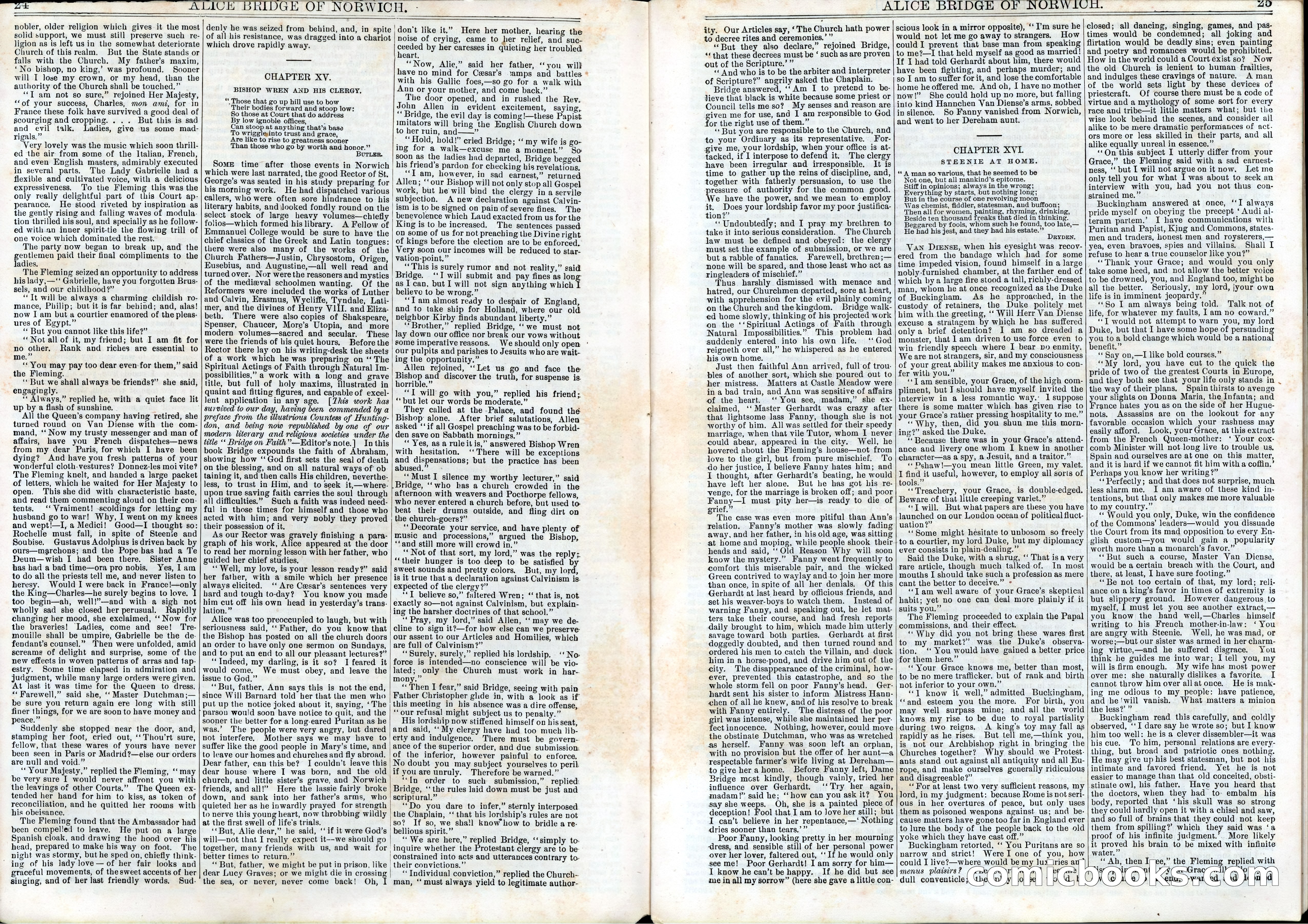
A restored page from Penny Dreadfuls, 1881. Page through the whole issue in the reader above.
📄 Transcribed text from this page (OCR, searchable)
Machine-transcribed from the original scan — historical spelling and the odd misread are preserved.
EK OF NORWICH. - nobler, older religion which gives it the most solid support, we must still preserve such re- ligion as is left us in the somewhat deteriorate Church of this realm. But the State stands or falls with the Church. My father’s maxim, ‘No bishop, no king,’ was profound. Sooner will I lose my crown, or my head, than the authority of the Church shall be touched.” “T am not so sure,” rejoined Her Majesty, ‘of your success, Charles, mon ami, for in France these folk have survived a good deal of scourging and cropping. . . . But this is sad and evil talk. Ladies, give us some mad- rigals.” Very lovely was the music which soon thrill- ed the air from some of the Italian, French, and even English masters, admirably executed in several parts. The Lady Gabrielle had a flexible and cultivated voice, with a delicious expressiveness. To the Fleming this was the only really delightful part of this Court ap- pearance. He stood riveted by inspiration as the gently rising and falling waves of modula. tion thrilled his soul, and specially as he follow- ed with an inner spirit-tie the flowing trill of one voice which dominated the rest. The party now began to break up, and the geutlemen paid their final compliments to the ladies. The Fleming seized an opportunity to address his lady,—“' Gabrielle, have you forgotten Brus- sels, and our childhood?” “It will be always a charming childish ro- mance, Philip; but it is far behind; and, alas! now I am but a courtier enamored of the pleas- ures of Egypt.” “ But you cannot like this life?” “Not all of it, my friend; but I am fit for no other. Rank and riches are essential to me.” “You may pay too dear even-for them,” said the Fleming. ‘* But we shall always be friends?” she said, engagingly. “« Always,” replied he, with a quiet face lit up by a flash of sunshine. ; All the Queen’s company having retired, she turned round on Van Diense with the com- mand, ‘‘ Now my trusty messenger and man of affairs, have you French dispatches—news from my dear Paris, for which I have been dying? And have you fresh patterns of your wonderful cloth-vestures? Donnez-les moi vite? The Fleming knelt, and handed a large packet of letters, which he waited for Her Majesty to open. This she did with characteristic haste, and read them commenting aloud on their con- tents. ‘‘ Vraiment! -scoldings for letting my husband go to war! Why, I went on my knees and wept!—I, a Medici! Good—I thought so: Rochelle must fall, in spite of Steenie and Soubise. Gustavus Adolphus is driven back by ours—marchons; and the Pope has had a Te Deum—wish I had been there. Sister Anne has had a bad time—ora pro nobis, Yes, I am to do all the priests tell me, and never listen to heresy. Would I were back in France!—onl the King—Charles—he surely begins to love. too begin—ah, well!’—and with a sigh not wholly sad she closed her perusual. Rapidly changing her mood, she exclaimed, ‘‘ Now for the braveries! Ladies, come and see! Tre- mouille shall be umpire, Gabrielle be the de- fendant’s counsel.” Then were unfolded, amid screams of delight and surprise, some of the new effects in woven patterns of arras and tap- estry. Some time elapsed in admiration and judgment, while many large orders were given. At last it was time for the Queen to dress. «‘ Farewell,” said she, ‘‘ Master Dutchman ;— be sure you return again ere long with still finer things, for we are soon to have money and peace.” Suddenly she stopped near the door, and, stamping her foot, cried out, ‘‘Thou’rt sure, fellow, that these wares of yours have never been seen in Paris or Madrid?—else our orders are null and void.” “Your Majesty,” replied the Fleming, ‘‘ may be very sure I would never affront you with the leavings of other Courts.” The Queen ex- tended her hand for him to kiss, as token of reconciliation, and he quitted her rooms with his obeisance. The Fleming found that the Ambassador had been compelled to leave. He put on a large Spanish cloak, and drawing the hood over his head, prepared to make his way on foot. The night was stormy, but he sped on, chiefly think- ing of his lady love — of her fair looks and | parson would soon have notice to quit, and the denly he was seized from behind, and, in spite of all his resistance, was dragged into a chariot which drove rapidly away. CHAPTER XV. BISHOP WREN AND HIS CLERGY, “ Those that go up hill use to bow Their bodies forward and stoop low: So those at Court that do address By low ignoble offices, é Can stoo at anything that’s base To wriggle;into trust and grace, Are like to rise to greatness sooner Than those who go by worth and honor.” BUTLER. Some time after those events in Norwich which were last narrated, the good Rector of St. George’s was seated in his study preparing for his morning work. He had dispatched various callers, who were often sore hindrance to his literary habits, and looked fondly round on the select stock of large heavy volumes—chiefly fotios—which formed his library. A Fellow of Emmanuel College would be sure to have the chief classics of the Greek and Latin tongues: there were also many of the works of the Church Fathers—Justin, Chrysostom, Origen, Eusebius, and Augustine,—all well read and turned over. Nor were the reasoners and mystics of the medieval schoolmen wanting. Of the Reformers were included the works of Luther and Calvin, Erasmus, Wycliffe, Tyndale, Lati- mer, and the divines of Henry VIII. and Eliza- beth. There were also copies of Shakspeare, Spenser, Chaucer, More’s Utopia, and more modern volumes—sacred and secular. These were the friends of his quiet hours. Before the Rector there lay on his writing-desk the sheets of a work which he was preparing on “ The Spiritual Actings of Faith through Natural Im- possibilities,” a work with a long and grave title, but full of holy maxims, illustrated in quaint and fitting figures, and capable of excel- Jent application in any age. [Zhis work has survived to our day, having been commended by a preface from the illustrious Countess of Hunting- don, and being now republished by one of our modern literary and religious societies under the title ‘* Bridge on Faith””—Bditor’s note.] In this book Bridge expounds the faith of Abraham, showing how “God first sets the seal of death on the blessing, and on all natural ways-of ob taining it, and then calls His children, neverthe- less, to trust in Him, and to seek it,—where- upon true saving faith carries the soul through all difficulties.” Such a faith was indeed need- ful in those times for himself and those who acted with him; and very nobly they proved their possession of it. As our Rector was gravely finishing a para- graph of his work, Alice appeared at the door to read her morning lesson with her father, who guided her chief studies, ‘* Well, my love, is your lesson ready?” said her father, with a smile which her presence always elicited. ‘Are Cesar’s sentences very hard and tough to-day? You know you made him cut off his own head in yesterday’s trans. lation.” Alice was too preoccupied to laugh, but with seriousness said, ‘‘ Father, do you know that the Bishop has posted on all the church doors an order to have only one sermon on Sundays, and to put an end to all our pleasant lectures?” ‘‘Indeed, my darling, is it so? I feared it would come, We must obey, and leave the issue to God.” ‘“‘But, father, Ann says this is not the end, since Will Barnard told her that the men who put up the notice joked about it, saying, ‘The sooner the better for a long-eared Puritan as he was.’ The people were very angry, but dared not interfere. Mother says we may have to | suffer like the good people in Mary’s time, and to leave our homes and churches and fly abroad. Dear father, can this be? I couldn't leave this dear house where I was born, and the old) church, and little sister’s grave, and Norwich friends, and all!” Here the lassie fairly broke down, and sank into her father’s arms, who quieted her as he inwardly prayed for strength to nerve this young heart, now throbbing wildly at the first swell of life's trials. ‘But, Alie dear,” he said, ‘‘ if it were God’s will—not that I really expect it--we should go together, many friends with us, and wait for better times to return.” “But, father, we might be put in prison, like graceful movements, of the sweet accents of her singing, and of her last friendly words. Sud- /don't like it.” Here her mother, hearing the noise of crying, came to her relief, and suc- pusset by her caresses in quieting her troubled eart, “Now, Alie,” said her father, “you will have no mind for Cesar’s ‘amps and battles with his Gallic foes,—so go for a walk with Ann or your mother, and come back.” The door opened, and in rushed the Rey. John Allen in evident excitement, saying, ‘‘ Bridge, the evil day is coming !—these Papist Imitators will bring the English Church down to her ruin, and ye _ ‘Hold, hold!” cried Bridge; “ my wife is go- ing for a walk—excuse me a moment.” So soon as the ladies had departed, Bridge begged his friend’s pardon for checking his revelations, “Tam, however, in sad earnest,” returned Allen; “our Bishop will not only stop all Gospel work, but he’ will bind the clergy ina servile subjection. A new declaration against Calvin- ism is to be signed on pain of severe fines. The benevolence which Laud exacted from us for the King is to be increased. The sentences passed on some of us for not preaching the Divine right of kings before the election are to be enforced. Very soon our incomes will be reduced to star- vation-point,” ‘This is surely rumor and not reality,” said Bridge. ‘I will submit and pay fines as lon as I can, but I will not sign anything which believe to be wrong.” ‘“‘T am almost ready to despair of England, and to take ship for Holland, where our old neighbor Kirby finds abundant liberty.” ‘*Brother,” replied Bridge, ‘‘ we must not lay down our office nor break our vows without some imperative reasons, our pulpits and parishes to Jesuits who are wait- ing the opportunity.” Allen rejoined, ‘‘Let us go and face the Bishop and discover the truth, for suspense is. horrible.” : ‘I will go with you,” replied his friend; “but let our words be moderate.” They called at the -Palace, and found thé Bishop alone. After brief salutations, Allen asked ‘‘if all Gospel preaching was to be forbid- den save on Sabbath mornings.” “Yes, as a rule it is,” answered Bishop Wren with hesitation. ‘‘There will be exceptions and dispensations; but the practice has been abused.” ‘Must I silence my worthy lecturer,” said | Bridge, ‘‘who has a church crowded in the afternoon with weavers and Pocthorpe fellows, who never entered a church before, but used to beat their drums outside, and fling dirt on the church-goers?” ‘Decorate your service, and have plenty of music and processions,” argued the Bishop, ‘fand still more will crowd in.” ‘Not of that sort, my lord,” was the reply;. “their hunger is too deep to be satisfied b sweet sounds and pretty colors. But, my lord, is it true that a declaration against Calvinism is. expected of the clergy?” ‘*T believe so,” fultered Wren; ‘‘ that is, not exactly so—not against Calvinism, but explain- ing the harsher doctrines of that school.” ‘*Pray, my lord,” said Allen, ‘‘may we de- cline to sign it?—for how else can we preserve: our assent to our Articles and Homilies, which are full of Calvinism?” “Surely, surely,” replied his lordship. ‘‘No force is intended—no conscience will be vio- lated; only the Church must work in har- mony.” “Then I fear,” said Bridge, seeing with pain Father Christopher glide in, with a look as if this meeting in his absence was a dire offense, “our refusal might subject us to penalty.” His lordship now stiffened himself on his seat, and said, ‘‘My clergy have had too much lib- erty and indulgence. There must be govern- ance of the superior order, and due submission: of the inferior, however painful to enforce, No doubt you may subject yourselves to peril. if you are unruly. Therefore be warned.” ‘‘In order to such submission,” replied: Bridge, ‘' the rules laid down must be just and | scriptural.” ‘“Do you dare to infer,” sternly interposed the Chaplain, ‘‘ that his lordship’s rules are not so? If so, we sha!l know how to bridle a re- | bellious spirit.” “We are here,” replied Bridge, ‘‘simply to. inquire whether the Protestant clergy are to be- constrained into acts and utterances contrary to- their convictions.” dear Lucy Graves; or we might die in crossing the sea, or never, never come back! Oh, I \ ‘‘ Individual conviction,” replied the Church- man, “ must always yield to legitimate author- ’ We should only open ‘' ALICE BRIDGE OF NOHWIOCH. ity. Our Articles say, ‘The Church hath power to decree rites and ceremonies,’” — : “But they also declare,” rejoined Bridge, ‘«that these decrees must be ‘ such as are proven out of the Scripture.’ ” : “« And who is to be the arbiter and interpreter of Scripture?” angrily asked the Chaplain. Bridge answered, ‘‘Am I to pretend to be- lieve that black is white because some priest or Council tells me so? My senses and reason are given me for use, and I am responsible to God for the right use of them.” “ But you are responsible to the Church, and to your Ordinary as its representative. For- give me, your lordship, when your office is at- tacked, if I interpose to defend it. The clergy have been irregular and irresponsible. It is time to gather up the reins of discipline, and, together with fatherly persuasion, to use the pressure of authority for the common good. We have the power, and we mean to employ it. Does your lordship favor my poor justifica- tion?” “Undoubtedly; and I pray my brethren to take it into serious consideration. The Church law must be defined and obeyed: the clergy must set the example of submission, or we are but a rabble of fanatics. Farewell, brethren ;— none will be spared, and those least who act as ringleaders of mischief.” Thus. harshly dismissed with menace and hatred, our Churchmen departed, sore at heart, with apprehension for the evil plainly coming on the Church and the kingdom. Bridge walk- ed home slowly, thinking of his projected work on the ‘‘Spiritual Actings of Faith through Natural Impossibilities.” This problem had suddenly entered into his own life. ‘God reigneth over all,” he whispered as he entered his own home. Just then faithful Ann arrived, full of trou- bles of another sort, which she poured out to her mistress. Matters at Castle Meadow were in a bad train, and Ann was sensitive of affairs of the heart, ‘‘ You see, madam,” she ex- claimed, ‘‘ Master Gerhardt was crazy after that lightsome lass Fanny, though she is not worthy of him, All was settled for their speedy marriage, when that vile Tutor, whom I never could abear, appeared in the city.. Well, he hovered about the Fleming’s house—not from love to the girl, but from pure mischief. To do her justice, I believe Fanny hates him; and I thought, after Gerhardt’s beating, he would have left her alone. But he has got his re- venge, for the marriage is broken off; and poor Fanny—I must pity her—is ready to die of tief,” . The case was even more pitiful than Ann’s Telation, Fanny’s mother was slowly fading away, and her father, in his old age, was sitting at home and mopipg, while people shook their heads and said, ‘‘Old Reason Why will soon know the mystery.” Fanny went frequently to comfort this miserable pair, and the wicked Green contrived to waylay and-to join her more than once, inspite of all her denials. Of this Gerhardt at last heard by officious friends, and set his weaver-boys to watch them. Iustead of warning Fanny, and speaking out, he let mat- ters take their course, and had fresh reports daily brought to him, which made him utterly savage toward both parties. Gerhardt at first doggedly doubted, and then turned round and ordered his men to catch the Villain, and duck him in a horse-pond, and drive him out of the city. The disappearance of the criminal, how- ever, prevented this catastrophe, and so the whole storm fell on poor Fanny’s head. Ger- hardt sent his sister to inform Mistress Hann- chen of ajl he knew, and of his resolve to break with Fanuy entirely. The distress of the poor git] was intense, while she maintained her per- fect innocence. Nothing, however, could move the obstinate Dutchman, who was as wretched as herself. Fanny was soon left an orphan, with no provision but the offer of her aunt—a respectable farmer's wife living at Dereham— to give hera home. Before Fanny left, Dame Bridge most kindly, though vainly, tried her influence over Gerhardt. ‘‘Try her again, madam!” said he; ‘‘ how can you ask it? You say she weeps. Oh, she is a painted piece of deception! Fool that I am to Jove her still; but I can’t believe in her repentance,—‘ Nothing dries sooner than tears.’” : Poor Fanny, looking pretty in her mourning ress, and sensible still of her personal power over her lover, faltered out, ‘‘If he would only see me! Poor Gerhardt! I am sorry for him— I know he can’t be happy. If he did but see me in all my sorrow” (here she gave a little con- scious look in a mirror opposite), ‘I’m sure he would not let me go away to strangers. How could I prevent that base man from speaking to me?—I that held myself as good as married! If I had told Gerhardt about him, there would have been fighting, and perhaps murder; and so I am to suffer for it, and lose the comfortable home he offered me. And oh, I have no mother now!” She could hold up no more, but falling into kind Hannchen Van Diense’s arms, sobbed in silence. So Fanny vanished from Norwich, and went to her Dereham aunt. CHAPTER XVI. STEENIE AT HOME. “ A man so various, that he seemed to be Not one, but all mankind’s epitome. Stiff in opinions; always in the wrong; Everything by starts, but nothing long; But in the course of one revolving moon Was chemist, fiddler, statesman, and buffoon; Then all for women, peingin , rhyming, drinking, Beside ten thousand freaks that died in thinking. Beggared by fools, whom such he found, too late,— He had his jest, and they had his estate.’* DRYDEN. Van Deonsn, when his eyesight was recov- ered from the bandage which had for some time impeded vision, found himself in a large nobly-furnished chamber, at the farther end of which by a large fire stood a tall, richly-dressed man, whom he at once recognized as the Duke of Buckingham. As he approached, in the custody of retainers, the Duke politely met him with the greeting, ‘‘ Will Herr Van Diense excuse a stratagem by which he has suffered only a brief detention? I am so dreaded a monster, that Iam driven to use force even to win friendly speech where I bear po enmity, Weare not strangers, sir, and my consciousness of your great ability makes me anxious to con- fer with you.” : “‘T am sensible, your Grace, of the high com- pliment, but I should have myself invited the interview in a less romantic way.: I suppose there is some matter which has given rise to your Grace’s rather pressing hospitality to me.” “Why, then, did you shun me this morn- ing?” asked the Duke. “ Because there was in your Grace’s attend- ance and livery one whom I knew in another character—as a spy, a Jesuit, and a traitor.” “‘Pshaw!—you mean little Green, my valet. I find it useful, however, to employ all sorts of tools.” ‘Treachery, your Grace, is double-edged. Beware of that little creeping varlet.” “J will. But what papers are these you have launched on our London ocean of political fluct- uation?” ‘‘Some might hésitate to unbosom so freely to a courtier, my lord Duke, but my diplomacy ever consists in plain-dealing.” Said the Duke, with a shrug, ‘‘ That isa very rare article, though much talked of. In most mouths I should take such a profession as mere cant the better to deceive.” ° “Tam well aware of your Grace’s skeptical habit; yet no one can deal more plainly if it suits you.” The Fleming proceeded to explain the Papal commissions, and their effect. “Wh