
Penny Dreadfuls, 1881 · page 3 of 38
Alice Bridge of Norwich — page 3: what you’re looking at
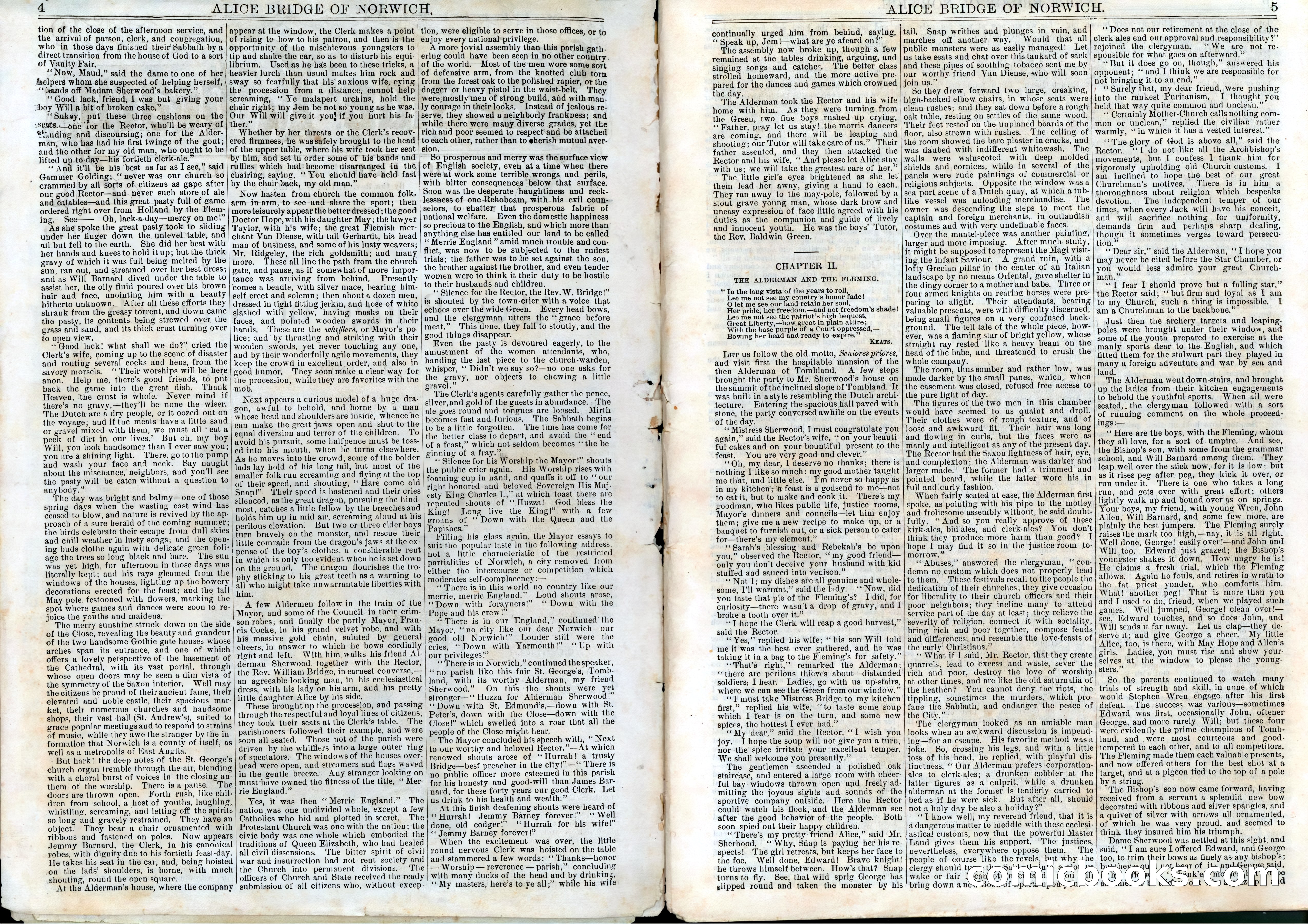
A restored page from Penny Dreadfuls, 1881. Page through the whole issue in the reader above.
📄 Transcribed text from this page (OCR, searchable)
Machine-transcribed from the original scan — historical spelling and the odd misread are preserved.
| | | 4 AL ICE BRIDGE OF NORWICH, tion of the close of the afternoon service, and the ‘arrival of parson, clerk, and congregation, who in those days finished their Sabbath by a direct transition from the house of God to a sort ; of Vanity Fair, “Now, Maud,” said the dame to one of her} fselpers whom she suspected of helping herself, ~**fyands off Madam Sherwood’s bakery.” “Good lack, friend, I was, but giving your “boy Will a bit of broken cake.” ‘‘Sukey, put these three cushions on the -Seat3.one for the Rector, who’ll be weary of *tunding and discoursing; one for the Alder- man, wlio has had his first twinge of the gout; and fhe other for my old man, who ought to be lifted up to-day—his fortieth clerk-ale.” “And it'll be his best as far as I see,” said Gammer Golding; ‘‘ never was our church so crammed by all sorts of.citizens as gape after our good Rector—and never such store of ale and eatables—and this great pasty full of game ordered right over from Holland by the Flem- ing. See—— Oh, lack-a-day—mercy on me!” As she spoke the great pasty took to sliding under her finger down the unlevel table, and all but fell to the earth. She did her best with her hands and knees to hold it up; but the thick gravy of which it was full being melted by the sun, ran out, and streamed over her best dress; and as Will Barnard dived under the table to assist her, the oily fluid poured over his brown jair and face, anointing him with a beauty hitherto unknown. After ali these efforts they shrank from the greasy torrent, and down came the pasty, its contents being strewed over the grass and sand, and its thick crust turning over to open view. ‘©Good lack! what shall we do?” cried the Clerk’s wife, coming up to the scene of disaster aud routing several cocks and hens, from the savory morsels. ‘‘ Their worships will be here anon. Help me, there’s good friends, to put back the game into the great dish, Thank Heaven, the crust is whole. Never mind if there’s no gravy,—they’ll be none the wiser. The Dutch-are a dry people, or it oozed out on the voyage; and ifthe meats have a little sand or gravel mixed with them, we must all ‘eat a peck of dirt in our lives.” But oh, my boy ‘Will, you look handsomer than I ever saw you; you are a shining light. There, go to the pump ‘and wash your face and neck. Say naught about the mischance, neighbors, and you'll see the pasty will be eaten without a question to anybody.” The day was bright and balmy—one of those spring days when the wasting east wind has ceased to blow, and nature is revived by the ap- proach of a sure herald of the coming summer; the birds celebrate their escape from dull skies and chill weather in lusty songs; and the open- ing buds clothe again with delicate green foli- age the trees so long black and bare. The sun was yet high, for afternoon in those days was literally kept; and his rays gleamed from the windows of the houses, lighting up the bowery decorations erected for the feast; and the tall May-pole, festooned with flowers, marking the spot where games and dances were soon to re- joice the youths and maidens, : The merry sunshine struck down on the side of the Close, revealing the beauty and grandeur of the two handsome Gothic gate houses whose arches span its entrance, and one of which offers a lovely perspective of the basement of the Cathedral, with its vast portal, through whose open doors may be seen a dim vista of the symmetry of the Saxon interior. Well may the citizens be proud of their ancient fame, their elevated and noble castle, their spacious mar- ket, their numerous churches and handsome shops, their vast hall (St. Andrew’s), suited to grace popular meetings and to respond to strains of music, while they awe the stranger by the in- formation that Norwich is a county of itself, as well as a metropolis of East Anglia. - But hark! the deep notes of the St. George's church organ tremble through the air, blending with a choral burst of voices in the closing an- them of the worship. There isa pause. The doors are thrown open. Forth rush, like chil- dren from school, a host of youths, laughing, whistling, screaming, and letting off the spirits so long and gravely restrained. They have an object. They bear a chair ornamented with ribbons and fastened on poles. Now appears Jemmy Barnard, the Clerk, in his canonical robes, with dignity due to his fortieth feast-day. He takes his seat in the car, and, being hoisted appear at the window, the Clerk makes a point of rising te bow to his patron, and then is the opportunity of the mischievous youngsters to tip and shake the car, so as to disturb his equi- librium. Used as he has been to these tricks, a heavier Jurch than usual makes him rock and sway so fearfully that his' anxious wife, eying the procession from a distance, cannot help screaming, ‘‘ Ye malapert urchins, hold the chair right; my Jem be not so young as he was. de Will will give it youfif you hurt his fa er. ‘Whether by her threats or the Clerk’s recov- ered firmness, he wassafely brought to the head of the upper table, where his wife took her seat by him, and set in order some of bis bands and ruffles which had become disarranged in the chairing, saying, ‘‘ You should Lave held fast by the chair-vack, my old man.” Now hasten from church the common folk, arm inarm, to see and-share the sport; then more leisurely appear the better dressed ; the good Doctor Hope, with his daughter May; thé lawyer Taylor, with his wife; the great Flemish mer- chant Van Diense, with tall Gerhardt, his head man of business, and some of his lusty weavers; Mr. Ridgeley, the rich goldsmith; and many more. These all line the path from the church gate, and pause, as if somewhat of more impor- tance was arriving from behind. Presently ‘comes a beadle, with silver mace, hearing him- self erect and solemn; then abouta dozen men, dressed in tight-fitting jerkin, and hose of white slashed with yellow, having masks on their faces, and pointed wooden swords in their hands. These are the whzfflers, or Mayor’s po. lice; and by thrusting and striking with their wooden swords, yet never touching any one, and by their wonderfully agile movements, they keep the crowd in excellent order, and also in good humor. They soon make a clear way for a Pree while they are favorites with the mob. Next appears a curious model of a huge dra- gon, awful to behold, and borne by a man whose head and shouldersare inside, whence he equal diversion and terror of the children. To avoid his pursuit, some halfpence must be toss- ed into his mouth, when he turns elsewhere. As he moves into the crowd, some of the bolder lads lay hold of his long tail, but_most of the smaller folk run screaming and flying at the top of their speed, and shouting, ‘‘ Hare come old Snap!” Their speed is hastened and their cries silenced, as the great dragon, pursuing the hind- most, catches a little fellow by the breeches and holds him up in mid air, screaming aloud at his perilous elevation. But two or three elder boys turn bravely on the monster, and rescue their little comrade from the dragon’s jaws at the ex- pense of the boy’s clothes, a considerable rent in which is only too evident when he is set down on the ground, The dragon flourishes the tro. phy sticking to his great teeth as a warning to all who might take unwarrantable liberties with him. A few Aldermen follow in the train of the Mayor, and some of the Council in their crim- son robes; and finally the portly Mayor, Fran- cis Cocke, in his grand velvet robe, and with his massive gold chain, saluted by general cheers, in answer to which he bows cordially right and left. With him walks his friend Al- derman Sherwood, together with the Rector, the Rev. William Bridge, in earnest converse,— an agreeable-looking man, in his ecclesiastical dress, with his lady on his arm, and his pretty little daughter Alice by his side. These brought up the procession, and passing through the respectful and loyal lines of citizens, parishioners followed their example, and were soon all seated. Those not of the parish were driven by the whifflers into a large outer ring of spectators. The windows of the houses over- head were open, and streamers and flags waved in the gentle breeze. Any stranger looking on must ‘have owned the fitness of the title, ‘‘ Mer- rie England.” Yes, it was then ‘‘ Merrie England.” The nation was one undivided whole, except a few -Catholics who hid and plotted in secret. The Protestant Church was one with the nation; the civic body was one whole which embodied the traditions of Queen Elizabeth, who had healed all civil dissensions. The bitter spirit of civil war and insurrection had not rent society and on the lads’ shoulders, is borne, with much shouting, round the open square. At the Alderman’s house, where the company the Church into permanent divisions, The officers of Church and State received the ready submission of all citizens who, without excep- can make the great jaws operand. shut-to the | to be alittle forgotten. The time has come for they took their seats at the Clerk’s table. The) tion, were eligible to serve in those offices, or to enjoy every national privilege. A more jovial assembly than this parish gath- of the world. Most of the men wore some gort of defensive arm, from the knotted club torn from the forest oak to the polished rapier, or the dagger or heavy pistol in the waist-belt. They were,mostly men of strong build, and with man- ly courage in their looks. Instead of jealous re- serve, they showed a neighborly frankpess; and while there were many diverse grades, yet the rich aud poor seemed to respect'and be attached to each other, rather than to eherish mutual aver- sion. So prosperous and merry was the surface view of English society, even at a time wher there were at work some terrible.wrongs and perils, | with bitter consequences below that surface, Soon was the desperate /haughtiness and reck- lessness of one-Rehoboam, with his evil coun- selors, to shatter’ that prosperous fabric of national welfare. Even the domestic happiness so precious to the English, and which more than anything else has entitled our land fo be called ‘Merrie England” amid much trouble and con- flict, was now to be subjected to the rudest trials; the father was to be set against the son, the brother against the brother, and even tender women were to think it their duty to be hostile to their husbands and children. ‘* Silence for the Rector, the Rev. W. Bridge!” is shouted by the town-crier with a voice that echoes over the wide Green. Every head bows, and the clergyman utters the ‘‘grace before meat.” This done, they fall to stoutly, and the good things disappear. Even the pasty is devoured eagerly, to the amusement of the women attendants, who, handing the last piece to the church-warden, whisper, ‘‘ Didn’t we say so?—no one asks for the gravy, nor objects to chewing a little gravel.” 2 The Clerk’s agents carefully gather the pence, silver,and gold of the guests in abundance. The ale goes round and tongues. are loosed. Mirth becomes fast and furious, The Sabbath begins the better class to depart, and avoid the ‘‘end of a feast,” which not seldom becomes ‘‘ the be- ginning of a fray.” “« Silence for his Worship the Mayor!” shouts the public crier again. His Worship rises with foaming cup in hand, and quaffs it off to ‘our ‘right honored and beloved Sovereign His Maj- esty King Charles J.,” at which toast there are repeated shouts of ‘‘Huzza! God bless the King! Long live the King!” with a few groans of ‘* Down with the Queen and the Papishes.” Filling his glass again, the Mayor essays to |suit the popular taste in the following address, not a little characteristic of the restricted partialities of Norwich, a city removed from either the intercourse or competition which moderates self-complacency :— ‘©There is in this world no country like our metrie, merrie Eng)and.” Loud shouts arose, “Down with forayners!” ‘‘ Down with the Pope and his crew!” “There is in our England,” continued’ the Mayor, ‘‘no city like our dear Norwich—our good old Norwich!” Louder still were the cries, ‘‘Down with Yarmouth!” ‘Up with our privileges!” ‘«Thereis in Norwich,” continued the speaker, ‘no parish like this fair St. George’s, Tomb- land, with its worthy Alderman, my friend Sherwood.” On this the shouts were yet stronger—‘‘ Huzza for Alderman Sherwood!” “Down with St. Edmund’s,—down with St. Peter’s, down with the Close—down with the Close!” which swelled into a roar that all the people of the Close might hear, The Mayor concluded hts speech with, ‘‘ Next to our worthy and beloved Rector.”—At which renewed shouts arose of “Hurrah! a trusty Bridge—besf preacher in the city!” —‘‘ There is no public officer more esteemed in this parish for his honesty and good-will than James Bar- nard, for these forty years our good Clerk. Let us drink to his health and wealth.” At this finish deafening shouts were heard of “«Hurrah! Jemmy Barney forever!” ‘* Well done, old codger!” ‘Hurrah for his wife!” <‘Jemmy Barney forever!” When the excitement was over, the little round nervous Clerk was hoisted on the table and stammered a few words: . ‘‘ Thanks—honor — Worship — reverence — parish,” concluding with many ducks of the head and by drinking, ‘‘My masters, here’s to ye all;” while his wife ering could have been seen in no other country, a ALICE BRIDGE OF NORWICH. 5 continually urged him from behind, saying, “ Speak up, Jem!—what are ye afeard on?” The assembly now broke up, though a few remained at the tables drinking, arguing, and singing songs and catches. The better class strolled homeward, and the more active pre- pared for the dances and games which crowned the day, The Alderman took the Rector and his wife home with him. As they were turning from the Green, two five Soys rushed up crying, ‘‘ Father, pray let us stay! the morris dancers are coming, and there will be leaping and shooting; our Tutor will take care of us.” Their father assented, and they then attacked the Rector and his wife, ‘“‘ And please let Alice stay with us; we will take the greatest care of her.” The little girl’s eyes brightened as she let them lead her away, giving a hand to each. They ran away to the may-pole, followed by a stout grave young man, whose dark brow and uneasy expression of face little agreed with his duties as the companion and guide of lively and innocent youth. He was the boys’ Tutor, the Rev. Baldwin Green. CHAPTER IL THE ALDERMAN AND THE FLEMING, “ Tn the long vista of the years to roll, Let me not see my: country’s honor fade! O let me see our land retain her soul, Her pride, her freedom,—and not freedom’s shade! Let me not see the patriot’s high bequest, Great Liberty,—how great in plain attire; With the base purple of a Court oppressed,— Bowing her head and ready to expire.” Kuats. Let us follow, the old motto, Seniores priors, and visit first the hospitable mansion of the then Alderman of Tombland, A few steps brought the party to Mr. Sherwood’s house on the summit of the inclined slope of Tombland. It was built in astyle resembling the Dutch archi- tecture. Entering the spacious hall paved with stone, the party conversed awhile on the events of the day. “ Mistress Sherwood, I must congratulate you again,” said the Rector’s wife, ‘‘on your beauti- ful cakes and on your bountiful present to the feast. You are very good and clever.” “Oh, my dear, I deserve no thanks; there is nothing I Jikeso much: my good mother taught me that, and little else. I’m never so happy as in my kitchen; @ feast is a godsend to me—not to eat it, but to make and cook it. There’s my goodman, who likes public life, justice rooms, Mayor's dinners and councils—let him enjoy them; give me a new recipe to make up, or a banquet to furnish out, or a sick person to cater for—there’s my element.” “Sarah’s blessing and Rebekah’s be upon you,” observed the Rector, ‘‘ my good friend— only you don’t deceive your husband with kid stuffed and sauced into verison.” “Not I; my dishes are all genuine and whole- some, I'll warrant,” said the Indy. ‘‘ Now, did you taste that pie of the Fleming’s? I did, for curiosity—there wasn’t a drop of gravy, and I broke a tooth over it.” “T hope the Clerk will reap a good harvest,” said the Rector. “Yes,”’ replied his wife; ‘“his son Will told . me it was the best ever gathered, and he was taking it in a bag to the Fleming’s for safety.” “That’s right,’ remarked the Alderman; ‘‘there are perilous thieves about—disbanded soldiers; I hear. Ladies, go with us up-stairs, where we can see the Green from our window.” “TJ must take Mistress Bridge to my kitchen first,” replied his wife, ‘‘to taste some soup which I fear is on the turn, and some new spices, the hottest I ever had.” “‘My dear,” said the Rector, “I wish you joy. hope the soup will not give you a turn, nor the spice irritate your excellent temper, We shall welcome you presently.” The gentlemen ascended a polished oak staircase, and entered a large room with cheer- ful bay windows thrown open and freely ad- mitting the joyous sights and sounds of the sportive company outside. Here the Rector could’ watch his flock, and the Alderman see after the good behavior of the people. Both soon spied out their happy children. ‘“There’s my pretty friend Alice,” said Mr. Sherhood. ‘ Why, Snap is paying her his re- spects! The girl retreats, but keeps her face to the foe. Well done, Edward! Brave knight! he throws himself between. How's that? Snap turns to fly. See, that wild sprig George has slipped round and taken the monster by his tail. Snap writhes and plunges in vain, and marches off another way. Would that all public monsters were as easily managed! Let us take seats and chat over this tankard of sack and these pipes of soothing tobacco sent me by our worthy friend Van Diense, awho will soon join us.” So they drew. forward two large, creaking, high-backed elbow chairs, in whose seats were clean rushes; and they sat down before arough oak table, resting on settles of the same wood. Their feet rested on the unplaned boards of the floor, also strewn with rushes. The ceiling of the room showed the bare plaster in cracks, and was daubed with indifferent whitewash. The walls were wainscoted with deep molded shields and cornices, while in several of the panels were rude paintings of commercial or religious subjects. Opposite the window wasa sea port scene of a Dutch quay, at which a tub- like vessel was unloading merchandise. The owner was descending the steps to meet the captain and foreign merchants, in outlandish costumes and with very undefinable faces. Over the mantel-piece was another painting, larger and more imposing. After much study, it might be supposed to represent the Magi visit- ing the infant Saviour. A grand ruin, with a lofty Grecian pillar in the center of an Italian landscape by no means Oriental, gave shelter in the dingy corner to a mother and babe. Three or four armed knights on rearing horses were pre- paring to alight. Their attendants, bearing valuable presents, were with difficulty discerned, being small figures on a very confused back- ground. ‘The tell-tale of the whole piece, how- ever, was a flaming star of bright yellow, whose straight ray rested like a heavy beam on the head of the babe, and threatened to crush the whole company. ‘The room, thus somber and rather low, was made darker by the small panes, which, when the casement was closed, refused free access to the pure light of day. The figures of the two men in this chamber would have seemed to us quaint and droll. Their clothes were of rough texture, and of loose and awkward fit. Their hair was long and flowing in curls, but the faces were as manly and intelligent as any of the present day. The Rector had the Saxon lightness of hair, eye, and complexion; the Alderman was darker and larger made. The former had a trimmed and pointed beard, while the latter wore his in full and curly fashion. Whe