
Penny Dreadfuls, 1881 · page 4 of 38
Alice Bridge of Norwich — page 4: what you’re looking at
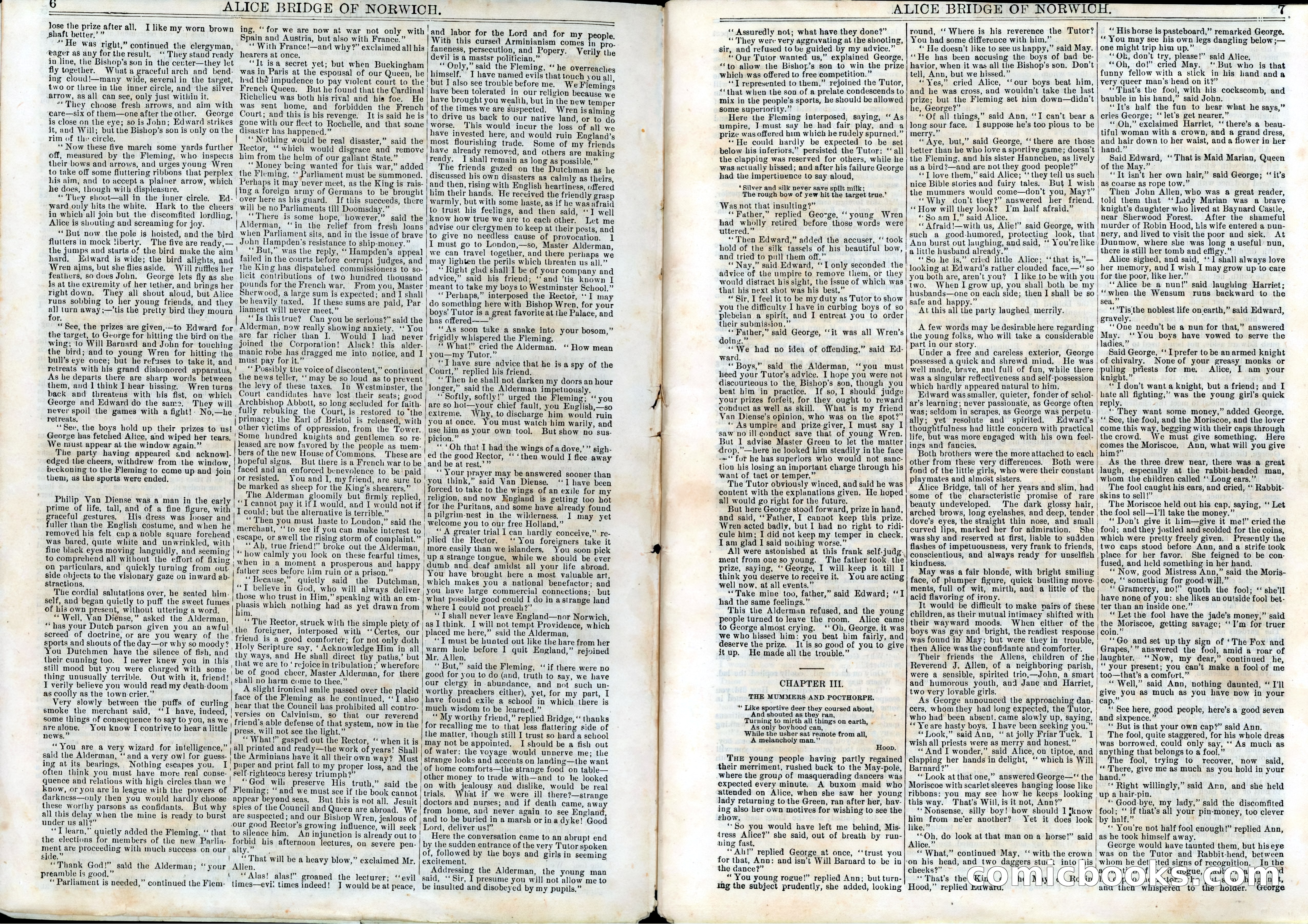
A restored page from Penny Dreadfuls, 1881. Page through the whole issue in the reader above.
📄 Transcribed text from this page (OCR, searchable)
Machine-transcribed from the original scan — historical spelling and the odd misread are preserved.
o ALICE BRIDGE OF NORWICH. lose the prize after all, I like my. w Shaft better,’ ” vreaon “He was right,” continued the clergyman, | ‘eager as any forthe result, ‘ They stand ready in line, the Bishop’s son in the certer—they let fly together. What a graceful arch and bend- ing cloud!—many wide, several in the target, two or three in the inner circle, and ‘the silver arrow, as all can see, only just within it. “They choose fresh arrows, and aim with care—six of them—one after the other. George is close on the eye; so is John; Edward strikes it, and Will; but the Bishop’s son is only on the rim of the circle. ‘* Now these five march some yards further off, measured by the Fleming, who inspects their-bows and arrows, and urges young Wren to take off some fluttering ribbons that perplex his aim, and to accept a plainer arrow, which he does, though with displeasure. “They shoot—all in the inner circle, Ed- ward only hits the white. Hark to the cheers in which all join but the discomfited lordling, Alice is shouting and screaming for joy. “‘But now the pole is hoisted, and the bird flutters in mock liberty. The five are ready,— the jumps and starts of the bird make the aim hard, Hdward is wide; the bird alights, and ‘Wren aims, but she flies aside. “Will ruffles her feathers, so does John. George lets fly as she is at the extremity of her tether, and brings her right down, They all shout aloud, but Alice runs sobbing to her young friends, and they = lurn away ;—'tis the pretty bird they mourn or. ‘See, the prizes are given,—to Edward for the target, to George for hitting the bird on the ing, ‘‘for we are now at war not only with ! Spain and Austria, but also with France.” ** With France!—and why?” exclaimed all his hearers at once, “It isa secret yet; but when Buckingham was in Paris at the espousal of our Queen, be had thé impudence to pay violent court to the | French Queen. But he found that the Cardinal Richelieu was both his rival and his foe. He was sent home, and forbidden the French Court; and this is his revenge. It is said he is gone with our fleet to Rochelle, and that some disaster has happened.” ‘ Nothing would be real disaster,” said the Rector, ‘‘ which would disgrace and remove him from the helm of our gallant State.” ‘* Money being wanted for this war,” added the Fleming, ‘* Parliament must be summoned. Perhaps it may never meet, as the King is rais- [ing a foreign army of Germans to be brought over here as his guard. If this succeeds, there will be no Parliaments till Doomsday.” ‘“‘There is some hope, however,” said the Alderman, ‘in the relief from fresh loans | when Parliament sits, and in the issue of brave John Hampden’s resistance to ship-money.” | ‘* But,” was the reply, ‘ Hampden's appeal | failed in the courts before corrupt judges, and the King has dispatehed commissioners to so- licit contributions of two hundred thousand pounds for the French war, From you, Master Sherwood, a large sum is expected; and I shall be heavily taxed. If these sums ate paid, Par liament will never meet,” ‘Ts this true? Can you be serious?” said the Alderman, now really showing anxiety. ‘‘ You are far richer than I, Would I lad never wing; to Will Barnard and John for touching joined the Corporation! Aluck! this alder. the bird; and to young Wren for hitting the manic robe has dragged me into notice, and I bull’s eye once; but he refuses to take it, and Must pay for it.” retreats with his grand dishonored apparatus, |. “‘ Possibly the voice of discontent,” continued As he departs there are sharp words between the news teller, ‘‘may be so loud as to prevent them, aud 1 think I bear hissing. Wren turns the levy of these taxes. In Westminster, the back and threatens with his fist, on which Court candidates have lost their seats; good George and Edward do the sam2, They will Archbishop Abbott, so long secluded for faith- never spoil the games with a fight! No,—he ,fully rebuking the Court, is restored to ‘the and labor for the Lord and for my people With this cursed Arminianism comes in pro- faneness, persecution, and Popery. Verily the devil is a mastsr politician.” “Only,” said the Fleming, “‘ he overreaches himself. I have named evils that touch you all but I also see trouble before me. We Fiemings have been tolerated in our religion because we have brought you wealih, but in the new temper of the times we are suspected. Wren is aiming to drive us back to our native land, or to do worse. This would incur the loss of all we have invested here, and would ruin England’s most flourishing trade. Some of my friends have already removed, and others are makine ready. I shall remain as long as possible.” > _The friends gazed on the Dutchman as he discussed his own disasters as calmly as theirs, and then, rising with English heartiness, offered him their hands. He received the friendly grasp warmly, but with some haste, as if he was nfraid to trust his feelings, and then said, ‘I well know how true we are to each other. Let me advise our clergymen to keep at their posts, and to give no needless cause of provocation. 1 I must go to London,—so, Master Alderman, we can travel together, and there perhaps we may lighten the perils which threaten us all,” “ Right glad shall-I be of your company and advice,” said his friend; ‘‘and ’tis known I meant to take my boys to Westminster School.” ‘* Perhaps,” interposed the Rector, ‘‘I may do something here with Bishop Wren, for your boys’ Tutor is a great favorite at the Palace, and has offered——” ‘‘ As soon tike a snake into your bosom,” frigidly whispered the Fleming, ** What!” cried the Alderman. ‘How mean you—my Tutor,” “T have sure advice that he isa spy of the Court,” replied his friend. “Then he shall not darken my doors an hour longer,” said the Alderman impetuously. ‘Softly, softly!” urged the Fleming; ‘you are so hot—yout chief fault, you English,—so extreme, Why, to discharge him would ruin retreats, “See, the boys hold up their prizes to us! George has fetched’ Alice, and wiped her tears. We must appear at the window again.” The party having appeared «nd acknowl- edged the cheers, withdrew from the window, beckoning to the Fleming to come up and join them, us the sports were ended. Philip Van Diense was a man in the early prime of life, tall, and of a fine figure, with raceful gestures, His dress was looser and uller than the English costume, and when he removed his felt capa noble square forehead was bared, quite white and unwrinkled, with fine black eyes moving languidly, and seeming | to comprehend all without the effort of fixing on particulars, and quickly turning from out- side objects to the visionary gaze on inward ab- stractions, The cordial salutations over, he seated him- self, and began quietly to puff the sweet fumes of his own present, without uttering a word. primacy; the Earl of Bristol is released, with you at once. You must watch him warily, and other victims of oppression, from the Tower. | use him as your own tool, But show no sus- ‘Some hundred knights and gentlemen so re- picion.” leased ure now favored by the people as mem- Hes ‘Oh that I had the wings of a dove,’” sigh- bers of the new House of Commons. These are! ed the good Rector, ‘‘ ‘then would I flee away hopeful signs, But there is a French war to be , and be at rest.’” faced and an enforced benevolence to be. paid, ‘' Your prayer may be answered sooner than or resisted. You and I, my friend, are sure to you think,” said Van Diense. ‘I have been be marked as sheep for the King’s shearers,” forced to take to the wings of an exile for my The Alderman gloomily but firmly replied, religion, and now England is getting too hot “T cannot pay it if I would, and I would not if| for the Puritans, and some have already found I could; but the alternative is terrible.” a pilgrim-nest in the wilderness, I may yet “Then you must haste to London,” said the | welcome you to our free Holland.” , Merchant, ‘‘to see if you can make interest to| “A greater trial 1 can hardly conceive,” re- escape, or swell the rising storm of complaint.” | plied the Rector, ‘ You foreigners take it ‘‘ Ah, true friend!” broke out the Alderman, | more easily than we islanders, You soon pick “how calmly you look on these fearful times, up a strange tongue, while we should be ever ; when in a Moment a prosperous and happy |dumb and deaf amidst all your life abroad. futher sees before him ruin or a prison.” You have brought here a most valuable art, se Because,” quietly said the Dutchman, | which makes you a national benefactor; and “I believe in God, who will always deliver you have large commercial connections;- but those who trust in Him,” speaking with an em-| what possible good could I do in astrange land phasis which nothing had as yet drawn from | where I could not preach?” ‘* Well, Van Diense,” asked the Alderman, ““has your Dutch parson given you an awful screed of doctrine, or are you weary of the! sports and shouts of the day—or why so moody? You Dutchmen have the silence of fish, and their cunning too. I never knew you in this still mood but you were charged with some | thing unusually terrible. Out with it, friend! I verily believe you would read my death-doom as coolly as the town-crier.” Very slowly between the puffs of curling smoke the merchant said, ‘I have, indeed, some things of consequence to say to you, as we arealone. You know I contrive to hear a little news.” “You are a very wizard for intelligence,” said the Alderman, ‘‘ and a very ow! for guess- ing at its bearings, Nothing escapes you. I often think you must have more real conse- quence and relations with high circles than we | know, or you are in league with the powers of darkness—only then you would hardly choose these worthy parsons as confidants. ut why all this delay when the mine is ready to burst under us all?” ‘‘T Jearn,” quietly added the Fleming, “ that the elections for members of the new Patlia- IED ee proceeding with much success on our side. \ “Thank God!” said the Alderman; “your preamble is good.” \ “ Parliament is needed,” continued the Flem- him. ; ‘'T shall never leave England—nor Norwich, ‘*The Rector, struck with the simple piety of | as I think. I will not tempt Providence, which the foreigner, interposed with ‘‘Certes, our | placed me here,” said the Alderman, friend is a good comforter; for not only doth| “I must be buated out like the hare from her Holy Scripture say, ‘Acknowledge Him in all| warm hole before I quit England,” rejoined thy ways, and He shall direct thy paths,’ but | Mr, Allen. that we are to ‘rejoice in tribulation;’ wherefore | ‘' But,” said the Fleming, ‘if there were no be of good cheer, Master Alderman, for there good for you to do (and, truth to Say, we have shall no harm come to thee.” our clergy in abundance, and not such un- A slight ironical smile passed over the placid | worthy preachers either), yet, for my part, I face of the Fleming as he continued, ‘‘I also|have found exile a school in which there is hear that the Council has prohibited all contro- | much wisdom to be learned.” versies on Calvinism, so that our reverend| ‘My worthy friend,” replied Bridge, ‘‘ thanks friend's able defense of that system, now in the | for recalling me to that less flattering side of press, will not see the light.” the matter, though still I trust so hard a school “What!” gasped out the Rector, ‘ when it is may not be appointed. I should be a fish out all printed and ready—the work of years! Shall | of water: the voyage would unnerve me; the the Arminians have it all their own way? Must strange looks and accents on Janding—the want , buper and print fall to my proper loss, and the! of home comforts—the strange food on table— self-righteocs heresy triumph?” other money to trade with—and to he looked God wil preserve His truth,” said the|on with jealousy and dislike, would be real Fleming; ‘and we must see if the book cannot | trials. Whiat if we were ill there?—strange appear beyond seas. But this is vot all. Jesuit | doctors and nurses; and if death came, away spies of the Council and Queen are abroad. We! from home, and never again to see England, are suspected ; and our Bishop Wren, jealous of | and to be buried in a marsh orina dyke! Good -our good Rector’s growing influence, will seek | Lord, deliver us!” to sileace him. An injunction is already out to! Here the conversation came to an abrupt end forbid his afternoon lectures, on severe pen- | by the sudden entrance of the very Tutorspoken alty. i of, followed by the boys and girls in seeming ‘‘ That will be a heavy blow,” exclaimed Mr, | excitement. i Allen. Addressing the Alderman, the young man _ ‘Alas! alas!” groaned the lecturer; ‘‘evil said, ‘Sir, I presume you will not allow me to {imes—evii times indeed! J would beat peace, be insulted and disobeyed by my pupils.” ALICE BRIDGE OF NORWICH. : r “« Assuredly not; what have they done?” sir, and refused to be guided by my advice.” “Our Tutor wanted us,” explained George, “to allow. the Bishorp’s son to win the prize| havior, when it was all the Bishop’s son. Don’t which was offered to free competition.” “‘T represented to them,” rejoined the Tutor, “‘that when the son of a prelate condescends to} and he was cross, and wouldn't take the lust mix in the people's sports, he should be allowed | prize; but the Fleming set him down—didn't some superiority.” : Here the Fleming interposed, saying, ‘‘ As umpire, Jmust say he had fair play, and a|long sour face. I suppose he’s too pious to be prize was offered bim which he rudely spurned.” “He could hardly be expected to be set below. his inferiors,” persisted the Tutor: ‘all the clappiug was reserved for others, while he was actually hissed; and after his failure George had the impertinence to say aloud, ‘Silver and silk never save spilt milk; The rough bow of yew hit the target true.’ Was not that insulting?” ‘* Father,” replied Geocge, ‘‘young Wren had wholly retired before those words were uttered.” “‘Then Edward,” added the accuser, ‘‘ took hold of the silk tassels of his beautiful bow, and tried to pull them off.” “Nay,” suid Edward, “I only seconded the} advice of the umpire to remove them, or they would distract his sight, the issue of which was that his next shot was his best,” “Sir, I feel it to be my duty as Tutor to show you the difficulty I have in curbing boys of so plebeian a spirit, and I entreat you to order their submission.” ‘* Father,” said George, ‘‘it was all Wren’s doins.” ‘“We had no idea of offending,” said Ed- ward. “Boys,” said the Alderman, ‘‘you must heed your Tutor’s advice. I hope you were not discourteous to the, Bishop’s son, though you beat him in practice. If so, I should judge your prizes forfeit, for they, ought to reward conduct as well as skill. What is my friend Van Diense's opinion, who was on the spot?” * As umpire and prize-giver, I must say I saw no ill conduct save that of young Wren. But I advise Master Green to let the matter drop,”—here ne looked him steadily in the face -+“* fof he has superiors who would not sanc- tion his losing an important charge through his want of tact or temper,” round, ‘‘ Where is his reverence the Tutor? “ They were very aggravating at the shooting, | You had some difference with him,’ The Tutor obviously winced, and said he was content with the explanations given. He hoped all would go right for the future. But here George stood forward, prize in hand, and said, ‘‘ Father, I cannot keep this prize. Wren acted badly, but I had no right to ridi- cule him; I did not keep my temper in check. Iam glad I said noihing worse.” All were astonished at this frank self-judg., ment from one so young. The father took, the prize, saying, ‘George, I will keep it till I think you deserve to receive it. You are acting well now, at all events.” ‘Take mine too, father,” said Edward; ‘I had the same feelings.” This the Alderman refused, and the young people turned to leave the room, Alice came to George almost crying. ‘' Oh, George, it was we who hissed him: you beat him fairly, and deserve the prize. It is so good of you to give Jt up. He made all the trouble.” i CHAPTER IIL. THE MUMMERS AND POCTHORPE. “‘ Like sportive deer they coursed about, And shouted as' they ran, Turning to mirth all things on earth, . As only boyhood can, While the usher sat remote from all, A melancholy man.” Hoop. THE young people having partly regained their merriment, rushed back to the May-pole, where the group of masquerading dancers was expected every minute. A buxom maid who attended on Alice, when she saw her young lady returning tothe Green, ran after her, hav- ing also her own motives for wishing to see the chow. ‘So you would have left me behind, Mis- dress Alice?” she said, out of breath by run- ning fast. “Ah!” replied George at once, ‘‘trust you for that, Ann: and isn’t Will Barnard to be in the dance?” _ “ You young rogue!” replied Ann; but turn- ing the subject prudently, she added, looking “ His horse is pasteboard,”’ remarked George. ‘“You may see his own legs dangling below ;— “ He doesn’t like to see us happy,” said May. | one might trip him up.” ‘‘He has been accusing the boys of bad be- tell, Ann, but we hissed.” “‘Ok, don’t try, please!” said Alice, “Oh, do!” cried May. ‘ But who is that funny fellow with a slick in his hand anda “Yes,” cried Alice, ‘‘our boys beat him, | very queer man’s head on it?” he, George?” “OF all things,” said Ann, “I can’t bear a merry.” «Aye, but,” said George, ‘‘ there are those better than he who love a sportive game; doesn’t the Fleming, and his sister Hannchen, as lively us a bird?—and are not they good people?” “T love them,” said Alice; ‘* they tell us such nice Bible stories and fuiry tales. But I wish the mummers would come—don’t you, May?” ‘““Why don’t they?” answered her friend. “How will they look? I’m half afraid.” «So am I,” said Alice. “ A fraid!—with us, Alie!” said George, with such a good-humored, protecting look, that Ann burst out laughing, and said, ‘t You're like , a little husband already.” “So he is,” cried little Alice; ‘‘that is,”’— | looking at Edward’s rather clouded face,—‘‘ so you both are, aren’t you? I like to be with you | two. When I grow up, you shall both be my husbands—one on each side; then I shall be so safe and happy.” ; At this all the party laughed merrily. A few words may be desirable here regarding the young folks, who will take a considerable | part in our story. Under a free and careless exterior, George possessed a quick and shrewd mind. He was well made, brave, and full of fun, while there was a singular reflectiveness and self-possession which hardly appeared natural to him, Edward was smaller, quieter, fonder of schol- ar’s learning; never passionate, as George often was; seldom in scrapes, as George was perpetu- ally; yet resolute and spirited. Edward's thoughtfulness had little concern with practical life, but was more engaged with his own feel- ings and fancies. Both brothers were the more attached to each other from these very differences. Both were fond of the little girls, who were their constant playmates and almost sisters. : Alice Bridge, tall of her years and slim, had some of the characteristic promise of rare beauty undeveloped. The dark glossy hair, arched brows, long eyelashes, and deep, tender dove's eyes, the straight thin nose, and small curved lips, marked her for admiration. She was shy and reserved at first, liable to sudden | flashes of impetuousneas, very frank to friends, conscientious, and always ready for unselfish kindness. May was a fair blonde, with bright smiling face, of plumper figure, quick bustling move- acid flavoring of irony. ' It would be difficult to make vairs of these children, as their mutual intimacy shifted with their wayward moods. When either of the boys was gay and bright, the readiest response was found in May; but were they in trouble, then Alice was the confidante and comforter. Their friends the Allens,