
Penny Dreadfuls, 1881 · page 6 of 38
Alice Bridge of Norwich — page 6: what you’re looking at
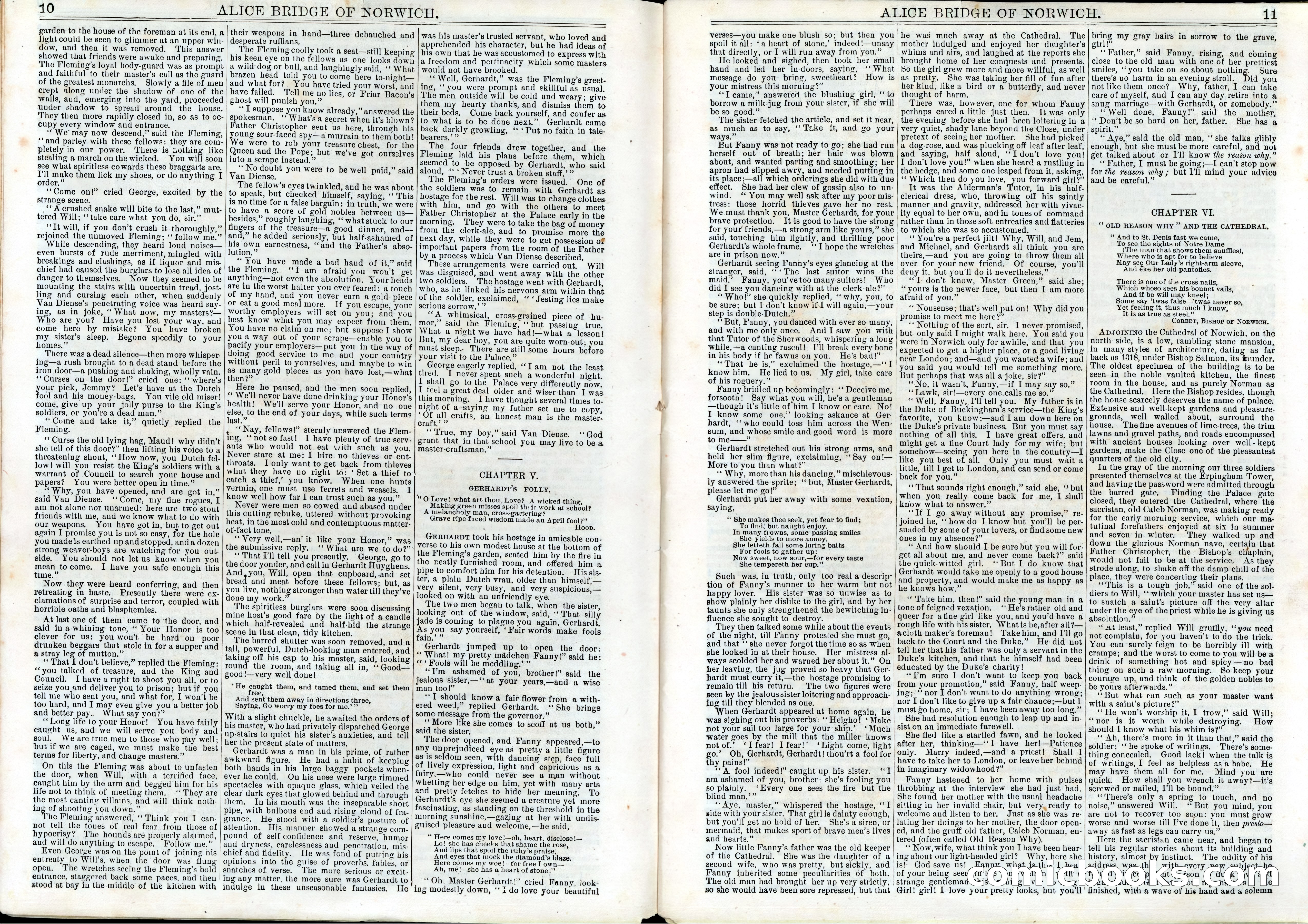
A restored page from Penny Dreadfuls, 1881. Page through the whole issue in the reader above.
📄 Transcribed text from this page (OCR, searchable)
Machine-transcribed from the original scan — historical spelling and the odd misread are preserved.
10 ALICE BRIDGE OF NORWICH. garden to the house of the foreman at its end, a light could be seen to glimmer at an upper win- dow, and then it was removed. This answer showed that friends were awake and preparing. The Fleming’s loyal body-euard was as prompt and faithful to their master’s call as the guard of the greatest monarchs. Slowly a file of men crept along under the shadow of one of the walls, and, emerging into the yard, proceeded under shadow to spread around the house. They then more rapidly closed in, so as to oc- cupy every window and entrance. ‘“We may now descend,” said the Fleming, ‘and parley with these fellows: they are com- pletely in our power. There is sothing like stealing a march on the wicked. You will soon see what spiritless cowards these braggarts are. Pll make them lick my shoes, or do anything I order.” ‘Come on!” cried George, excited by the strange scene. _“‘Acrushed snake will bite to the last,” mut- tered Will; ‘‘take care what you do, sir.” “Tt will, if you don’t crush it thoroughly,” rejoined the unmoved Fleming; ‘‘ follow me.” While descending, they heard loud noises— even bursts of rude merriment, mingled with breakings and clashings, as if liquor and mis- chief had caused the burglars to lose all idea of danger to themselves. Now they seemed to be mounting the stairs with uncertain tread, jost- ling and cursing each other, when suddenly Van Diense’s penetrating voice was heard say- ing, as in joke, “‘What now, my masters?— Who are you? Have you lost your way, and come here by mistake? You have broken my sister’s sleep. Begone speedily to your homes.” There was a dead silence—then more whisper. ing—a rush brought to a dead stand before the iron door—a pushing and shaking, wholly vain. ‘*Curses on the door!” cried one: ‘‘ where’s your pick, Jemmy? Let’s have at the Dutch fool and his money-bags, ‘You vile old miser! come, give up your jolly purse to the King’s soldiers, or you’re a dead man.” “Come and take it,” quietly replied the Fleming. ‘* Curse the old lying hag, Maud! why didn’t she tell of this door?” then lifting his voice to a threatening shout, ‘‘How now, you Dutch fel- low! will you resist the King’s soldiers with a warrant of Council to search your house and papers? You were better open in time.” ‘‘ Why, you have opened, and are got in,” said Van Diense. ‘‘Come, my fine rogues, I am not alone nor unarmed: here are two stout friends with me, and we know what to do with our weapons. You have yot in, but to get out again I promise you is not so easy, for the hole you madeis earthed up and stopped, and a dozen strong weaver-boys are watching for you out- side. You should not let us know when you mean tocome. I have you safe enough this time.” Now they were heard conferring, and then retreating in haste. Presently there were ex- clamations of surprise and terror, coupled with horrible oaths and blasphemies, At last one of them came to the door, and said in a whining tone, ‘‘ Your Honor is too clever for us: you won’t be hard on poor drunken beggars that stole in for a supper and a stray leg of mutton.” ‘That I don’t believe,” replied the Fleming: ‘‘you talked of treasure, and the King and Council. I have aright to shoot you all, or to seize you and deliver you to prison; but if you tell me who sent you, and what for, I won’t be too hard, and I may even give you a better job and better pay. What say you?” ‘Long life to your Honor! You have fairly caught us, and we will serve you body and soul. We are true men to those who pay well; but if we are caged, we must make the best terms for liberty, and change masters.” On this the Fleming was about to unfasten the door, when Will, with a terrified face, caught him by the arm and begged him for his life not to think of meeting them. ‘‘They are the most canting villains, and will think noth- ing of shooting you down,” The Fleming answered, ‘ Think you I can- not tell the tones of real fear from those of hypocrisy? The hounds are properly alarmed, and will do anything to escape. Follow me.” Even George was on the point of joining his entreaty to Will’s, when the door was flung open. The wretches seeing the Fleming’s bold entrance, staggered back some paces, and then | stood at bay in the-middle of the kitchen with their weapons in hand—three debauched and desperate ruffians, : The Fleming coolly took a seat—still keeping his keen eye on the fellows as one looks down a wild dog or bull, and laughingly said, ‘‘ What brazen head told you to come here to-night— and what for? You have tried your worst, and have failed. Tell me no lies, or Friar Bacon’s ghost will punish you.” “‘T suppose you know already,” answered the spokesman. ‘* What’s a secret when it’s blown? Father Christopher sent us here, through his youns sour-faced spy—a murrain to them both! e were to rob your treasure chest, for the Queen and the Pope; but we’ve got ourgelves into a scrape instead.” ‘No doubt you were to be well paid,” said Van Diense. The fellow’s eyes twinkled, and he was about to speak, but checked himself, saying, ‘‘ This is no time for a false bargain: in truth, we were to have a score of gold nobles between us— besides,” roughly laughing, ‘what stuck to our fingers of the treasure—a good dinner, and— and,” he added seriously, but half-ashamed of his own earnestness, ‘‘and the Father’s abso- lution.” “You have made a bad hand of it,” said the Fleming. ‘I am afraid you won't get anything—not even the absolution. Your heads are in the worst halter you ever feared: a touch of my hand, and you never earn a gold: piece or eat a good meal more. If you escape, your worthy employers will set on you; and you best know what you may expect from them, You have no claim on me; but suppose I show you a way out of your scrape—enable you to pacify your employers—put you in the way of doing good service to me and your country without peril to yourselves, and maybe to win as many gold pieces as you have lost,—what then?” Here he paused, and the men soon replied, “ We'll never have done drinking your Honor's health! We'll serve your Honor, and no one sed to the end of your days, while such terms ast.’ . ‘‘Nay, fellows!” sternly arswered the Flem- Ing, ‘‘notso fast! I have plenty of true serv- ants who would not eat (ith such as you. Never stare at me: I hire no thieves or cut- throats. I only want to get back from thieves what they have no right to: ‘Set a thief to catch a thief,” you know. When one hunts vermin, one must use ferrets and weasels, I know well how far I can trust such as you.” Never were men so cowed and abased under this cutting rebuke, uttered without provoking heat, in the most cold and contemptuous matter- of-fact tone, ‘Very well,—an’ it like your Honor,” was the submissive reply. “That Pll tell you presently. George, go to the door yonder, and call in Gerhardt Huyghens. And,you, Will, open that cupboard,-and set bread and meat before these fellows; but, as you live, nothing stronger than water till they’ve done my work,” The spiritless burglars were soon discussing mine host’s good fare by the light of a candle which half-revealed and half-hid the strange scene in that clean, tidy kitchen. The barred shutter was soon removed, anda tall, powerful, Dutch-looking man entered, and taking off his cap to his master, said, looking round the room, and taking all in, ‘‘Good— good !—very well done! ‘He caught them, and tamed them, and set them ree. And sent them away in directions three, Saying, Go worry my foes for me.’ ” With a slight chuckle, he awaited the orders of his master, who had privately dispatched George up-stairs to quiet his sister’s anxieties, and tell her the present stute of matters. Gerhardt was a man in his prime, of rather awkward figure. He had a habit of keeping both hands in his large baggy pockets when- ever he could. On his nose were large rimmed spectacles with opaque glass, which veiled the clear dark eyes that glowed behind and through them. In his mouth was the inseparable short pipe, with bulbous end and rising cloud of fra- grance, He stood with a soldier’s posture of attention. His manner showed a strange com- pound of self-confidence and reserve, humor and dryness, carelessness and penetration, mis- chief and fidelity. He was fond of putting his opinions into the guise of proverbs, fables, or snatches of verse. The more serious or excit- ing any matter, the more sure was Gerhardt to indulge in these unseasonable fantasies, He ‘What are we to do?”) was his master’s trusted servant, who loved and apprehended his character, but he had ideas of his own that he was accustomed to express with a freedom and pertinacity which some masters would not have brooked. ‘Well, Gerhardt,” was the Fleming’s greet- ing, ‘‘you were prompt and skillful as usual. The men outside will be cold and weary; give them my hearty thanks, and dismiss them to their beds, Come back yourself, and confer ag to what is to be done next.” Gerhardt came back darkly growling, ‘ ‘Put no faith in tale- bearers,’ ” The four friends drew together, and the Fleming laid his plans before them, which seemed to be opposed by Gerhardt, who said aloud, ‘' ‘ Never trust a broken staff.” The Fleming’s orders were issued. One of the soldiers was to remain with Gerhardt as hostage for the rest. Will was to change clothes with him, and go with the others to meet Father Christopher at the Palace early in the morning. ‘They were to take the bag of money from the clerk-ale, and to promise more the next day, while they were to get possession of important papers from the room of the Father by a process which Van Diense described, These arrangements were carried out. Will was disguised, and went away with the other two soldiers. The hostage went with Gerhardt, who, as he linked his nervous arm within that of the soldier, exclaimed, ‘‘ ‘ Jesting lies make serious sorrow.’ ” “‘A whimsical, cross-grained piece of hu- mor,” said the Fleming, ‘ but passing true, What a night we have had!—what a lesson! But, my dear boy, you are quite worn-out; you must sleep. There are still some hours before your visit to the Palace,” George eagerly replied, “Iam not the least tired. I never spent such a wonderful night. I shall go tothe Palace very differently now. I feel a great deal older and wiser than I was this morning. I have thought several times to- night of a»saying my father set me to copy, “OF all crafts, an honest man is the master. craft.’ ” : ‘True, my boy,” said Van Diense. <‘‘God grant that in that school you may live to be a master-craftsman.” CHAPTER Y. GERHARDT’S FOLLY, “oO Love! what art thou, Love? A wicked thing, Making green misses spoil their work at school? A melancholy man, cross-gartering? Grave ripe-fuced wisdom made an April fool?” Hoop, GERHARDT took his hostage in amicable con- verse to his own modest house at the bottom of the Fleming’s garden, seated him by the fire in the reatly furnished room, and offered him a pipe to comfort him for his detention. His sis- ter, a plain Dutch vrau, older than himself,— very silent, very busy, and very suspicious,— looked on with an unfriendly eye. The two men began to talk, when the sister, looking out of the window, said, ‘‘ That silly jade is coming to plague you again, Gerhardt, As you say yourself, ‘Fair words make fools fain.’ ” : “Gerhardt jumped up to open the door: “What! my pretty médchen Fanny!” said he: “** Fools will be meddling.’ ” “Tm ashamed of you, brother!” said the jealous sister,—“ at your years,—and a wise man too!” **T should know a fair flower from a with- ered weed,” replied Gerhardt, ‘She brings some message from the governor.” ‘‘ More like she comes to scoff at us both,” said the sister, The door opened, and Fanny appeared,—to any unprejudiced eye as pretiy a little figure as is seldom seen, with dancing step, face full of lively expression, light and capricious as a fairy,—who could never see a man without whetting her edge on him, yet with many arts and pretty fetches to hide her meaning. To Gerhardt’s eye she seemed a creature yet more fascinating, as standing on the threshold in the morning sunshine,—gazing at her with undis- guised pleasure and welcome,—he said, “ Here comes my love!—oh, heart, disclose !— Lo! she has cheel’s that shame the rose, And lips that spoil the ruby’s praise, And eyes that mock the diamond’s blaze, Here comes my woe! - for free I own— Ah, me!—she has a heart of stone!”” ore Oh, Master Gerhardt!” cried Fanny, look- ing modestly down, ‘‘i do love your beautiful ALICE BRIDGE OF NORWICH. 11 verses—you make one blush so; but then you | he was much away at the Cathedral. The spoil it all: ‘a heart of stone,’ indeed !—unsay | thut directly, or I will run away from you.” He looked and sighed, then took her small hand and led her in-doors, saying, ‘‘ What message do you bring, sweetheart? How is your mistress this morning?” : ‘ “Teame,” answered the blushing girl, “to borrow a milk-jug from your sister, if she will be so good.” : : The sister fetched the article, and set it near, as much as to say, ‘‘Tzke it, and go your ways.” : But Fanny was not ready to go; she had run herself out of breath; her hair was blown about, and wanted parting and smoothing; her apron had slipped awry, and needed putting in its place:—all which orderings she did with due effect. She had her clew of gossip also to un- wind. ‘* You may well ask after my poor mis- tress: those horrid thieves gave her no rest. We must thank you, Master Gerhardt, for your brave protection. It is good to have the strong for your friends,—a strong arm like yours,” she said, touching him lightly, and thrilling poor Gerhardt’s whole frame. ‘‘ I hope the wretches are in prison now.” : Gerhardt seeing Fanny’s eyes glancing at the | as oe stranger, said, ‘‘‘ The last suitor wins the. maid,’ Fanny, you’vetoo many suitors! Who did I see you dancing with at the clerk-ale?” “Who!” she quickly replied, ‘‘ why, you, to be sure; but I don’t know if will again,—your step is double- Dutch.” “ But, Fanny, you danced with ever so many, and with me only ouce. that Tutor of the Sherwoods, whispering a long while,—a canting rascal! I'll break every bone in his body if he fawns on you. He's bad!” ‘That he is,” exclaimed the hostage,—‘‘I know him. He lied tous, My girl, take care of his roguery.” Fanny bridled up becomingly: ‘‘ Deceive me, forsooth! Say what you will, he’s a gentleman —though it’s little of him I know or care. No! I know some one,” looking askance at Ger. hardt, ‘‘ who could toss him across the Wen- sum, and whose smile and good word is more to me——” Gerhardt stretched out his strong arms, and held her slim figure, exclaiming, ‘‘Say on!— More to you than what?” ‘* Why, more than his dancing,” mischievous- ly answered the sprite; ‘‘ but, Master Gerhardt, please let me go!” ; Gerhardt put her away with some vexation, saying, “ She makes thee seek, yet fear to find; To find; but naught enjoy. In many frowns, some passing smiles She yields to more annoy, She letteth fall some luring baits For fools to gather up: Now sweet, now sour,—for every taste She tempereth her cup.” Such was, in truth, only too real a descrip- tion of Fanny’s manner to her warm but not happy lover. His sister was so unwise as to show plainly her dislike to the girl, and by her taunts she only strengthened the bewitching in- fluence she sought to destroy. They then talked some while about the events of the night, till Fanny protested she must go, and that ‘‘ she never forgot the time so as when she looked in at their house. Her mistress al- ‘ways scolded her and warned her about it.” On her leaving, the jug proved so heavy that Ger- hardt must carry it,—the hostage promising to remain till his return. The two figures were seen by the jealoussister loitering and approach- ing till they blended as one. ‘When Gerhardt appeared at home again, he was sighing out his proverbs: ‘‘ Heigho! ‘ Make not your sail too large for your ship.’ ‘Much water goes by the mill that the miller knows not of.’ ‘Ifear! I fear!’ ‘Light come, light go.’ Oh, Gerhardt, Gerhardt! thou’rt a fool for thy pains!” ‘© A fool indeed!” caught up his sister. ‘1 am ashamed of you, brother: she’s fooling you so plainly. ‘Every one sees the fire but the blind man.’” “ Aye, master,” whispered the hostage, ‘I side with your sister. That girl is dainty enough, but you'll get no hold of her, She’s a siren, or mermaid, that makes sport of brave men’s lives and hearts.”- Now little Fanny’s father was the old keeper of the Cathedral. She was the daughter of a second wife, who was pretty, but sickly, and Fanny inherited some peculiarities of both. The old man had brought her up very strictly, So she would have been sore repressed, but that ” And I saw you with | | her kin mother indulged and enjoyed her daughter’s whims and airs, and laughed at the reports she brought home of her conquests and presents. So the girl grew more and more willful, as well She was taking her fill of fun after like a bird or a butterfly, and never thought of harm. There was, however, one for whom Fanny perhaps cared a little just then. It was only ‘the evening before she had been loitering in a very quiet, shady lane beyond the Close, under pretext of seeingher mother. She had picked a dog-rose, and was plucking off leaf after leaf, and saying, half aloud, ‘‘I don’t love you! I don’t love you!” when she heard a rustling in the hedge, and some one leaped from it, asking, ‘Which then do you love, you forward girl?” It was the Alderman’s Tutor, in his half- clerical dress, who, throwing off his saintly manner and gravity, addressed her with vivac- ity equal to her own, and in tones of commard rather than in those soft entreaties and flatteries to which she was so accustomed, - “* Yow're a perfect jilt! Why, Will, and Jem, and Michael, and Gerhardt all think you are theirs,—and you are going to throw them all over for your new friend. Of course, you'll deny it, but you’ll do it nevertheless,” ““T- don’t know, Master Green,” said she; “yours is the newer face, but thea I am more afraid of you.” ‘* Nonsense; that’s well put on! Why did you promise to meet me here?” “« Nothing of the sort, sir. I never promised, but only said I might walk here. You said you were in Norwich only for awhile, and that you expected to get a higher place, ora good living near London; and—and you wanted a wife; and you said you would tell me something more. But perhaps that was all a joke, sir?” ‘No, it wasn’t, Fanny,—if I may say so.” “‘Lawk, sir!—every one.calls me so.” “Well, Fanny, I'll tell you. My father is in the Duke of Buckingham'sservice—the King’s favorite, you know;—and I am down here on the Duke’s private business, But you must say nothing of all this. I have great offers, and might get a fine Court lady for my wife; but | Somehow—seeing you here in the country—I like you best of all. Only you must wait a little, till I get to London, and can send or come back for you.” ‘«That sounds right enough,” said she, ‘‘ but when you really come back for me, I shall know what to answer.” “Tf I go away without any promise,” re- joined he, ‘‘howdo I know but you'll be per- sunded by some of your lovers, or find some new ones in my absence?” “And how should I be sure but you will for- get all about me, and never come back?’ said the quick-witted girl. ‘‘But I do know that Gerhardt would take me openly to a good house and property, and would make me as happy as he knows how.” ‘«Take him, then!” said the young man in a tone of feigned vexation. ‘‘ He’s rather old and queer for afine girl like you, and you’d have a rough life with his sister. Whatis be,after all2— acloth maker’s foreman! Takehim, and I'll go back to the Court and the Duke.” He did not tell her that his father was only a servant in the Duke's kitchen, and that he himself had been educated by the Duke’s charity! “‘(?'m sure I don’t want to keep you back from your promotion,” said Fanny, half weep- ing; ‘‘nor I do