
Penny Dreadfuls, 1881 · page 5 of 38
Alice Bridge of Norwich — page 5: what you’re looking at
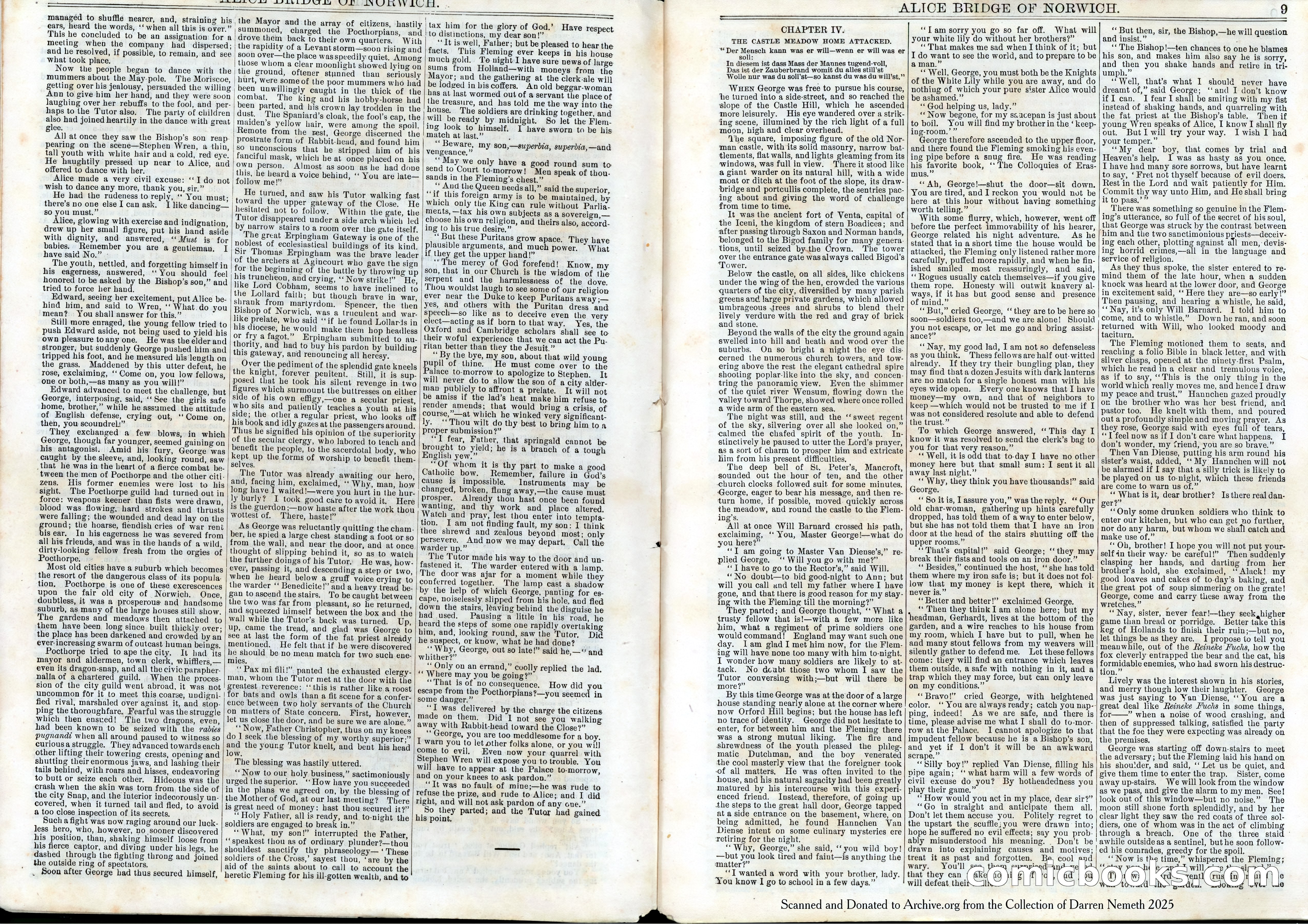
A restored page from Penny Dreadfuls, 1881. Page through the whole issue in the reader above.
📄 Transcribed text from this page (OCR, searchable)
Machine-transcribed from the original scan — historical spelling and the odd misread are preserved.
So managed to shuffle nearer, and, straining his ears, heard the words, ‘‘ when all this is over.” This he concluded to be an assignation for a meeting when the company had dispersed; and he resolved, if possible, to remain, and’ see what took place. Now the people began to dance with the mummers about the May-pole. getting over his jealousy, persuaded the willing Ann to give him her hand, and they were soon laughing over her rebuffs to the fool, and per- haps to the Tutor also. The party of children ms had joined heartily in the dance with great glee. All at once they saw the Bishop’s son reap. pearing on the scene—Stephen Wren, a thin, tall youth with white hair and a cold, red eye. He haughtily pressed up near to Alice, and offered to dance with her. Alice made a very civil excuse: ‘‘I do not wish to dance any more, thank you, sir.” He had the rudeness to reply, “ You must; there’s no one else I can ask, Tike dancing— so you must.” Alice, glowing with exercise and indignation, drew up her small figure, put his hand aside with dignity, and answered, ‘‘ Must is’ for babies. Remember you are a gentleman. I have said No.” - The youth, nettled, and for; etting himself in his eagerness, answered, ‘‘ You should feel honored to be asked by the Bishop’s son,” and tried to force her hand. Edward, seeing her excitement, put Alice be- hind him, and said to Wren, ‘‘ What. do you mean?: You shall answer for this.” Still more enraged, the young fellow tried to push Edward aside, not being used to yield his own pleasure toanyone. He was the élderand stronger, but suddenly George pushed him and tripped his foot, and he measured his ‘length on the grass. Maddened by this utter defeat, he rose, exclaiming, ‘‘Oome on, you low fellows, one or both,—as many as you will!” Edward advanced to meet the challenge, but George, interposing, said, ‘‘ See the girls safe home, brother,” while he assumed the attitude of English defense, crying out, ‘‘ Come on, then, you scoundrel!” They exchanged a few blows, in which George, though far younger, seemed gaining on his antagonist. Amid his: fury, George was caught by the.sleeve, and, looking round, saw that he was ia the heart of a fierce combat be- tween the men of Pocthorpe and the other citi- zens. His former enemies were lost to his sight. The Pocthorpe guild had turned out in force; weapons keener. than fists were drawn, blood was. flowing, hard strokes and thrusts were falling; the wounded and dead lay on the ground; the hoarse, fiendish cries of war rent bis ear. In his eagerness he was severed from all his friends, and was in the hands of a wild, dirty-looking fellow fresh from the orgies of Pocthorpe. Most old cities have a suburb which becomes the resort of the dangerous class of its popula. tion, Pocthorpe is one of these excrescences upon the fair old city of Norwich. Once, doubtless, it was a prosperous and handsome suburb, as many of the large houses still show, The gardens and meadows then attached to them have been. long since, built thickly over; the place has been darkened and crowded by an ever-increasing swarm of outcast human beings, Pocthorpe tried to ape the city. It had its mayor and aldermen, town clerk, whifflers,— even its dragon-snap, and all the civic parapher- nalia of a chartered guild. , When the proces- sion of the city guild went abroad, it was not uncommon for it to meet this coarse; undigni- fied rival, marshaled over against it, and stop- ping the thoroughfare, Fearful was the struggle which then ensved! The two dragons, even, had been known to be seized with the raddes pugnandi when all around paused to witness so curiousa struggle. They advanced towards each other lifting their towering crests, opening and shutting their enormous jaws, and lashing theix tails behind, with roars and hisses, endeavoring to butt or seize each other. Hideous was the crash when the skin was torn from, the side of the city Snap, and the interior indecorously un- covered, when it turned tail and fled, to avoid a too close inspection of its secrets, Such a fight’ was now raging around our luck- less hero, who, however, no sooner discovered his position, than, shaking himself loose from his fierce captor, and diving under his legs, he dashed through the fighting throng and joined The Moriscoe, | { ,the Mayor and the array of citizens, -hastily | summoued, charged the Pocthorpians, and drove them back to their own quarters. With the rapidity of a Levant storm—soon rising and soon over—the place was speedily quiet. Among those whom a clear moonlight showed lying on the ground, oftener stunned than seriously hurt, were some of the poor mummers who had been unwillingly caught in the thick of the combat. The king and his hobby-horse had been parted, and his crown lay trodden in the dust. The Spaniard’s cloak, the fool’s cap, the | maiden’s yellow hair, were among the spoil. Remote from the test, George discerned the prostrate form of Rabbit-head, and found him So unconscious that he stripped him of his | fanciful mask, which he at once placed on his |OwWn person. Almost as soon as he had done | this, he heard a voice behind, ‘‘ You are late— | follow me!” He turned, and saw his Tutor walking fast toward the upper gateway of the Close. He hesitated not to follow. Within the gate, the Tutor disappeared under a side arch which led by narrow stairs to a room over the gate itself. The great Erpingham Gateway is one of the noblest of ecclesiastical buildings of its kind. Sir Thomas Erpingham was the brave leader of the archers at Agincourt who gave the sign | for the beginning of the battle by throwing up his truncheon, and crying, ‘‘ Now strike!” He, like Lord Cobham, seems to have inclined to the Lollard faith; but though brave in war, shrank from martyrdom. Spencer, the then Bishop of Norwich, was a truculent and war- like prelate, who said “if he found Lollar-ds in his diocese, he would make them hop headless or fry a fagot.” Erpingham submitted to au- thority, and had to buy his pardon by building this gateway, and renouncing all heresy. Over the pediment of the splendid gate kneels the knight, forever penitent. Still, it is sup- posed that he took his silent revenge in two figures which surmount the bultresses on either side of his own effigy,—one a secular priest, who sits and patiently teaches a youth at his side; the other a regular priest, who looks off his book and idly gazes at the passengers around. Thus he signified his opinion of the superiority of the secular clergy, who labored to teach and benefit the people, to the sacerdotal body, who kept up the forms of worship to benefit them- selves. . The Tutor was already awaiting our hero, ly burly? I took good cate to avoid it, Here wottest of. There, haste!” thought of slipping behind it, so as to watch the warder ‘‘ Benedicite!” anda heavy tread be- gan to ascend the stairs. To be caught between Mentioned. He felt that if he were discovered mies. ‘‘ Pax mi fili!”. panted the exhausted clergy- | « man, whoin the Tutor met at the door with the ence between two holy servants of the Church on matters of State concern. ‘Now, Father Christopher, thus on my knees low. The blessing was hastily uttered. urged the superior. ‘‘ How haye you succeeded and, facing him, exclaimed, ‘* Wh , man, how cause is impossible. long have | wailed|—were you hae iaihe how changed, broken, flung away,—the cause must the further doings of his Tutor, He was, how- | fastened it, ever, passing it, and descending a step or two, The door was ajar for i when he heard below a gruff voice crying to conferred ‘oud rina ome eee greatest reverence; ‘‘this is rather like.a roost | escape from the P ‘0 for bats and owls than a fit scene for a confer- ees danger.” do I seek the blessing of my worthy superior;” | [ w and the young Tutor knelt, and bent his head come to evil. tax him for the glory of God.’ Have respect to distinctions, my dear son!” ‘*It is well, Father; but be pleased to hear the facts. This Fleming ever keeps in his house much gold. Te-night'I have sure news of large sums from Holland—with Moneys from the Mayor; and the gathering at the clerk-ale will be lodged in bis coffers. An old beggar-woman has at last wormed out of a servant the place of the treasure, and has told me the way into the house. The soldiers are drinking together, and will be ready by midnight. So let the Flem- ing look to himself. I have sworn to be his match at last.” : “Beware, my son,—superbia, swperbia,—and vengeance,” ‘‘May we only have a good round sum to send to Court to-morrow! Men speak of thou- sands in the Fleming’s chest.” a And the Queen needsall,” said the superior, “if this foreign army is to be maintained, by which only the King can rule without Parlia- ments, —tax his own subjects asa sovereign,— choose his own religion, and theirs also, accord- ing to his true desire,” “But these Puritans grow apace. They have plausible arguments, and much Power. What if they get the upper hand!” ‘The merey of God forefend! Know, my son, that in our Church is the wisdom of the Serpent and the harmlessness of the dove. Thou wouldst laugh to see some of our religion ever near the Duke to keep Puritans away ;— yes, and others with the Puritan dress and speech—so like as to deceive even the very elect—acting as if born to that way. Yes, the Oxford and Cambridge scholars ‘shall see to their woful experience that we can act the Pu- rilan better than they the Jesuit.” “ By the bye, my son, about that wild young pupil of thine. He must come over to the Palace to-morrow to apologize to Stephen. It will never do to allow the son of a city alder- man publicly to affront a prelate. It will not be amiss if the lad’s heat make him refuse to. render amends; that would bring a crisis, of course,”—at which he winked very siguificant- ly. ‘Thou wilt do thy best to bring him toa proper submission?” “JT fear, Father, that springald cannot be brought to yield; he is a branch of a tough English yew.” “Of whom it is thy part to make a ‘ood Catholic bow. Romsneee failure in God's Instruments may be prosper. Already thou hast once been found is the guerdon;—now haste after the work thou vee, aad thy work and place altered, atch and pray, lest thou enter into tempta- As George was reluctantly quitting the cham- thet wen pore ni pegs Are ahs ber, he spied a large chest standing a foot or so 6 from the wall, and near the door, and at once vacuo i lal ea d and zealous beyond most; onl The Tutor made his way to the door and un- The warder entered with a lamp. The lamp cast a shadow by the help of which George, panting for es- cape, noiselessly slipped from his hole, and fled the two was far from pleasant, so he returned, | qo th iri i i isoui and squeezed himself between the box and the tae? ised. ee ae oe peer he wall while the Tutor’s back was turned. Up, | heard the steps of some one ra up, came the tread, and glad was George to] him, and, looking round, saw the Tutor, Dia see at last the form of the fat priest already | he suspect, or know, what he had done? Pausing a little in his road, he pidly overtaking “Why, George, out so late!” said he, —“ and he should be no mean match for two such ene- | whither?” “‘ Only on an errand,” cvolly replied the lad. ‘Where may you be going?” “That is of no consequence. How did you cethorpians?—you seemed in “I was delivered by the charge the citizens First, however, | made on t i valki let us close the door, and be gure we are alone.” away with Babbit wed a) 4 Oli i oward the Close?” ‘George, you are too meddlesome for a boy. arn you to let other folks alone, or you will Even now your quarrel with Stephen Wren will expose you to trouble. You . ) i ; i will have to appear at the Palace to-morrow, Now to our holy business, sactimoniously | and on your knees to ask pardon.” “Tt was no fault of mine;—he was rude to is great need of money: hast thou secured it?” soldiers are engaged to break in.” ‘* What, my son!” interrupted the Father, ‘‘speakest thou as of ordinary, plunder?—thou shouldest sanctify thy phraseology— ‘These in the plans we agreed on, by the blessing of | refuse the prize, and rude to Alice: and I did the Mother of God, at our last meeting? There | right, and will not ask pardon of any one,” So they parted; and the Tutor had gained ‘‘ Holy Father, all is ready, and. to-night the | his point, soldiers of the Cross,’ sayest thou, ‘are by the the outside ring of spectators. . Soon after George had thus secured himself, aid of the saints about to call to account the heretic Fleming for his ill-gotten wealth, and to ALICE BRIDGE OF NORWICH. 9 | CHAPTER IV. THE CASTLE MEADOW HOME ATTACKED. “Der Mensch kann was er will—wenn er will was er soll: In diesem ist dass Mass der Manunes tugend-voll, Das ist der Zauberbrand womit du alles still’st_ Wolle nur was du soll’st—so kanst du was du will’st.” WHEN George was free to pursue his course, he turned into a side-street, and so reached the slope of the Castle Hill, which he ascended more leisurely. His eye wandered over a strik- ing scene, illumined by the rich light of a full moon, high and clear overhead, V'he square, imposing figure of the old Nor- man castle, with its solid masonry, narrow bat- tlements, flat walls, and lights gleaming from its windows, was full in view. There it stood like a giant warder on its natural hill, with a wide moat or ditch at the foot of the slope, its draw- bridge and portcullis complete, the sentries pac- ing about and giving the word of challenge from time to time. It was the ancient fort of Venta, capital of the Iceni, the kingdom of stern Boadicea; and after passing through Saxon and Norman hands, belonged to the Bigod family for many genera- tions, until seized bythe Crown. The tower over the entrance gate was always called Bigod’s ‘Tower. Below the castle, on all sides, like chickens under the wing of the hen, crowded the various quarters of the city, diversified by many parish greens aud large private gardens, which allowed umbrageous ,frees and shrubs to blend their lively verdure with the red and gray of brick and stone. Beyond the walls of the city the ground again swelled into hill and heath and wood over the suburbs. On so bright a night the eye dis. cerned the numerous church towers, and tow- ering above the rest the elegant cathedral spire shooting poplar-like into the sky, and concen- tring the panoramic view. Even the shimmer of the quiet river Wensum, flowing down the valley toward Thorpe, showed where once rolled a wide arm of the eastern sea. The night was still, and the ‘“‘ sweet regent of the sky, silvering over all she Jooked on,” calmed the chafed spirit of the youth. In- stinctively he paused to utter the Lord’s prayer, as a sort of charm to prosper him and extricate him from his present difficulties, The deep bell of St. Peter’s, Mancroft, sounded out the hour of ten, and the other church clocks followed suit for some minutes, George, eager to bear his message, and then re- turn home, if possible, moved quickly across the meadow, and round the castle to the Flem- ing’s. ‘All at once Will Barnard crossed his path, exclaiming, ‘‘ You, Master George!—what do you here?” “T am going to Master Van Diense’s,”’ re- plied George. ‘‘ Will you go with me?” ‘‘T have to go to the Rector’s,” said Will. ““No doubt—to bid good-night to Ann; but will you call und tell my father where I have gone, and that there is good reason for my stay- ing with the Fleming till the morning?” They parted; and George thought, ‘‘What a trusty fellow that isl—with a few more like him, what a regiment of prime soldiers one wouldcommand! England may want such one day. lam glad I met him now, for the Flem- ing will have none too many with him to-night. I wonder how many soldiers are likely to at- tack. No dcubt those two whom I saw the Tutor conversing with;—but will there be more?” By this time George was at the door of a large house standing nearly alone at the corner where now Orford Hill begins; but the house has left no trace of identity. George did not hesitate to enter, for between him and the Fleming there was a strong mutual liking. The fire and ‘shrewdness of the youth pleased the phileg- matic Dutchman, and the boy venerated the cool masterly view that the foreigner took of all matters. He was often invited to the house, and his natural sagacity had been greatly matured by his intercourse with this experi- enced friend. Instead, therefore, of going up the steps to the great hall door, George tapped at a side entrance on the basement, where, on being admitted, he found Hannchen Van Diense intent on some culinary mysteries ere retiring for the night. “Why, George,” she said, ‘‘you wild boy! —but you look tired and faint—is anything the matter?” “I wanted a word with your brother, lady. ‘You know I go to school ina few days.” ‘Tam sorry you go so far off. What will your white lily do without her brothers?” “That makes me sad when I think of it; but I do want to see the world, and to prepare to be aman.” “‘ Well, George, you must both be the Knights of the White Lily while you are away, and do nothing of which your pure sister Alice would be ashamed.” ‘“God helping us, lady.” “Now begone, for my saiacepan is just about to boil. ‘You will find my brother in the ‘keep- ing-room.’” George therefore ascended to the upper floor, and there found the Fleming smoking his even- ing pipe before a snug fire. He was reading his favorite book, ‘* The Colloquies of Eras- mus,” “Ah, George!|—shut the door—sit down. You are tired, and I reckon you would nut be here at this hour without having something worth telling.” ~ With some flurry, which, however, went off before the perfect immovability of his hearer, George related his night adventure. As he stated that in a short time the house would be attacked, the Fleming only listened rather more carefully, puffed more rapidly, and when he fin- ished smiled most reassuringly, and said, “Rogues usually catch themselves—if you give them rope. Honesty will outwit knavery al- ways, if it has but good sense and presence of mind,” “* But,” cried George, ‘they are to be here so soon—soldiers too,—and we are alone! Should you not escape, or Jet me go and bring assist- ance?” ‘‘Nay, my good lad, I am not so defenseless as youthink, These fellows are half out-witted already. If they try their bungling plan, they may find that a dozen Jesuits with dark lanterns are no match for a single honest man with his eyes wide open. Every one knows that I have money—my own, and that of neighbors to keep —which would not be trusted to me if I was not considered resolute and able to defend the trust.” To which George answered, “ This day I know it was resolved to send the clerk’s bag to you for that very reason.” ‘« Well, it is odd that to-day I have no other money here but that small sum: I sent it all away last night.” ‘* Why, they think you have thousands!” said George. “‘So itis, lassure you,” was thereply. ‘Our old char-woman, gathering up hints carefully dropped, has told them of a way to enter below, but she has not told them that I have an iron door at the head of the stairs shutting off the upper rooms.” “That's capital!” said George; ‘‘ they may break their fists and tools on an iron door.” “ Besides,” continued the host, ‘‘she has told them where my iron safe is; but it does not fol- low that my money is kept there, which it never is.” “Better and better!” exclaimed George. . ‘Then they thinkI am alone here; but my headman, Gerhardt, lives at the bottom of the garden, and a wire reaches to his house from my room, which I have but to pull, when he and many stout fellows from my weavers will silently gather to defendme. Let these fellows come: they will find an entrance which leaves them outside, a safe with nothing in it, and a trap which they may force, but can only leave on my conditions.” “‘Bravol” cried George, with heightened color, ping, indeed! As we are safe, and there is