
Penny Dreadfuls, 1868 · page 8 of 98
The Frozen Crew Of The Ice-Bound Ship; Or, Terrors Of The Arctic Region — page 8: what you’re looking at
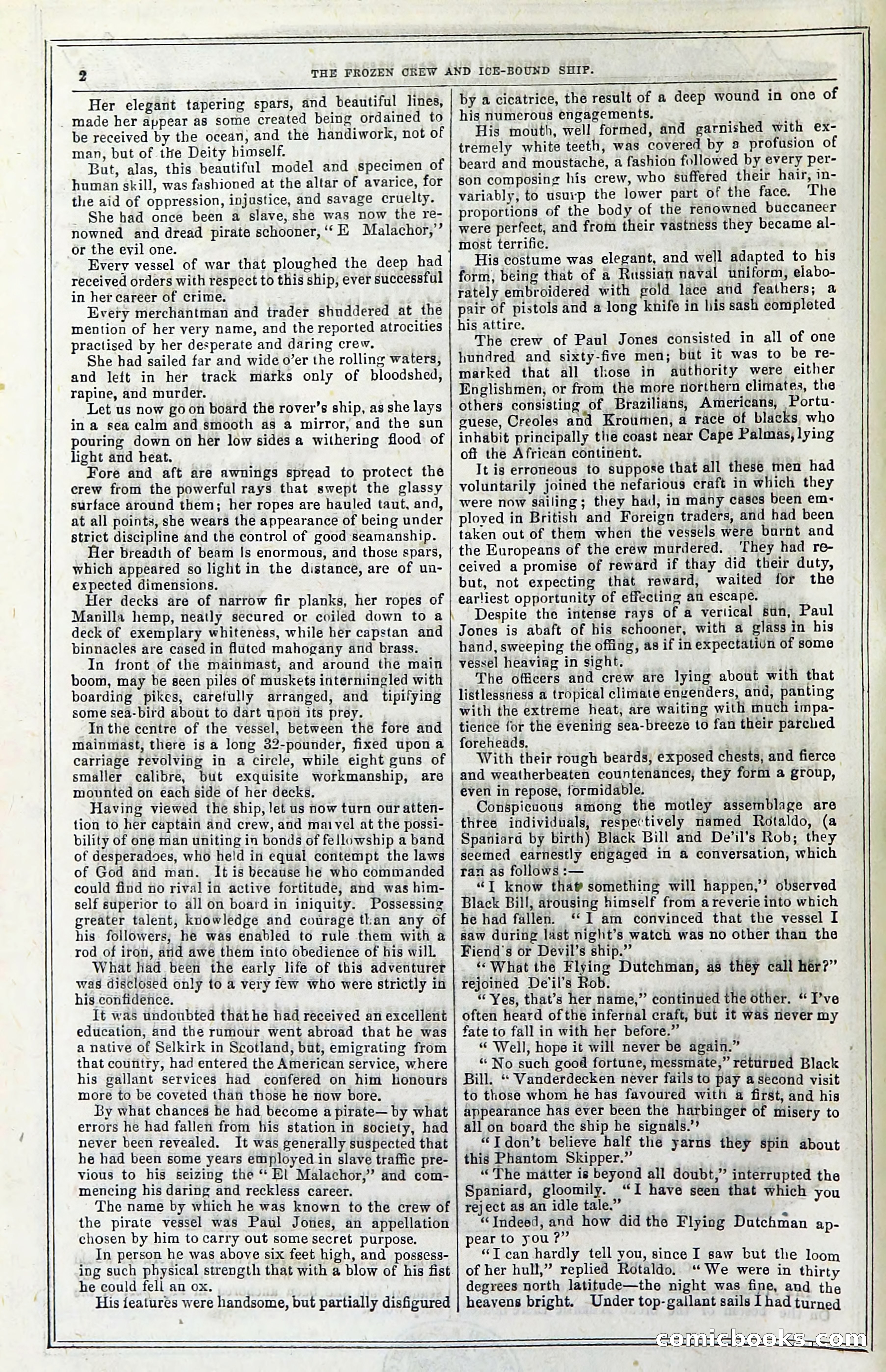
A restored page from Penny Dreadfuls, 1868. Page through the whole issue in the reader above.
📄 Transcribed text from this page (OCR, searchable)
Machine-transcribed from the original scan — historical spelling and the odd misread are preserved.
eS... aea.—[V..—.eSw—w“m0@000—0w 4 2 THE FROZEN OREW AND ICE-BOUND SHIP. Her elegant tapering spars, and beautiful lines, made her appear as some created being ordained to be received by the ocean, and the handiwork, not of man, but of the Deity himself. But, alas, this beautiful model and specimen of human skill, was fashioned at the altar of avarice, for the aid of oppression, injustice, and savage cruelty. She had once been a slave, she was now the re- nowned and dread pirate schooner, ‘‘ Malachor,” or the eyil one. Every vessel of war that ploughed the deep had received orders with respect to this ship, ever successful in her career of crime. Every merchantman and trader shuddered at the mention of her very name, and the reported atrocities practised by her desperate and daring crew. She had sailed far and wide o’er the rolling waters, and left in her track marks only of bloodshed, rapine, and murder. Let us now goon board the rover’s ship, as she lays in a sea calm and smooth as a mirror, and the sun pouring down on her low sides a withering flood of light and heat. Fore and aft sre awnings spread to protect the crew from the powerful rays that swept the glassy surface around them; her ropes are hauled taut, and, at all points, she wears the appearance of being under strict discipline and the control of good seamanship. Her breadth of beam Js enormous, and those spars, which appeared so light in the distance, are of un- expected dimensions. Her decks are of narrow fir planks, her ropes of Manilla hemp, neatly secured or coiled down to a } deck of exemplary whiteness, while her capstan and binnacles are cased in fluted mahogany and brass. In front of the mainmast, and around the main boom, may be seen piles of muskets interniingled with boarding pikes, carefully arranged, and tipifying some sea-bird about to dart upon its prey. In the centre of the vessel, between the fore and mainmast, there is a long 32-pounder, fixed upon a carriage revolving in a circle, while eight guns of smaller calibre, but exquisite workmanship, are mounted on each side of her decks. Having viewed the ship, let us now turn our atten- tion to her captain and crew, and maivel at the possi- bility of one man uniting in bonds of fellowship a band of desperadoes, who held in equal contempt the laws of God and man. It is because he who commanded could find no rival in active fortitude, and was him- self superior to all on board in iniquity. Possessing greater talent, knowledge and courage than any of his followers, he was enabled to rule them with a rod of iron, arid awe them into obedience of his will. What had been the early life of this adventurer was disclosed only to a very few who were strictly in his confidence. It was undoubted that he had received an excellent education, and the rumour went abroad that he was a native of Selkirk in Scotland, but, emigrating from that country, had entered the American service, where his gallant services had confered on him honours more to be coveted than those he now bore. By what chances he had become a pirate— by what errors he had fallen from his station in society, had never been revealed. It was generally suspected that he had been some years employed in slave traffic pre- vious to his seizing the ‘‘ Bl Malachor,’ and com- mencing his daring and reckless career. The name by which he was known to the crew of the pirate vessel was Paul Jones, an appellation chosen by him to carry out some secret purpose. In person he was above six feet high, and possess- ing such physical strength that with a blow of his fist he could fell an ox. His features were handsome, but partially disfigured by a cicatrice, the result of a deep wound in one of his numerous engagements, His mouth, well formed, and garnished with ex- tremely white teeth, was covered by 2 profusion of beard and moustache, a fashion followed by every per- son composing his crew, who suffered their hair, in- variably, to usurp the lower part of the face. The proportions of the body of the renowned buccaneer were perfect, and from their vastness they became al- most terrific. _ His costume was elegant, and well adapted to his form, being that of a Russian naval uniform, elabo- rately embroidered with gold lace and feathers; a pair of pistols and a long knife in his sash completed his attire. The crew of Paul Jones consisted in all of one hundred and sixty-five men; bit it was to be re- marked that all those in authority were either Englishmen, or from the more northern climates, the others consisting of Brazilians, Americans, Portu- guese, Creoles and Krotimen, a race of blacks who inhabit principally the coast near Cape Palmas, lying oft the African continent. It is erroneous to suppose that all these men had voluntarily joined the nefarious craft in which they were now sailing; they had, in many cases been em- ployed in British and Foreign traders, and had been taken out of them when the vessels were barnt and the Europeans of the erew murdered. ‘They had re- ceived a promise of reward if thay did their duty, but, not expecting that reward, waited for the earliest opportunity of effecting an escape. Despite the intense rays of a vertical stn, Paul Jones is abaft of his schooner, with a glass in his hand, sweeping the offing, as if in expectatiun of some vessel heaving in sight. . The officers and crew are lying about with that listlessness a tropical climate engenders, and, panting with the extreme heat, are waiting with much impa- tience for the evening sea-breeze to fan their parched foreheads. With their rough beards, exposed chests, and fierce and weatherbeaten countenances, they form a group, even in repose, formidable. | Conspicuous among the motley assemblage are three individuals, respectively named Rotaldo, (a Spaniard by birth) Black Bill and De’il’s Rob; they seemed earnestly engaged in a conversation, which ran as follows :— “] know that something will happen,’’ observed Black Bill, arousing himself from a reverie into which he had fallen. “I am convinced that the vessel I saw during last night’s watch was no other than the Fiend's or Devil’s ship.” : ‘© What the Flying Dutchman, as they call her?” rejoined De'il’s Rob. RE. “Yes, that’s her name,” continued the other. “I’ve often heard of the infernal craft, but it was never my fate to fall in with her before.” “ Well, hope it will never be again.” — “ No such good fortune, messmate,” returned Black Bill. ‘* Vanderdecken never fails to pay a second visit to those whom he has favoured with 4 first, and his appearance has ever been the harbinger of misery to all on board the ot ie signals.” “JT don’t believe half the yarns they spin ab fia Pheutoi Skipper”. ” pig Pet “The matter is beyond all doubt,” interrupted the Spaniard, gloomily. “I have seen that which you reject as an idle tale.” Ee “Indeed, and how did the Flying Dutchman ap- pear to you?” “T can hardly tell you, since I saw but the loom of her hull,” replied Rotaldo. ‘We were in thirty degrees north latitude—the night was fine, and the heavens bright. Under top-gallant sails I had turned OiicpOOKS-Com