
Penny Dreadfuls, 1868 · page 9 of 98
The Frozen Crew Of The Ice-Bound Ship; Or, Terrors Of The Arctic Region — page 9: what you’re looking at
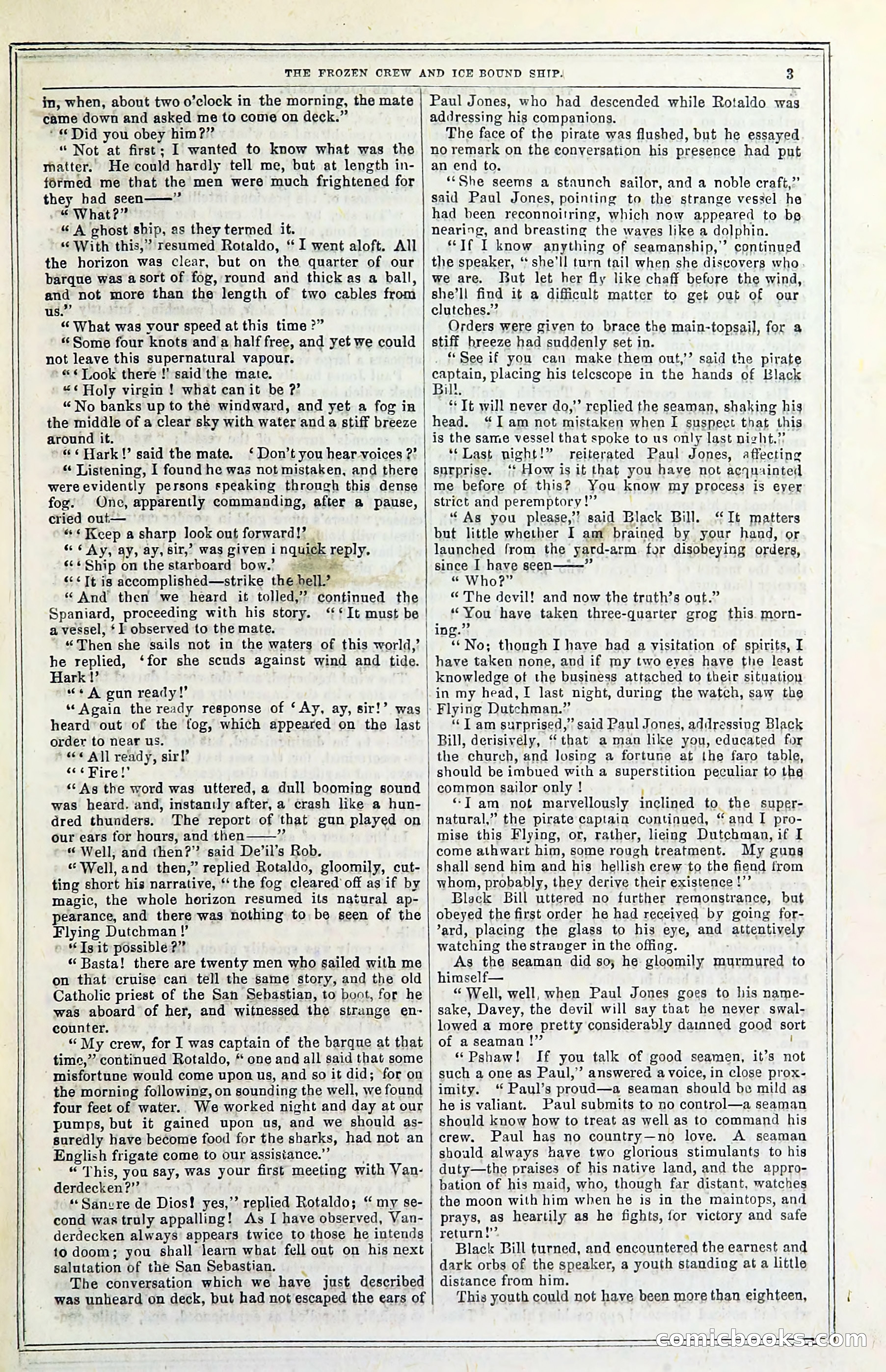
A restored page from Penny Dreadfuls, 1868. Page through the whole issue in the reader above.
📄 Transcribed text from this page (OCR, searchable)
Machine-transcribed from the original scan — historical spelling and the odd misread are preserved.
THE FROZEN CREW AND ICE BOUND SHIP: 3 in, when, about two o’clock in the morning, the mate came down and asked me to come on deck.” ‘Did you obey him?” “ Not at first; I wanted to know what was the matter. He could hardly tell me, but at length in- formed me that the men were much frightened for they had seen——” “What?” «“ A ghost ship, as they termed it. “With this,’ resumed Rotaldo, “I went aloft. All the horizon was clear, but on the quarter of our barque was asort of fog, round and thick as a ball, and not more than the length of two cables from us.” “ What was vour speed at this time ?” “Some four knots and a half free, and yet we could not leave this supernatural vapour. «6 Took there !’ said the mate. “¢ Holy virgin ! what can it be ?’ “No banks up to the windward, and yet a fog in the middle of a clear sky with water and a stiff breeze around it. . “<¢ Hark! said the mate. ‘ Don’t you hear voices ?’ “ Listening, I found he was not mistaken, and there were evidently persons speaking through this dense fog. One, apparently commanding, after a pause, cried out— | “¢ Keep a sharp look ont forward!? | “ * Ay, ay, ay, sir,’ was given i nquick reply, ‘¢¢ Ship on the starboard bow. = «<< Tt ig accomplished—strike the hell.’ “ And then we heard it tolled,’? continued the Spaniard, proceeding with his story. ‘It must be | a vessel, * l observed to the mate. “Then she sails not in the waters of this world,’ he replied, ‘for she scuds against wind and tide. Hark!’ «¢ A gun ready!’ “Again the ready response of ‘ Ay, ay, sir!’ was heard out of the fog, which appeared on the last order to near us. * «6 All ready, sir? <.¢ Kire! «‘ Ag the word was uttered, a dull booming sound was heard. and, instantly after, a crash like a hun- dred thunders. The report of that gun played on our ears for hours, and then——”’ “ Well, and then?” said De’il’s Rob. «“ Well, and then,’ replied Rotaldo, gloomily, cut- ting short his narrative, ‘‘the fog cleared off as if by magic, the whole horizon resumed its natural ap- pearance, and there was nothing to be seen of the Flying Dutchman!’ » “Is it possible?” “ Basta! there are twenty men who sailed with me on that cruise can tell the same story, and the old Catholic priest of the San Sebastian, to boot, for he was aboard of her, and witnessed the strange en- counter. “ My crew, for I was captain of the barque at that time,” continued Rotaldo, * one and all said that some ‘misfortune would come upon us, and so it did; for on the morning following, on sounding the well, we found four feet of water. We worked night and day at our pumps, but it gained upon us, and we should as- suredly have become food for the sharks, had not an English frigate come to our assisiance.”’ ; “ This, you say, was your first meeting with Yan- derdecken?”’ ‘‘Sanvre de Dios! yes,’’ replied Rotaldo; “ my se- cond was truly appalling! As I have observed, Van- derdecken always appears twice to those he intends to doom; you shall learn what fell out on his next salutation of tne San Sebastian. _ The conversation which we haye just described was unheard on deck, but had not escaped the ears of Paul Jones, who had descended while Rotaldo was addressing his companions. The face of the pirate was flushed, but he essayed no remark on the conversation his presence had put an end to. *‘She seems a staunch sailor, and a noble craft,” said Paul Jones, pointing to the strange vessel he had been reconnoitring, which now appeared to be nearing, and breasting the waves like a dolphin. “If I know anything of seamanship,” continued the speaker, ‘‘ she'll turn tail when she discovers who we are. [ut let her fly like chaff before the wind, she’ll find it a difficult matter to get out of our clutches.” Orders were given to brace the main-topsail, for a stiff hreeze had suddenly set in. “See if you can make them out,” said the pirate cepa placing his telescope in the hands of Llack ill, ** It will never do,’ replied the seaman, shaking his head. “Iam not mistaken when I suspect that this is the same vessel that spoke to us only last night.?? ‘‘Last night!” reiterated Paul Jones, affecting surprise. ‘‘ How is it that you have not acquainted me before of this? You know my process is eyer strict and peremptory!” “ As you please,?? said Black Bill. “It matters but little whether I am brained by your hand, or launched from the yard-arm for disobeying orders, since I have seen———”’ “ Who?” “ The devil! and now the truth’s out.” “You have taken three-quarter grog this. morn- 3) ‘No; though I have had a yisitation of spirits, I have taken none, and if my two eyes have tlie least knowledge of the business attached to their situation in my head, I last night, during the watch, saw the Flying Dutchman.” ‘“‘T am surprised,” said Paul Jones, addressing Black Bill, derisively, ‘that a man like you, educated for the church, and losing a fortune at the faro table, should be imbued with a superstition peculiar to the common sailor only ! ‘ ‘“-T am not marvellously inclined to the super- natural,” the pirate captain continued, “ and I pro- mise this Flying, or, rather, lieing Dutchman, if I come athwart him, some rough treatment. My guns shall send him and his hellish erew to the fiend from whom, probably, they derive their existence !”’ Black Bill uttered no further remonstrance, but obeyed the first order he had received by going for- ’ard, placing the glass to his eye, and attentively watching the stranger in the offing. As the seaman did so; he gloomily murmured to himself— “ Well, well, when Paul Jones goes to his name- sake, Davey, the devil will say that he never swal- lowed a more pretty considerably damnned good sort of a seaman !” ! ‘“ Pshaw! If you talk of good seamen, it’s not such a one as Paul,’ answerea a voice, in close prox- imity. ‘* Paul’s proud—a seaman should be mild as he is valiant. Paul submits to no control—a seaman should know how to treat as well as to command his crew. Paul has no country—no love. A seaman should always have two glorious stimulants to his duty—the praises of his native land, and the appro- bation of his maid, who, though far distant, watches the moon with him when he is in the maintops, and prays, as heartily as he fights, for victory and safe return!’’ ; Black Bill turned, and encountered the earnest and dark orbs of the speaker, a youth standing at a little distance from him. This youth could not have been more than eighteen, 10