
Penny Dreadfuls, 1867 · page 81 of 196
The Skeleton Crew; Or, Wildfire Ned — page 81: what you’re looking at
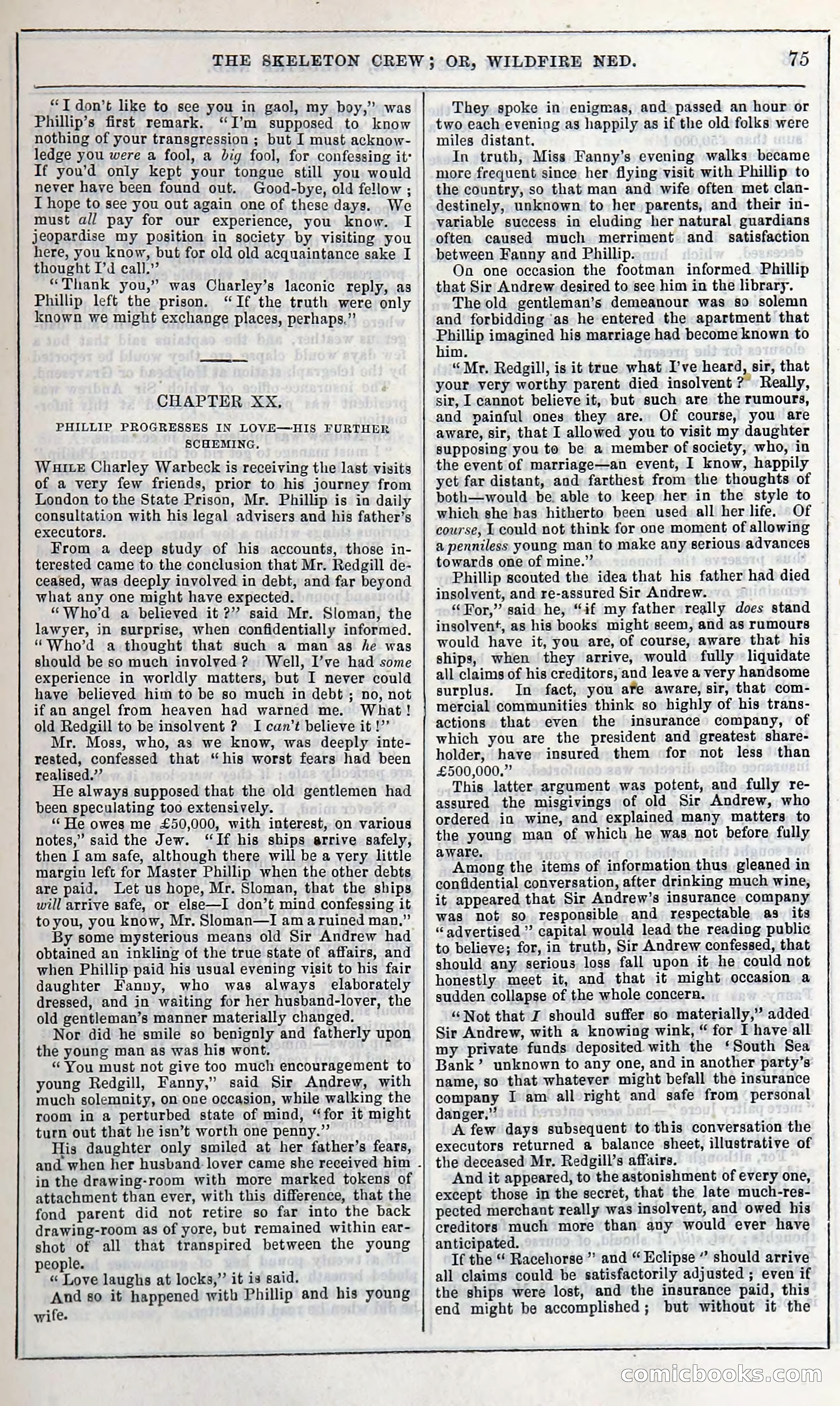
A restored page from Penny Dreadfuls, 1867. Page through the whole issue in the reader above.
📄 Transcribed text from this page (OCR, searchable)
Machine-transcribed from the original scan — historical spelling and the odd misread are preserved.
THE SKELETON CREW; OR, WILDFIRE NED. 75 “T don’t like to see you in gaol, my boy,’ was Phillip’s first BS leat Im teeth A know nothing of your transgression ; but I must acknow- ledge you were a fool, a big fool, for confessing it: If you’d only kept your tongue still you would never have been found out. Good-bye, old fellow ; I hope to see you out again one of these days. We must all pay for our experience, you know. I jeopardise my position in society by visiting you here, you know, but for old old acquaintance sake I thought I’d call.” “Thank you,” was Charley’s laconic reply, as Phillip left the prison. “If the truth were only known we might exchange places, perhaps.”’ CHAPTER XX, PHILLIP PROGRESSES IN LOVE—HIS FURTHER SCHEMING. Waite Charley Warbeck is receiving the last visits of a very few friends, prior to his journey from London to the State Prison, Mr. Phillip is in daily consultation with his legal advisers and his father’s executors. From a deep study of his accounts, those in- terested came to the conclusion that Mr. Redgill de- ceased, was deeply involved in debt, and far beyond what any one might have expected. “Who'd a believed it ?”? said Mr. Sloman, the lawyer, in surprise, when confidentially informed. “Who'd a thought that such a man as he was should be so much involyed? Well, I’ve had some experience in worldly matters, but I never could haye believed him to be so much in debt ; no, not if an angel from heaven had warned me. What! old Redgill to be insolvent ? I can’t believe it!’ Mr. Moss, who, as we know, was deeply inte- rested, confessed that “his worst fears had been realised.” He always supposed that the old gentlemen had been speculating too extensively. “ He owes me £50,000, with interest, on various notes,” said the Jew. “If his ships arrive safely, then I am safe, although there will be a very little margin left for Master Phillip when the other debts are paid. Let us hope, Mr. Sloman, that the ships will arrive safe, or else—I don’t mind confessing it to you, you know, Mr. Sloman—I am aruined man,” By some mysterious means old Sir Andrew had obtained an inkling of the true state of affairs, and when Phillip paid his usual evening visit to his fair daughter Fanny, who was always elaborately dressed, and in waiting for her husband-lover, the old gentleman’s manner materially changed. Nor did he smile so benignly and fatherly upon the young man as was his wont. “ You must not give too much encouragement to young Redgill, Fanny,” said Sir Andrew, with much solemnity, on one occasion, while walking the room in a perturbed state of mind, “for it might turn out that he isn’t worth one penny.” His daughter only smiled at her father’s fears, and when her husband: lover came she received him - in the drawing-room with more marked tokens of attachment than ever, with this difference, that the fond parent did not retire so far into the back drawing-room as of yore, but remained within ear- shot of all that transpired between the young people. « Love laughs at locks,’ it is said. And so it happened with Phillip and his young wife. They spoke in enigmas, and passed an hour or two each evening as happily as if the old folks were miles distant. In truth, Miss Fanny’s evening walks became more frequent since her flying visit with Phillip to the country, so that man and wife often met clan- destinely, unknown to her parents, and their in- variable success in eluding her natural guardians often caused much merriment and satisfaction between Fanny and Phillip. On one occasion the footman informed Phillip that Sir Andrew desired to see him in the library. The old gentleman’s demeanour was so solemn and forbidding as he entered the apartment that Phillip imagined his marriage had become known to hi m. “Mr. Redgill, is it true what I’ve heard, sir, that your very worthy parent died insolvent 2 Really, sir, I cannot believe it, but such are the rumours, and painful ones they are. Of course, you are aware, sir, that I allowed you to visit my daughter supposing you to be a member of society, who, in the event of marriage—an event, I know, happily yet far distant, and farthest from the thoughts of both—would be able to keep her in the style to which she has hitherto been used all her life. Of course, L could not think for one moment of allowing a penniless young man to make any serious advances towards one of mine.” Phillip scouted the idea that his father had died insolvent, and re-assured Sir Andrew. F “Wor,” said he, “if my father really does stand insolvent, as his books might seem, and as rumours would have it, you are, of course, aware that his ships, when they arrive, would fully liquidate all claims of his creditors, and leave a very handsome surplus. In fact, you afe aware, sir, that com- mercial communities think so highly of his trans- actions that even the insurance company, of which you are the president and greatest share- holder, have insured them for not less than £500,000.” This latter argument was potent, and fully re- assured the misgivings of old Sir Andrew, who ordered in wine, and explained many matters to the young man of which he was not before fully aware. Among the items of information thus gleaned in confidential conversation, after drinking much wine, it appeared that Sir Andrew’s insurance company was not so responsible and respectable as its “advertised” capital would lead the reading public to believe; for, in truth, Sir Andrew confessed, that should any serious loss fall upon it he could not honestly meet it, and that it might occasion a sudden collapse of the whole concera. “Not that J should suffer so materially,” added Sir Andrew, with a knowing wink, “ for I have all my private funds deposited with the ‘South Sea Bank’ unknown to any one, and in another party’s name, so that whatever might befall the insurance company I am all right and safe from personal danger,” A few days subsequent to this conversation the executors returned a balance sheet, illustrative of the deceased Mr. Redgill’s affairs. And it appeared, to the astonishment of every one, except those in the secret, that the late much-res- pected merchant really was insolvent, and owed his creditors much more than any would ever have anticipated. If the “ Racehorse ’’ and “ Eclipse ” should arrive all claims could be satisfactorily adjusted ; even if the ships were lost, and the insurance paid, this end might be accomplished; but without it the Ccomicboooks.conn