
Penny Dreadfuls, 1867 · page 82 of 196
The Skeleton Crew; Or, Wildfire Ned — page 82: what you’re looking at
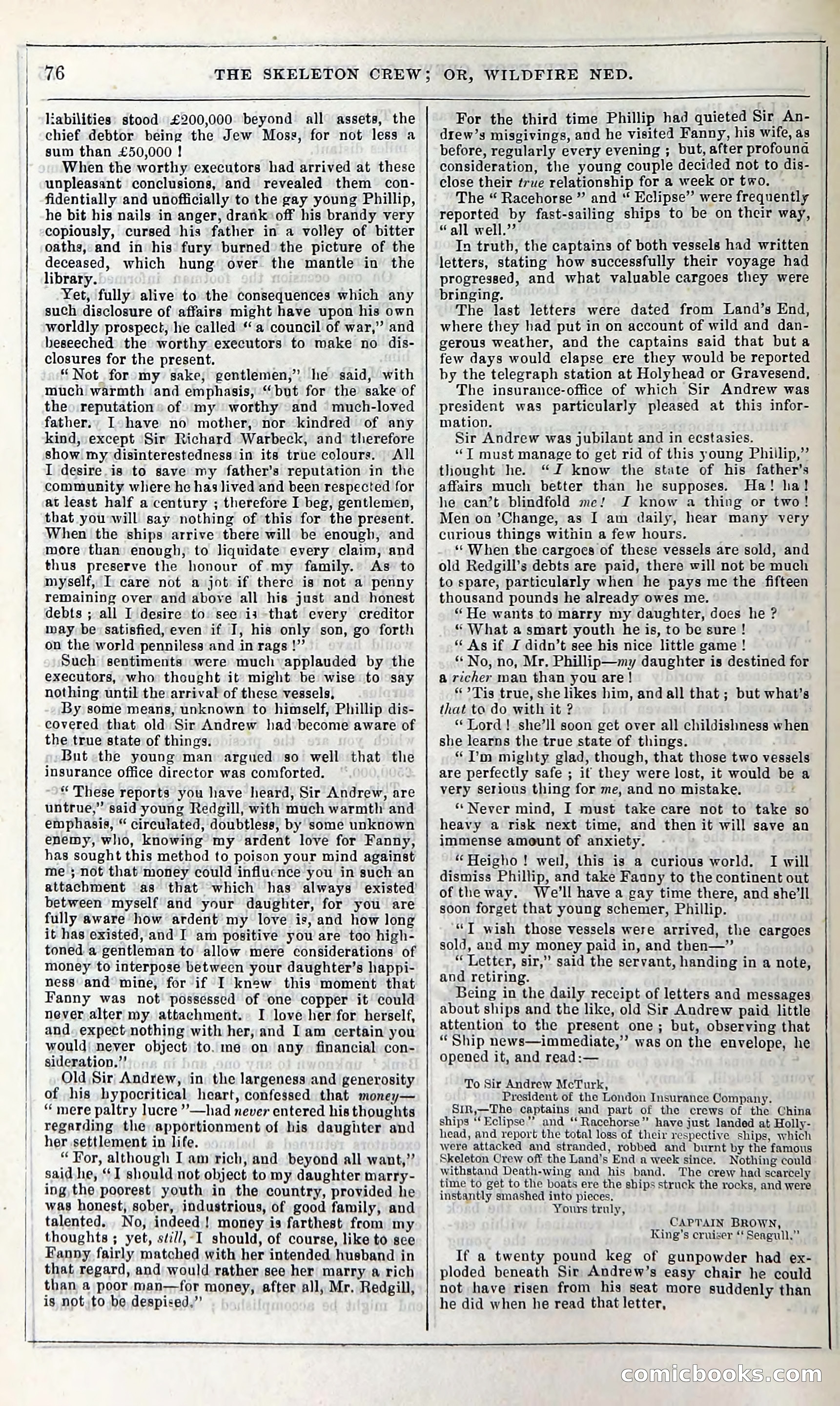
A restored page from Penny Dreadfuls, 1867. Page through the whole issue in the reader above.
📄 Transcribed text from this page (OCR, searchable)
Machine-transcribed from the original scan — historical spelling and the odd misread are preserved.
a a ee EL ALA AO rE 76 THE SKELETON CREW; OR, WILDFIRE NED. liabilities: stood £200,000 beyond all assets, the chief debtor being the Jew Moss, for not less a sum than £50,000 ! When the worthy executors had arrived at these unpleasant conclusions, and revealed them con- fidentially and unofficially to the gay young Phillip, he bit his nails in anger, drank off his brandy very copiously, cursed his father in a volley of bitter oaths, and in his fury burned the picture of the deceased, which hung over the mantle in the library. Yet, fully alive to the consequences which any such disclosure of affairs might have upon his own worldly prospect, he called ‘a council of war,” and heseeched the worthy executors to make no dis- closures for the present. “Not for my sake; gentlemen,” he said, with much warmth and emphasis, “but for the sake of the reputation of my worthy and much-loved father. I have no mother, nor kindred of any kind, except Sir Richard Warbeck, and therefore show my disinterestedness'in its true colours. All I desire.is to save my father’s reputation in the community where he has lived and been respected for at least half a century ; therefore I beg, gentlemen, that you will say nothing of this for the present. When the ships arrive there will be enough, and more than enough, to liquidate every claim, and thus preserve the honour of my family. As to myself, I care not a jot if there is not a penny remaining over and above all his just and honest debts ; all I desire to see is that every creditor may be satisfied, even if I, his only son, go forth on the world penniless and in rags !”’ Such sentiments were much applauded by the executors, who thought it might be wise to say nothing until the arrival of these vessels, By some means, unknown to himself, Phillip dis- covered that old Sir Andrew had become aware of the true state of things. But the young man argued so well that the insurance office director was comforted. “These reports you have heard, Sir Andrew, are untrue,” said young Redgill, with much warmth and emphasis, “ circulated, doubtless, by some unknown enemy, who, knowing my ardent love for Fanny, has sought this method to poison your mind against me ; not that money could influcnce you in such an attachment as that which has always existed between myself and your daughter, for you are fully aware how ardent my love is, and how long it has existed, and I am positive you are too high- toned a gentleman to allow mere considerations of money to interpose between your daughter’s happi- ness and mine, for if I knew this moment that Fanny was not possessed of one copper it could never alter my attachment. I love her for herself, and. expect nothing with her, and I am certain you would) never object to. me on any financial con- sideration.’’ Old Sir Andrew, in the largeness and generosity of his hypocritical heart, confessed that money— “‘ mere paltry lucre ’—had never entered his thoughts regarding the apportionment of his daughter and her settlement in life. “For, although I am rich, and beyond all want,’ said he, “I should not object to my daughter marry- ing, the poorest youth in the country, provided he was honest, sober, industrious, of good family, and talented. No, indeed! money is farthest from my thoughts ; yet, sti//,-I should, of course, like to see Fanny fairly matched with her intended husband in that regard, and would rather see her marry a rich than a poor man—for money, after all, Mr. Redgill, is not to be despised,”’ For the third time Phillip had quieted Sir An- drew’s misgivings, and he visited Fanny, his wife, as before, regularly every evening ; but, after profouna consideration, the young couple decided not to dis- close their true relationship for a week or two. The “ Racehorse ” and “ Eclipse” were frequently reported by fast-sailing ships to be on their way, “all well.”’ In truth, the captains of both vessels had written letters, stating how successfully their voyage had progressed, and what valuable cargoes they were bringing. The last letters were dated from Land’s End, where they had put in on account of wild and dan- gerous weather, and the captains said that buta few days would elapse ere they would be reported by the telegraph station at Holyhead or Gravesend. The insurance-office of which Sir Andrew was president was particularly pleased at this infor- mation. Sir Andrew was jubilant and in ecstasies. ‘“‘T must manage to get rid of this young Phillip,” thought he. “JZ know the state of his father’s affairs much better than he supposes. Ha! ha! he can’t blindfold me! J know a thing or two! Men on ’Change, as I am daily, hear many very curious things within a few hours. ‘* When the cargoes of these vessels are sold, and old Redgill’s debts are paid, there will not be much to spare, particularly when he pays me the fifteen thousand pounds he already owes me. “ He wants to marry my daughter, does he ? “ What a smart youth he is, to be sure! “ Asif I didn’t see his nice little game ! “No, no, Mr, Phillip—my daughter is destined for a richer man than you are! *?Tis true, she likes him, and all that; but what’s that ta do with it ? ** Lord! she’ll soon get over all childishness when she learns the true state of things. “Tm mighty glad, though, that those two vessels are perfectly safe ; if they were lost, it would be a very serious thing for me, and no mistake. ‘* Never mind, I must take care not to take so heavy a risk next time, and then it will save an immense amount of anxiety. ““Heigho ! weil, this is a curious world. I will dismiss Phillip, and take Fauny to the continent out of theway. We'll have a gay time there, and she’ll soon forget that young schemer, Phillip. “‘T wish those vessels were arrived, the cargoes sold, and my money paid in, and then—” “ Letter, sir,” said the servant, handing in a note, and retiring. Being in the daily receipt of letters and messages about ships and the like, old Sir Andrew paid little attention to the present one; but, observing that “Ship news—immediate,” was on the envelope, he opened it, and read :— To Sir Andrew McTurk, President of the London Insurance Company. SiR,—The captains and part of the crews of the China ships ‘‘Eclipse”’ and ‘‘ Racehorse’’ have just landed at Holly- head, and report the total loss of their respective ships, which were attacked and stranded, robbed and burnt by the famous Skeleton Crew off the Land’s End a week since. Nothing could withstand Death-wing and his band. The crew had scarcely time to get to the boats ere the ships struck the rocks, and were instantly smashed into pieces. Yours truly, CAPTAIN BROWN, King’s cruiser *f Seagull.” If a twenty pound keg of gunpowder had ex- ploded beneath Sir Andrew’s easy chair he could not have risen from his seat more suddenly than he did when he read that letter, ll oO Eomichooksncom