
Penny Dreadfuls, 1897 · page 43 of 52
Army and Navy Weekly — page 43: what you’re looking at
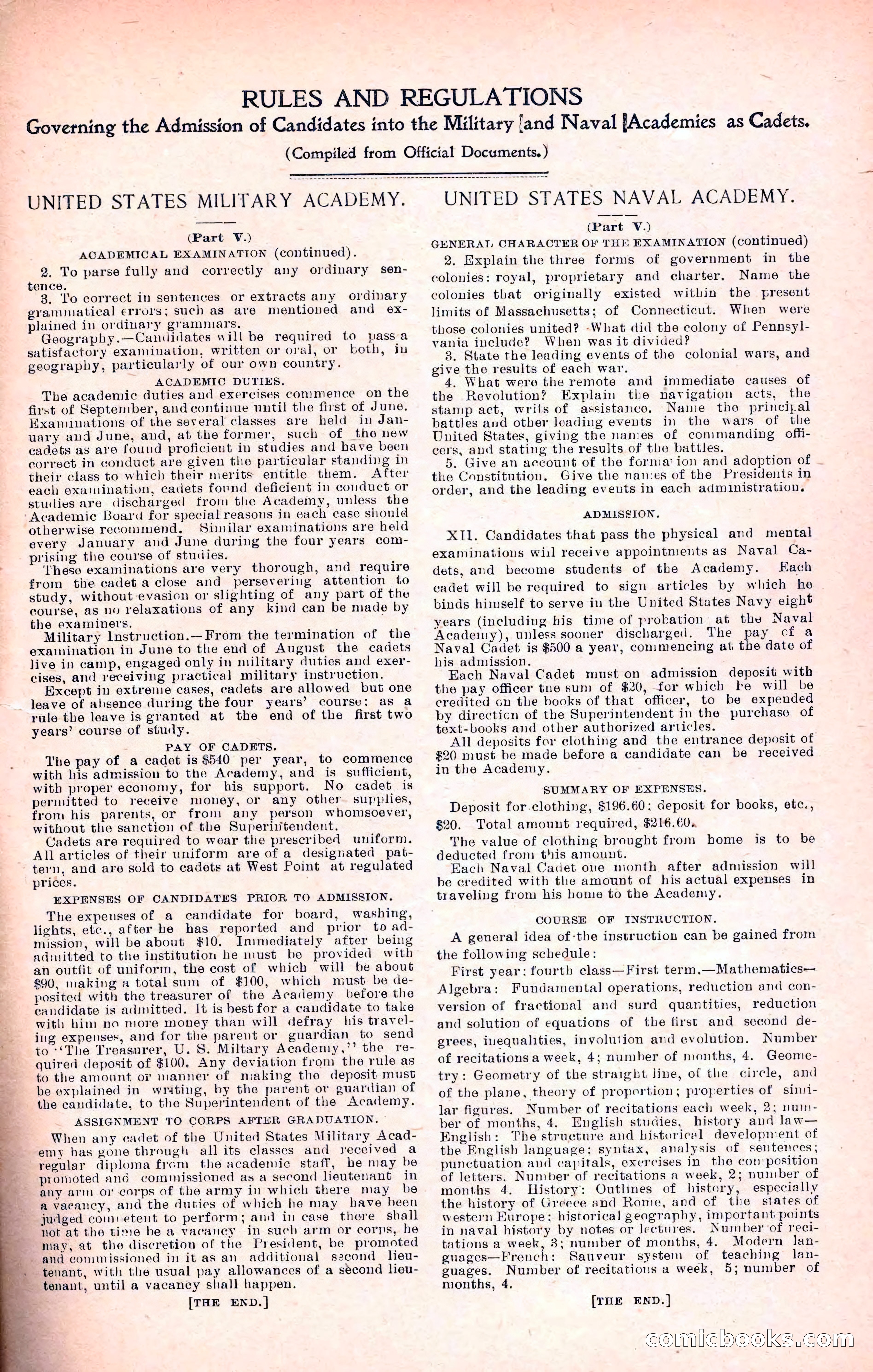
A restored page from Penny Dreadfuls, 1897. Page through the whole issue in the reader above.
📄 Transcribed text from this page (OCR, searchable)
Machine-transcribed from the original scan — historical spelling and the odd misread are preserved.
and commissioned In it as an RULES AND REGULATIONS Governing the Admission of Candidates into the Military [and Naval [Academies as Cadets. (Compiled from Official Documents. ) UNITED STATES MILITARY ACADEMY. (Part V.) ACADEMICAL EXAMINATION (continued). 2. To parse fully and correctly any ordinary sen- tence. 3. To correct in sentences or extracts any ordinary grammatical errors; such as are mentioned and ex- plained in ordinary grammars. Geograpbhy.—Candidates will be required to passa satisfactory examination, written or oral, or both, jn geography, particularly of our own country. ACADEMIC DUTIES. The academic duties and exercises commence on the first of September, and continue until the first of June. Examinations of the several classes are held in Jan- uary and June, and, at the former, such of the new cadets as are found proficient in studies and have been correct in conduct are given the particular standing in their class to which their merits entitle them. After each exanination, cadets found deficient in conduct or studies are discharged from the Academy, unless the ‘Academic Board for special reasous in each case should otherwise reconimmend, Similar examinations are held every January and June during the four years com- prising the course of studies. hese examinations are very thorough, and require from the cadet a close and persevering attention to study, without evasion or slighting of any part of the course, as no relaxatious of any kind can be made by the examiners. Military Instruction.—From the termination of the exalnination in June to the end of August the cadets live in camp, engaged only in military duties and exer- cises, and receiving practical military instruction. Except in extreme cases, cadets are allowed but one leave of absence during the four years’ course; as a rule the leave is granted at the end of the first two years’ course of study. PAY OF CADETS. The pay of a cadet is $540 per year, to commence with his admission to the Academy, and is sufficient, with proper economy, for his support. No cadet is permitted to receive money, or any other supplies, from his parents, or from any person whomsoever, without the sanction of the Superintendent. Cadets are required to wear the prescribed uniform. All articles of their uniform are of a designated pat- tern, and are sold to cadets at West Point at regulated prices. EXPENSES OF CANDIDATES PRIOR TO ADMISSION. The expeuses of a candidate for board, washing, lights, etc., after he has reported and prior to ad- mission, will be about $10. Inimediately after being admitted to the institution he must be provided with an outfit of uniform, the cost of which will be about #90, making a total sum of $100, which must be de- posited with the treasurer of the Academy before the caididate is admitted. It is hest for a candidate to take with him no more money than will defray his travel- ing expenses, and for the parent or guardian to send to ‘¢*The Treasurer, U. 8. Miltary Academy,’’ the re- quired deposit of $100. Any deviation from the rule as to the amount or manner of making the deposit must be explained in wrating, by the parent or euardian of the candidate, to the Superintendent of the Academy. ASSIGNMENT TO CORPS AFTER GRADUATION. © When any cadet of the United States Military Acad- emy has gone through all its classes and received a regular diploma from the academic staff, he may be promoted ang commissioned as a second lieutenant in any arm or corps of the army in which there may be a vacaucy, and the duties of which he may have been judged comnetent to perform; and in case there shall not at the time be a vaeancy in such arm or corns, he may, at the discretion of the President, be promoted additional sacond_ lieu- tenant, with the usual pay allowances of a second lieu- tenaut, until a vacancy shall happen. [THE END.] UNITED STATES NAVAL ACADEMY. (Part V.) GENERAL CHARACTER OF THE EXAMINATION (continued) 2. Explain the three forms of government in the colonies: royal, proprietary and charter. Name the colonies that originally existed within the present limits of Massachusetts; of Connecticut. When were those colonies united? -What did the colony of Pennsyl- vyania include? When was it divided? 3. State the leading events of the colonial wars, and give the results of each war. 4. What were the remote and immediate causes of the Revolution? Explain the navigation acts, the stanip act, writs of assistance. Name the princizal battles and other leading events in the wars of the United States, giving the names of commanding offi- cers, and stating the results of the battles. 5. Give an account of the forma‘ion and adoption of the Constitution. Give the nan:es of the Presidents in order, and the leading events in each administration. ADMISSION. XI1. Candidates that pass the physical and mental examinations wil receive appointments as Naval Ca- dets, and become students of the Academy. Each cadet will be required to sign articles by which he binds himself to serve in the United States Navy eight years (including his time of probation at the Naval Academy), unless sooner discharged. The pay of a Naval Cadet is $500 a year, commencing at the date of his admission, Each Naval Cadet must on admission deposit: with the pay officer tne sum of $20, for which be will be credited on the books of that officer, to be expended by directicn of the Superintendent in the purchase of text-books and other authorized articles. All deposits for clothing and the entrance deposit of #2() must be made before a candidate can be received in the Academy. SUMMARY OF EXPENSES. Deposit for-clothing, $196.60: deposit for books, etc., $20. Total amount required, $216.60. The value of clothing brought from home is to be deducted from this amount. Each Naval Cadet one month after admission will be credited with the amount of his actual expenses in traveling from his home to the Academy. COURSE OF INSTRUCTION. A general idea of -the instruction can be gained from the following schedule: First year; fourth class—First term.—Mathematics— Algebra: Fundamental operations, reduction and con- version of fractional and surd quantities, reduction and solution of equations of the first and second de- grees, inequalities, involution aud evolution. Number of recitations a week, 4; number of months, 4. Geome- try: Geometry of the straight line, of the circle, and of the plane, theory of propertion; properties of simi- lar figures. Number of recitations each week, 2; num- ber of months, 4. English studies, history and law— English: The structure and historical development of the English language; syntax, analysis of sentences; punctuation and capitals, exercises In the con position of letters. Number of recitations a week, 2; nuniber of months 4. History: Outlines of history, especially the history of Greece and Rome, and of the states of western Europe; historical geography, important points in naval history by notes or lectures. Number of reci- tations a week, 3; number of months, 4. Modern lan- guages—French: Sauveur system of teaching lan- guages. Number of recitations a week, 5; number of months, 4. [THE END.] COMMIELOOOKS .EO