
Penny Dreadfuls, 1897 · page 44 of 52
Army and Navy Weekly — page 44: what you’re looking at
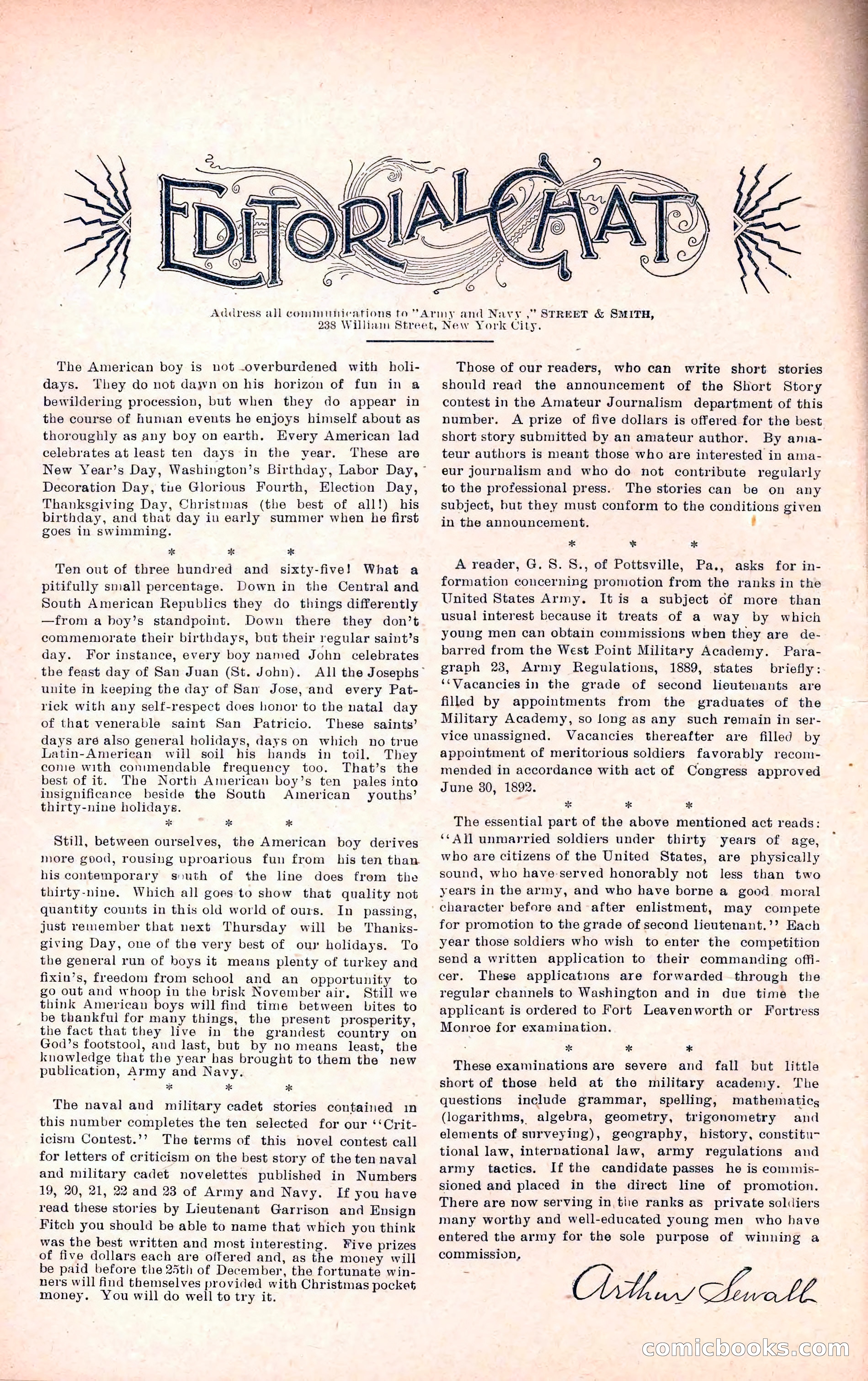
A restored page from Penny Dreadfuls, 1897. Page through the whole issue in the reader above.
📄 Transcribed text from this page (OCR, searchable)
Machine-transcribed from the original scan — historical spelling and the odd misread are preserved.
Address all connnunications to "Army and Navy ,” STREET & SMITH, 238 William Street, New York City. The American boy is not -overburdened with holi- days. They do not dajn on his horizon of fun in a bewildering procession, but when they do appear in the course of human eveuts he enjoys himself about as thoroughly as any boy on earth. Every American lad celebrates at least ten days in the year. These are New Year’s Day, Washington’s Birthday, Labor Day, © Decoration Day, tue Glorious Fourth, Election Day, Thanksgiving Day, Christmas (the best of all!) his birthday, and that day iu early summer when he first goes in swimming. oe * * Ten out of three hundred and sixty-five! What a pitifully small percentage. Down in the Central and South American Republics they do things differently —from a boy’s standpoint. Down there they don’t commeniorate their birthdays, but their regular saint’s day. For instance, every boy named John celebrates the feast day of San Juan (St. John). unite in keeping the day of San Jose, and every Pat- rick with any self-respect does honor to the natal day of that venerable saint San Patricio. These saints’ days aré also general holidays, days on which no true Latin-American will soil his hands in toil. They come with conimendable frequency too. That’s the best of it. The North American boy’s ten pales into insignificance beside the South American youths’ thirty-nine holidays. Still, between ourselves, the American boy derives more good, rousing uproarious fun from his ten than his contemporary south of the line does from the thirty-nine. Which all goes to show that quality not quantity counts in this old world of ours. In passing, just remember that next Thursday will be Thaniks- giving Day, one of the very best of our holidays. To the general run of boys it means plenty of turkey and fixin’s, freedom from school and an opportunity to go out and whoop in the brisk November air. Still we think American boys will find time between bites to be thankful for many things, the present prosperity, the fact that they live in the grandest country on God’s footstool, and last, but by no means least, the knowledge that the year has brought to them the new publication, Army and Navy. ot x * The naval aud military cadet stories contained in this number completes the ten selected for our ‘‘Crit- icism Contest.’? The terms of this novel contest call for letters of criticism on the best story of the ten naval and military cadet novelettes published in Numbers 19, 20, 21, 22 and 23 of Army and Navy. If you have read these stories by Lieutenant Garrison and Ensign Fitch you should be able to name that which you think was the best written and most interesting. ive prizes of five dollars each are offered and, as the money will be paid before the 25th of December, the fortunate win- ners will find themselves provided with Christmas pocket money. You will do well to try it. All the Josephs ~ Those of our readers, who can write short stories should read the announcement of the Short Story contest in the Amateur Journalism department of this number. <A prize of five dollars is offered for the best short story submitted by an amateur author. By ania- teur authors is meant those who are interested in ama- eur journalism and who do not contribute regularly to the professional press. The stories can be on any subject, but they must conform to the conditions given in the announcement. ' * * a A reader, G. 8. S., of Pottsville, Pa., asks for in- formation concerning promotion from the ranks in the United States Army. It is a subject of more than usual interest because it treats of a way by which young men can obtain commissions when they are de- barred from the West Point Military Academy. Para- graph 23, Army Regulations, 1889, states briefly: ‘‘Vacancies in the grade of second lieutenants are filled by appointments from the graduates of the Military Academy, so long as any such remain in ser- vice unassigned. Vacancies thereafter are filled by appointment of meritorious soldiers favorably recom- mended in accordance with act of Congress approved June 80, 1892. The essential part of the above mentioned act reads: ‘*All unmarried soldiers under thirty years of age, who are citizens of the United States, are physically sound, who have-served honorably not less than two years in the army, and who have borne a good moral character before and after enlistment, may compete for promotion to the grade of second lieutenant.’’ Each year those soldiers who wish to enter the competition send a written application to their commanding offi- cer. These applications are forwarded through the regular channels to Washington and in due time the applicant is ordered to Fort Leavenworth or Fortress Monroe for examination. x * * These examinations are severe and fall but little short of those held at the military academy. The questions include grammar, spelling, mathematics (logarithms, algebra, geometry, trigonometry and elements of surveying), geography, history, constitu- tional law, international law, army regulations and army tactics. If the candidate passes he is commis- sioned and placed in the direct line of promotion. There are now serving in tiie ranks as_ private soldiers many worthy and well-educated young men who have entered the army for the sole purpose of winning a commission, (C© COmMICLOOOKS