
Penny Dreadfuls, 1868 · page 230 of 400
Black Bess; or, The Knight of the Road — A Tale of the Good Old Times — page 230: what you’re looking at
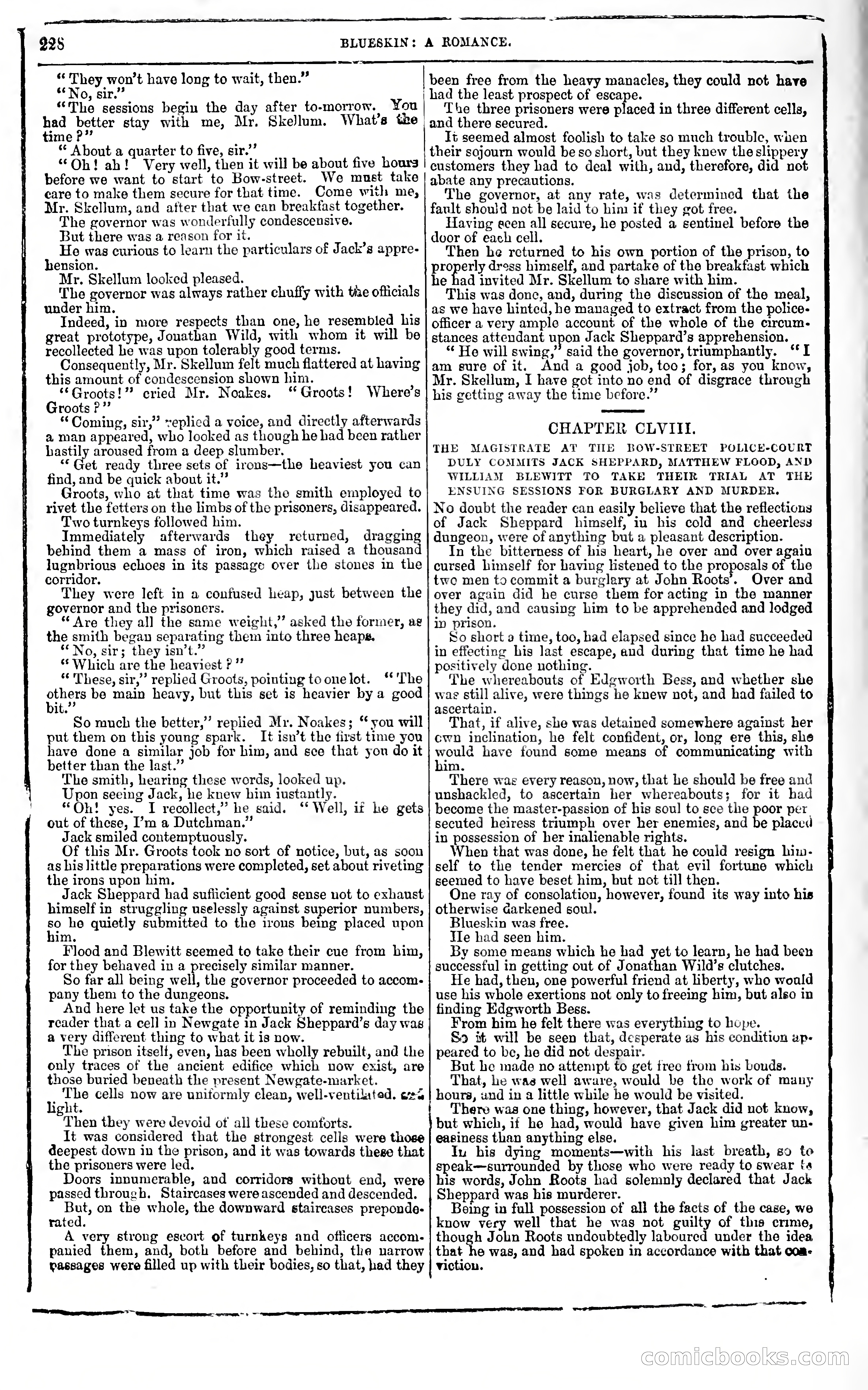
A restored page from Penny Dreadfuls, 1868. Page through the whole issue in the reader above.
📄 Transcribed text from this page (OCR, searchable)
Machine-transcribed from the original scan — historical spelling and the odd misread are preserved.
poe TOE AION a IE NTT tO EOE at I EI EEE LO A TT BLUESKIN: A ROMANCE. 225 “They won’t have long to wait, then.” **No, sir.” “The sessions begin the day after to-morrow. You had better stay with me, Mr. SkeJlum. What’s the time P” “ About a quarter to five, sir.”’ “Oh! ah! Very well, then it will be about five bours before we want to start to Bow-street. We must take care to make them secure for that time. Come with me, Mr. Skellum, and after that we can breakfast together. The governor was wonderfully condescensive. But there was a reason for it. He was curious to learn the particulars of Jack’s appre- hension. Mr. Skellum looked pleased. ., The governor was always rather chuffy with the officials under him. ; Indeed, in more respects than one, he resembled his great prototype, Jouathan Wild, with whom it will be recollected he was upon tolerably good terms. Consequently, Mr. Skellum felt much flattered at having this amount of condescension shown him. ‘¢Groots!”? cried Mr. Noakes. ‘Groots! Where’s Groots P” “Coming, sir,” veplicd a voice, and directly afterwards a man appeared, who looked as though he had been rather hastily aroused from a deep slumber. “Get ready three sets of irons—the heaviest you can find, and be quick about it.” Groots, who at that time was the smith employed to rivet the fetters on the limbs of the prisoners, disappeared. Two turnkeys followed him. Immediately afterwards they returned, dragging behind them a mass of iron, which raised a thousand lugnbrious echoes in its passage over the stones in the corridor. They were left in o confused heap, just between the governor and the prisoners. ** Are they all the same weight,” asked the former, ag the smith began separating them into three heaps. ‘* No, sir; they isn’t.” * Which are the heaviest P ”’ ** These, sir,” replied Groots, pointing toonelot. “ ‘The cee be main heavy, but this set is heavier by a good it. So much the better,’ replied Mr. Noakes; “ you will put them on this young spark. It isn’t the first time you have done a similar job for him, and sce that you do it better than the last.” The smith, hearing these words, looked up. Upon seeing Jack, he knew him iustantly. “Oh! yes. I recollect,’ he said. ‘*‘ Well, if he gets out of these, I’m a Dutchman.” Jack smiled contemptuously. Of this Mr. Groots teok no sort of notice, but, as soon ag his little preparations were completed, set about riveting the irons upon him. Jack Sheppard had sufiicient good sense not to exhaust himself in struggling uselessly against superior numbers, so he quietly submitted to the irons being placed upon im. Flood and Blewitt seemed to take their cue from him, for they behaved in a precisely similar manner. So far all being well, the governor proceeded to accom. pany them to the dungeons. And here let us take the opportunity of reminding the reader that a cell in Newgate in Jack Sheppard’s day wag a very different thing to what it is now. The prison itselt, even, has been wholly rebuilt, and the only traces of the ancient edifice which now exist, are those buried beneath the present Newgate-market. i ed cells now are uniformly clean, well-ventilated. exe gut. Then they were devoid of all these comforts. It was considered that the strongest cells were those deepest down iu the prison, and it was towards these that the prisoners were led. Doors innumerable, and corridors without end, were passed through. Staircases were ascended and descended. But, on the whole, the downward staircases preponde- rated. A very strong escort of turnkeys and officers accom- panied them, and, both before and behind, the narrow rassages were filled up with their bodies, so that, had they been free from the heavy manacles, they could not have had the least prospect of escape. The three prisoners were placed in three different cells, and there secured. It seemed almost foolish to take so much trouble, when their sojourn would be so short, but they knew the slippery customers they had to deal with, aud, therefore, did not abate any precautions. The governor, at any rate, was determined that the fault shoujd not be laid to him if they got free. Having acen all secure, he posted a sentinel before the door of each cell. Then he returned to his own portion of the prison, to properly dress himself, and partake of the breakfast which he had invited Mr. Skellum to share with him. This was done, and, during the discussion of the meal, as we have hinted, he managed to extract from the police- officer a very ample account of the whole of the circum. stances attendant upon Jack Sheppard’s apprehension. “ He will swing,” said the governor, triumphantly. ‘I am sure of it. And a good job, too; for,as you know, Mr. Skellum, I have got into no end of disgrace through his getting away the time before.” CHAPTER CLVIII. THE MAGISTRATE AT TITE BOW-STREET POLICE-COURT DULY COMMITS JACK SHEPPARD, MATTHEW FLOOD, AND WILLIAM BLEWITT TO TAKE THEIR TRIAL AT THE ENSUING SESSIONS FOR BURGLARY AND MURDER. No doubt the reader can easily believe that the reflections of Jack Sheppard himself, in his cold and cheerless dungeon, were of anything but a pleasant description. In the bitterness of his heart, he over and over agaiu cursed himself for having hstened to the proposals of the two men to commit a burglary at John Roots’. Over and over again did he curse them for acting in the manner they did, and causing him to be apprehended and lodged in prison. So short a time, too, had elapsed since he had succeeded in effecting his last escape, aud during that time he had positively done nothing. The whereabouts of Edgworth Bess, and whether she wag still alive, were things he knew not, and had failed to ascertain. That, if alive, she was detained somewhere against her cwn inclination, he felt confident, or, long ere this, she nome have found some means of communicating with mm. There wae every reason, now, that he should be free and uushackled, to ascertain her whereabouts; for it had become the master-passion of his sou] to sce the poor per secuted heiress triumph over her enemies, and be piaced in possession of her inalienable rights. When that was done, he felt that he could resign him- self to the tender mercies of that evil fortune which seemed to have beset him, but not til! then. One ray of consolation, however, found its way into his otherwise carkened soul. Blueskin was free. IIe had seen him. By some means which he had yet to learn, he had been successful in getting out of Jonathan Wild’s clutches. He had, then, one powerful friend at liberty, who would use his whole exertions not only to freeing him, but also in finding Edgworth Bess. From him he felt there was everything to hope. So it will be seen that, desperate as his condition ap- peared to be, he did not despair. But he made no attenpt to get tree from his bouds. That, he was well aware, would be tho work of many hours, and in a little while he would be visited. There waa one thing, however, that Jack did not know, but which, if he had, would have given him greater un- easiness than anything else. Iu his dying moments—with his last breath, so to speak—surrounded by those who were ready to swear ta his words, John Roots had solemnly declared that Jack Sheppard was his murderer. Being in full possession of all the facts of the case, we know very well that he was not guilty of this crime, though John Roots undoubtedly laboured under the idea that he was, and had spoken in accordance with that coa- viction. >