
Penny Dreadfuls, 1868 · page 231 of 400
Black Bess; or, The Knight of the Road — A Tale of the Good Old Times — page 231: what you’re looking at
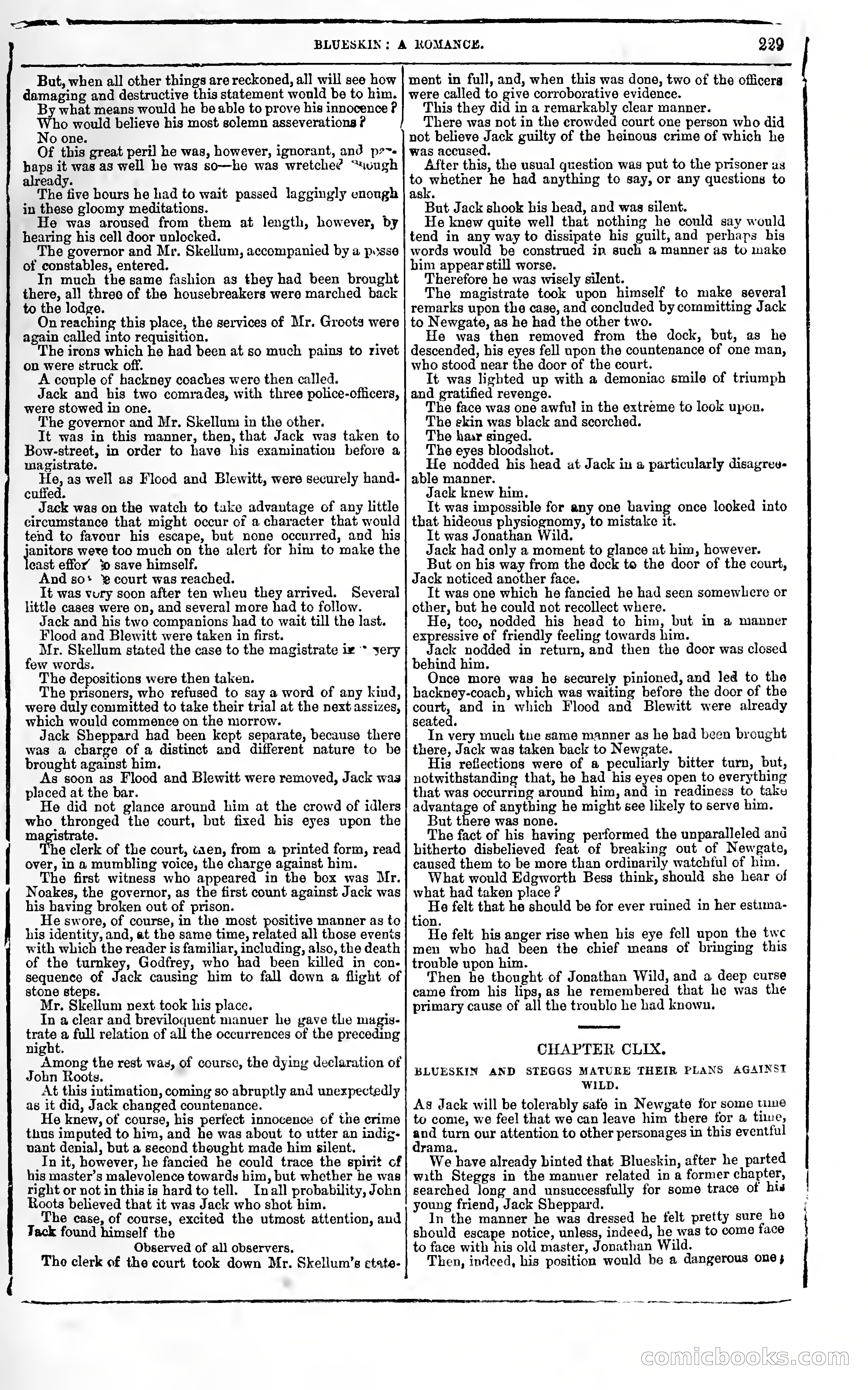
A restored page from Penny Dreadfuls, 1868. Page through the whole issue in the reader above.
📄 Transcribed text from this page (OCR, searchable)
Machine-transcribed from the original scan — historical spelling and the odd misread are preserved.
Cn — But, when all other things are reckoned, all will see how damaging and destructive this statement would be to him. By what means would he beable to prove his innocence ? Who would believe his most solemn asseverations ? No one. Of this great pert] he was, however, ignorant, and p?~- haps it was as well he was so—he was wretche¢ “wugh already. The five hours he had to wait passed laggingly enough in these gloomy meditations. He was aroused from them at length, however, by hearing his cell door unlocked. The governor and Mr. Skellum, accompanied by a pusse of constables, entered. In much the same fashion as they had been brought there, all three of the housebreakers were marched back to the lodge. On reaching this place, the services of Mr. Groots were again called into requisition. The irons which he had been at so much pains to rivet on were struck off. A couple of hackney coaches were then called. Jack and his two comrades, with three police-officers, were stowed in one. The governor and Mr. Skellum in the other. It was in this manner, then, that Jack was taken to Bow-street, in order to have his examination before a magistrate. ie as well as Flood and Blewitt, were securely hand- cuffed. Jack was on the watch to take advantage of any little circumstance that might occur of a character that would tend to favour his escape, but none occurred, and his Haulers were too much on the alert for him to make the east effor to save himself. And so+ court was reached. It was vury soon after ten wheu they arrived. Several little cases were on, and several more had to follow. Jack and his two companions had to wait till the last. Flood and Blewitt were taken in first. Mr. Skellum stated the case to the magistrate ix * yery few words. The depositions were then taken. The prisoners, who refused to say a word of any kind, were duly committed to take their trial at the next assizes, which would commence on the morrow. Jack Sheppard had been kept separate, because there was a charge of a distinct and different nature to be brought against him. As soon as Flood and Blewitt were removed, Jack was placed at the bar. He did not glance around him at the crowd of idlers who thronged the court, but fixed his eyes upon the magistrate. he clerk of the court, taen, from a printed form, read over, in a mumbling voice, the charge against him. The first witness who appeared in the box was Mr. Noakes, the governor, as the first count against Jack was his having broken out of prison. He swore, of course, in the most positive manner as to his identity, and, at the same time, related all those evenis with which the reader is familiar, including, also, the death of the turnkey, Godfrey, who had been killed in con- sequence of Jack causing him to fall down a flight of stone steps. Mr. Skellum next took his place. In a clear and breviloquent manuer he gave the magis- pas full relation of all the occurrences of the preceding night. Among the rest was, of course, the dying declaration of John Roots. At this intimation, coming so abruptly and unexpectedly as it did, Jack changed countenance. He knew, of course, his perfect innocence of the crime thus imputed to him, and he was about to utter an indig- vant denial, but a second thought made him silent. In it, however, he fancied he could trace the spirit cf his master’s malevolence towards him, but whether he was right or not in this is hard to tell. Inall probability, John Roots believed that it was Jack who shot him. The case, of course, excited the utmost attention, and Tack found himself the Observed of all observers. The clerk of the court took down Mr. Skellum’s etate- ce, arn re oe TE BLUESKIN: A KOMANCE. 229 ment in full, and, when this was done, two of the officers were called to give corroborative evidence. This they did in a remarkably clear manner. There was not in the crowded court one person who did not believe Jack guilty of the heinous crime of which he was accused. After this, the usual question was put to the prisoner as plete he had anything to say, or any questions to ask. But Jack shook his head, and was silent. He knew quite well that nothing he could say would tend in any way to dissipate his guilt, and perhaps his words would be construed in such a manner as to make him appear still worse. Therefore he was wisely silent. The magistrate took upon himself to make several remarks upon the case, and concluded by committing Jack to Newgate, as he had the other two. He was then removed from the dock, but, as he descended, his eyes fell upon the countenance of one man, who stoed near the door of the court. It was lighted up with a demoniac smile of triumph and gratified revenge. The face was one awful in the extreme to look upon. The ekin was black and scorched. The har singed. The eyes bloodshot. He nodded his head at Jack in a particularly disagree- able manner. Jack knew him. It was impossible for any one having once looked into that hideous physiognomy, to mistake it. It was Jonathan Wild. Jack had only a moment to glance at him, however. But on his way from the dock to the door of the court, Jack noticed another face. It was one which he fancied he had seen somewlere or other, but he could not recollect where. He, too, nodded his head to him, but m @ manner expressive of friendly feeling towards him. Jack nodded in return, and then the door was closed behind him. Once more was he securely pinioned, and led to the backney-coach, which was waiting before the door of the court, and in which Flood and Blewitt were already seated. In very much: tue same manner as he had been breught there, Jack was taken back to Newgate. His reflections were of a peculiarly bitter turn, but, notwithstanding that, he had his eyes open to everything that was occurring around him, and in readiness to take advantage of anything he might see likely to serve him. But there was none. The fact of his having performed the unparalleled and hitherto disbelieved feat of breaking out of Newgate, caused them to be more than ordinarily watchful of him. What would Edgworth Bess think, should she hear of what had taken place ? He felt that he should be for ever ruined in her estima- tion. He felt his anger rise when his eye fell upon the twe men who had been the chief means of bringing this trouble upon him. Then he thought of Jonathan Wild, and a deep curse came from his lips, as he remembered that he was the primary cause of all the troublo he had knowu. CHAPTER CLIX. BLUESKIN AND STEGGS MATURE THEIR PLANS AGAINST WILD. As Jack will be tolerably sate in Newgate for some time to conie, we feel that we can leave him there for a time, a turn our attention to other personages in this eventful rama. We have already hinted that Blueskin, after he parted with Steggs in the manuer related in a former chapter, searched long and unsuccessfully for some trace of hts young friend, Jack Sheppard. In the manner he was dressed he felt pretty sure he should escape notice, unless, indeed, he was to come face to face with his old master, Jonathan Wild. Then, indeed, his position would be a dangerous one} A rm es pt crete ce at ant I gen EO DOO C SS (SO) 5}