
Penny Dreadfuls, 1858 · page 265 of 400
The Young Duchess; or, Memoirs of a Lady of Quality — page 265: what you’re looking at
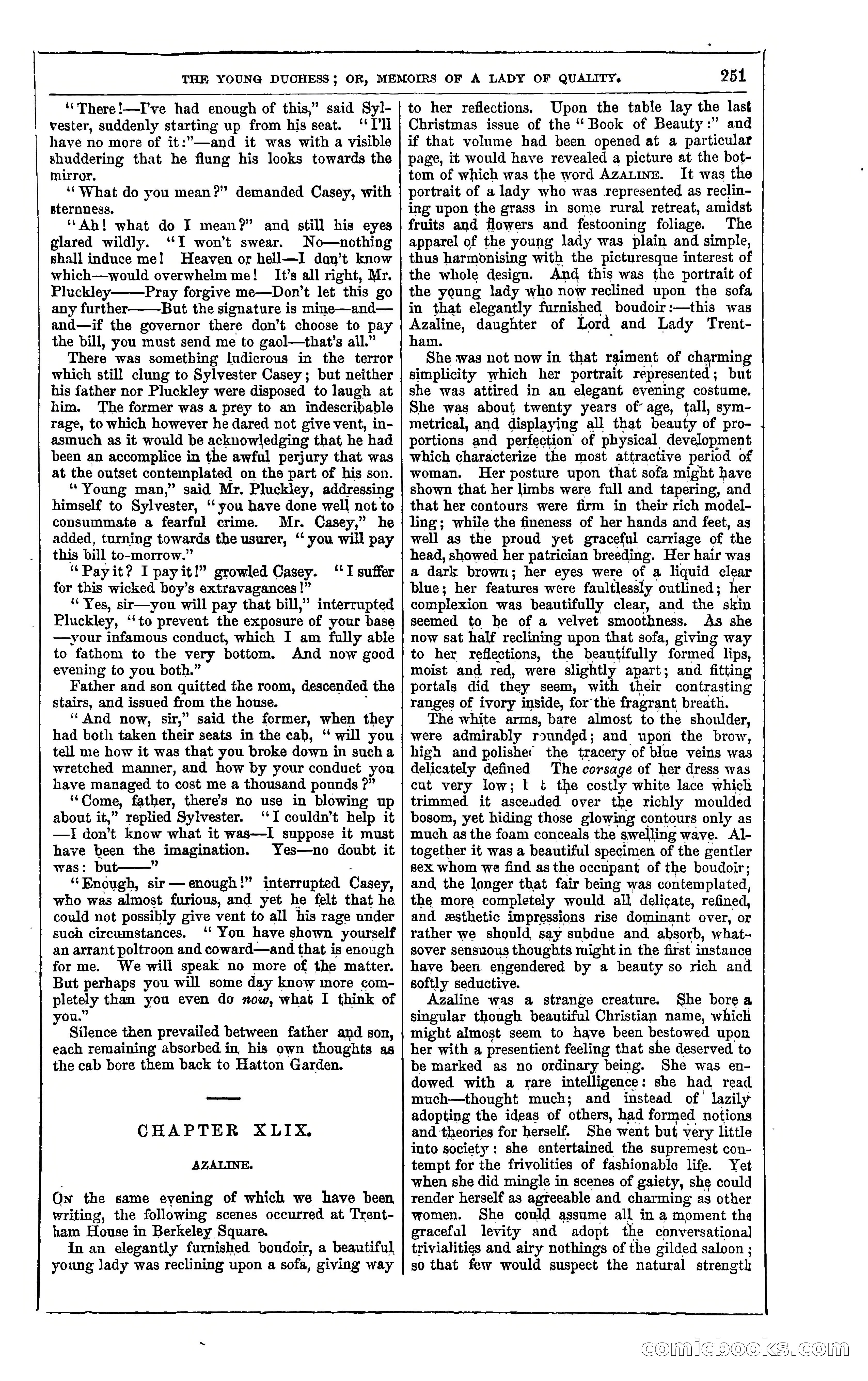
A restored page from Penny Dreadfuls, 1858. Page through the whole issue in the reader above.
📄 Transcribed text from this page (OCR, searchable)
Machine-transcribed from the original scan — historical spelling and the odd misread are preserved.
THE YOUNG DUCHESS; OR, MEMOIRS OF A LADY OF QUALITY. @ a amt tO a AOR SP TO te Na AE SET et St tO re EI a STS 251 ‘‘There!—I’ve had enough of this,” said Syl- vester, suddenly starting up from his seat. “Tl have no more of it:”—and it was with a visible shuddering that he flung his looks towards the mirror. ‘What do you mean?” demanded Casey, with sternness. ‘‘Ah! what do I mean?” and still his eyes glared wildly. “J won’t swear. No—nothing shall induce me! Heaven or hell—I don’t know which—would overwhelm me! It’s all right, Mr. Pluckley: Pray forgive me—Don’t let this go any further But the signature is mine—and— and—if the governor there don’t choose to pay the bill, you must send me to gaol—that’s all.” There was something Iudicrous in the terror which still clung to Sylvester Casey; but neither his father nor Pluckley were disposed to laugh at him. The former was a prey to an indescribable rage, to which however he dared not give vent, in- asmuch as it would be acknowledging that he had been an accomplice in the awful perjury that was at the outset contemplated on the part of his son. “Young man,” said Mr. Pluckley, addressing himself to Sylvester, “‘ you have done well not to consummate a fearful crime. Mr. Casey,” he added, turning towards the usurer, “‘ you will pay this bill to-morrow.” “Payit? I payit!’ growled Casey. for this wicked boy’s extravagances !” “Yes, sir—you will pay that bill,” interrupted Pluckley, ‘‘to prevent the exposure of your base —your infamous conduct, which I am fully able to fathom to the very bottom. And now good evening to you both.” Father and son quitted the room, descended the stairs, and issued from the house. 6 And now, sir,” said the former, when they had both taken their seats in the cab, “ will you tell me how it was that you broke down in sucha wretched manner, and how by your conduct you have managed to cost me a thousand pounds ?” “Come, father, there’s no use in blowing up about it,” replied Sylvester. ‘I couldn’t help it —I don’t know what it was—I suppose it must have been the imagination. Yes—no doubt it was: but——” “Enough, sir—enough!” interrupted Casey, who was almost furious, and yet he felt that he could not possibly give vent to all his rage under such circumstances. ‘ You have shown yourself an arrant poltroon and coward—and that is enough forme. We will speak no more of the matter. But perhaps you will some day know more com- pletely than you even do #ow, what I think of ou.” Silence then prevailed between father and son, each remaining absorbed in his own thoughts as the cab bore them back to Hatton Garden. “TY suffer Sy CHAPTER XLIX. AZALINE. On the same evening of which we have been writing, the following scenes occurred at Trent- ham House in Berkeley Square. In an elegantly furnished boudoir, a beautiful young lady was reclining upon a sofa, giving way to her reflections. Upon the table lay the last Christmas issue of the Book of Beauty:” and if that volume had been opened at a particular page, it would have revealed a picture at the bot- tom of which was the word AzALINE. It was the portrait of a lady who was represented as reclin- ing upon the grass in some rural retreat, amidst fruits and flowers and festooning foliage. The apparel of the young lady was plain and simple, thus harmonising with the picturesque interest of the whole design. And this was the portrait of the young lady who now reclined upon the sofa in that elegantly furnished boudoir:—this was Azaline, daughter of Lord and Lady Trent- ham. She was not now in that raiment of charming simplicity which her portrait represen ted; but she was attired in an elegant evening costume. She was about twenty years of age, tall, sym- metrical, and displaying all that beauty of pro- portions and perfection of physical development which characterize the most attractive period of woman. Her posture upon that sofa might have shown that her limbs were full and tapering, and that her contours were firm in their rich model- ling; while the fineness of her hands and feet, as well as the proud yet graceful carriage of ‘the head, showed her patrician breeding. Her hair was a dark brown; ; her eyes were of a liquid clear blue; her features were faultlessly outlined; her complexion was beautifully clear, and the skin seemed to be of a velvet smoothness. As she now sat half reclining upon that sofa, gi way to her reflections, the beautifully met lips, moist and red, were slightly apart; and fitting portals did they seem, with their contrasting ranges of ivory inside, for the fragrant breath. The white arms, bare almost to the shoulder, were admirably rounded; and upon the brow, high and polishec the tracery of blue veins was delicately defined The corsage of her dress was cut very low; t & the costly white lace which trimmed it asceuded over the richly moulded bosom, yet hiding those glowing contours only as much as the foam conceals the swelling wave. Al- together it was a beautiful specimen of the gentler sex whom we find as the occupant of the boudoir; and the longer that fair being was contemplated, the more completely would all delicate, refined, and sxsthetic impressions rise dominant over, or rather we should say subdue and absorb, what- sover sensuous thoughts might in the first instance have been. engendered by a beauty so rich and softly seductive. Azaline was a strange creature. She borea singular though beautiful Christian name, which might almost seem to have been bestowed upon her with a presentient feeling that she deserved to be marked as no ordinary being. She was en- dowed with a rare intelligence: she had read much—thought much; and instead of’ lazily adopting the ideas of others, had formed notions and theories for herself. She went but very little into society: she entertained the supremest con- tempt for the frivolities of fashionable life. Yet when she did mingle in scenes of gaiety, she could render herself as agreeable and charming as other women. She could assume all in a moment tha graceful levity and adopt the conversational trivialities and airy nothings of the gilded saloon ; so that few would suspect the natural strength oO COMO Colin