
Penny Dreadfuls, 1858 · page 266 of 400
The Young Duchess; or, Memoirs of a Lady of Quality — page 266: what you’re looking at
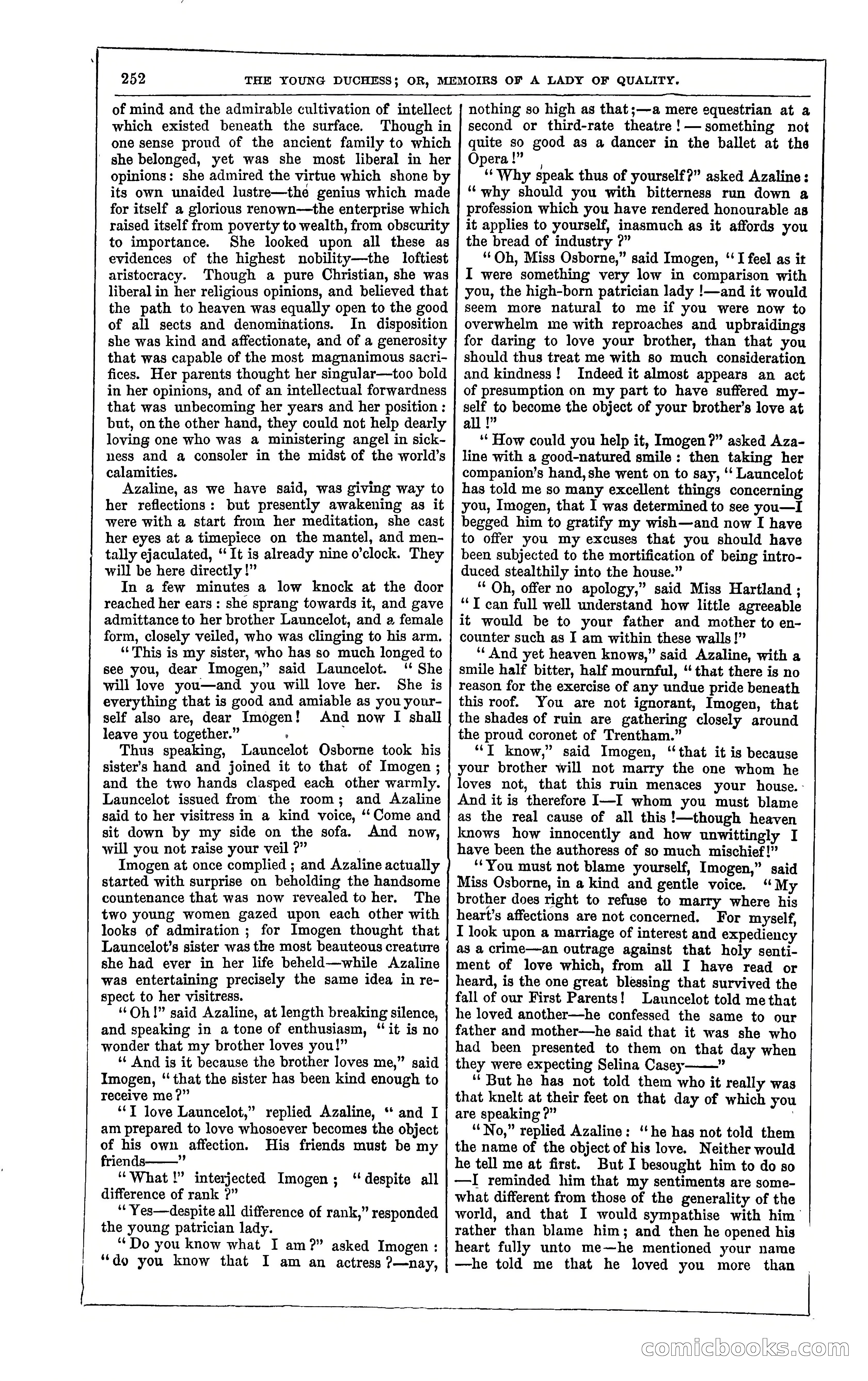
A restored page from Penny Dreadfuls, 1858. Page through the whole issue in the reader above.
📄 Transcribed text from this page (OCR, searchable)
Machine-transcribed from the original scan — historical spelling and the odd misread are preserved.
252 THE YOUNG DUCHESS; OR, MEMOIRS OF A LADY OF QUALITY. of mind and the admirable cultivation of intellect Though in one sense proud of the ancient family to which ' she belonged, yet was she most liberal in her opinions: she admired the virtue which shone by which existed beneath the surface. its own unaided lustre—the genius which made for itself a glorious renown—the enterprise which raised itself from poverty to wealth, from obscurity to importance. She looked upon all these as evidences of the highest nobility—the loftiest aristocracy. Though a pure Christian, she was liberal in her religious opinions, and believed that the path to heaven was equally open to the good of all sects and denominations. In disposition she was kind and affectionate, and of a generosity that was capable of the most magnanimous sacri- fices. Her parents thought her singular—too bold in her opinions, and of an intellectual forwardness that was unbecoming her years and her position : but, on the other hand, they could not help dearly loving one who was a ministering angel in sick- ness and a consoler in the midst of the world’s calamities. Azaline, as we have said, was giving way to her reflections: but presently awakening as it were with a start from her meditation, she cast her eyes at a timepiece on the mantel, and men- tally ejaculated, ‘It is already nine o’clock. They will be here directly !” In a few minutes a low knock at the door reached her ears : she sprang towards it, and gave admittance to her brother Launcelot, and a female form, closely veiled, who was clinging to his arm. “This is my sister, who has so much longed to see you, dear Imogen,” said Launcelot. ‘ She will love you—and you will love her. She is everything that is good and amiable as you your- self also are, dear Imogen! And now I shall leave you together.” , Thus speaking, lLauncelot Osborne took his sister’s hand and joined it to that of Imogen ; and the two hands clasped each other warmly. Launcelot issued from the room; and Azaline said to her visitress in a kind voice, ‘‘Come and sit down by my side on the sofa. And now, will you not raise your veil ?” | Imogen at once complied ; and Azaline actually started with surprise on beholding the handsome countenance that was now revealed to her. The two young women gazed upon each other with looks of admiration ; for Imogen thought that Launcelot’s sister was the most beauteous creature she had ever in her life beheld—while Azaline was entertaining precisely the same idea in re- spect to her visitress. “Oh!” said Azaline, at length breaking silence, and speaking in atone of enthusiasm, “it is no wonder that my brother loves you!” ‘‘ And is it because the brother loves me,” said Imogen, “ that the sister has been kind enough to receive me?” ‘““T love Launcelot,” replied Azaline, ** and I am prepared to love whosoever becomes the object of his own affection. His friends must be my frien ” ‘What !” interjected Imogen; “despite all difference of rank ?” ‘ Yes—despite all difference of rank,” responded the young patrician lady. ‘Do you know what I am?” asked Imogen : “do you know that I am an actress ?—nay, nothing so high as that;—a mere equestrian at a second or third-rate theatre !— something not quite so good as a dancer in the ballet at the Opera!” ‘Why speak thus of yourself?” asked Azaline : ““why should you with bitterness run down a profession which you have rendered honourable as it applies to yourself, inasmuch as it affords you the bread of industry ?” “Oh, Miss Osborne,” said Imogen, ‘I feel as it I were something very low in comparison with you, the high-born patrician lady !—and it would seem more natural to me if you were now to overwhelm me with reproaches and upbraidings for daring to love your brother, than that you should thus treat me with so much consideration and kindness! Indeed it almost appears an act of presumption on my part to have suffered my- self to become the object of your brother’s love at all !” ‘“* How could you help it, Imogen?” asked Aza- line with a good-natured smile: then taking her companion’s hand, she went on to say, ‘‘ Launcelot has told me so many excellent things concerning you, Imogen, that I was determined to see you—I begged him to gratify my wish—and now I have to offer you my excuses that you should have been subjected to the mortification of being intro- duced stealthily into the house.” ‘* Oh, offer no apology,” said Miss Hartland ; “T can full well understand how little agreeable it would be to your father and mother to en- counter such as I am within these walls!” ‘And yet heaven knows,” said Azaline, with a smile half bitter, half mournful, “that there is no reason for the exercise of any undue pride beneath this roof. You are not ignorant, Imogen, that the shades of ruin are gathering closely around the proud coronet of Trentham.” “T know,” said Imogen, ‘that it is because your brother will not marry the one whom he loves not, that this ruin menaces your house.- And it is therefore I—I whom you must blame as the real cause of all this !—though heaven knows how innocently and how unwittingly I have been the authoress of so much mischief!” “You must not blame yourself, Imogen,” said Miss Osborne, in a kind and gentle voice. “My brother does right to refuse to marry where his heart’s affections are not concerned. For myself, I look upon a marriage of interest and expediency as a crime—an outrage against that holy senti- ment of love which, from all I have read or heard, is the one great blessing that survived the fall of our First Parents! Launcelot told me that he loved another—he confessed the same to our father and mother—he said that it was she who had been presented to them on that day when they were expecting Selina Casey: 7 ‘‘ But he has not told them who it really was that knelt at their feet on that day of which you are speaking ?” “No,” replied Azaline: ‘he has not told them the name of the object of his love. Neither would he tell me at first. But I besought him to do so —I reminded him that my sentiments are some- what different from those of the generality of the world, and that I would sympathise with him’ rather than blame him; and then he opened his heart fully unto me—he mentioned your name —he told me that he loved you more than YN Wn) COMO Colin