
Penny Dreadfuls, 1856 · page 41 of 399
Ellen Percy; or, The Memoirs of an Actress — page 41: what you’re looking at
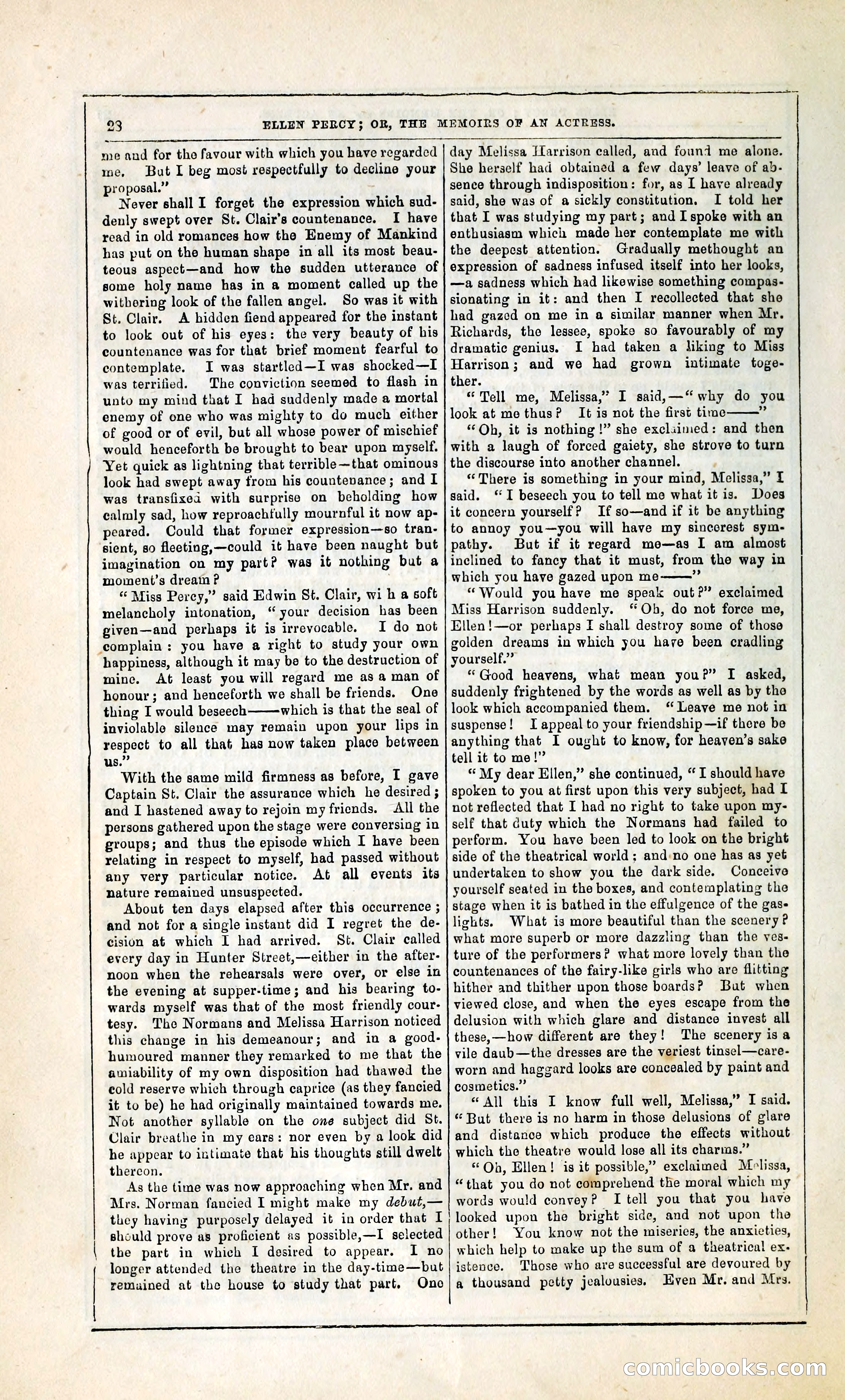
A restored page from Penny Dreadfuls, 1856. Page through the whole issue in the reader above.
📄 Transcribed text from this page (OCR, searchable)
Machine-transcribed from the original scan — historical spelling and the odd misread are preserved.
23 -~ me and for the favour with which you have regarded me, But I beg most respectfully to decline your proposal.” Never shall I forget the expression which sud- denly swept over St. Clair’s countenance. I have read in old romances how the Enemy of Mankind has put on the human shape in all its most beau- teous aspect—and how the sudden utterance of some holy name has in a moment called up the withering look of the fallen angel. So was it with St. Clair. A hidden fiend appeared for the instant to look out of his eyes: the very beauty of his countenance was for that brief moment fearful to contemplate. I was startled—I was shocked—I was terrified. The conviction seemed to flash in unto my mind that I had suddenly made a mortal enemy of one who was mighty to do much either of good or of evil, but all whose power of mischief | would henceforth be brought to bear upon myself. Yet quick as lightning that terrible—that ominous look had swept away from his countenance ; and I was transfixed with surprise on beholding how calmly sad, how reproachfully mournful it now ap- peared. Could that former expression—so tran- sient, so fleeting,—could it have been naught but imagination on my part? was it nothing but a moment’s dream? : “ Miss Percy,” said Edwin St. Clair, wi h a soft melancholy intonation, “your decision has been given—and perhaps it is irrevocable. I do not complain: you have a right to study your own happiness, although it may be to the destruction of mine. At least you will regard me as a man of honour; and henceforth we shall be friends. One thing I would beseech——which is that the seal of inviolable silence may remain upon your lips in respect to all that has now taken place between us.” With the same mild firmness as before, I gave Captain St. Clair the assurance which he desired ; and I hastened away to rejoin my friends. All the persons gathered upon the stage were conversing in groups; and thus the episode which I have been relating in respect to myself, had passed without any very particular notice. At all events its nature remained unsuspected. About ten days elapsed after this occurrence ; and not for a single instant did I regret the de- cision at which I had arrived. St. Clair called every day in Hunter Street,—either in the after- noon when the rehearsals were over, or else in the evening at supper-time; and his bearing to- wards myself was that of the most friendly cour- tesy. The Normans and Melissa Harrison noticed this change in his demeanour; and in a good- humoured manner they remarked to me that the amiability of my own disposition had thawed the cold reserve which through caprice (as they fancied it to be) he had originally maintained towards me. Not another syllable on the one subject did St. Clair breathe in my ears: nor even by a look did he appear to intimate that his thoughts still dwelt thereon. As the time was now approaching when Mr. and Mrs. Norman fancied I might make my debut,— they having purposely delayed it in order that I should prove as proficient as possible,—I selected the part in which I desired to appear. I no longer attended the theatre in the day-time—but remuined at the house to study that part. One ELLEN PERCY; OR, THE MEMOIRS OF AN ACTRESS. day Melissa ILarrison called, and found me alone. She herself had obtained a few days’ leave of ab- sence through indisposition: for, as I have already said, she was of a sickly constitution. I told her that I was studying my part; and I spoke with an enthusiasm which made her contemplate me with the deepest attention. Gradually methought an expression of sadness infused itself into her looks, —a sadness which had likewise something compas- sionating in it: and then I recollected that she had gazed on me in a similar manner when Mr. Richards, the lessee, spoke so favourably of my dramatic genius. I had taken a liking to Miss Harrison; and we had grown iutimate toge- ther. “Tell me, Melissa,” I said,—‘“‘ why do you look at me thus? It is not the first time 3 “Oh, it is nothing!” she exclaimed: and then with a laugh of forced gaiety, she strove to turn the discourse into another channel. “There is something in your mind, Melissa,” f said. ‘I beseech you to tell me what it is. Does it concern yourself? If so—and if it be anything to annoy you—you will have my sincorest sym- pathy. But if it regard me—as I am almost inclined to fancy that it must, from the way in which you have gazed upon me oy “Would you have me speak out?” exclaimed Miss Harrison suddenly. ‘Ob, do not force me, Ellen!—or perhaps I shall destroy some of those golden dreams in which you have been cradling yourself.” “Good heavens, what mean you?” I asked, suddenly frightened by the words as well as by the look which accompanied them. “Leave me not in suspense! I appeal to your friendship—if there be anything that I ought to know, for heaven’s sake tell it to me!” “ My dear Ellen,” she continued, “I should have spoken to you at first upon this very subject, had I not reflected that I had no right to take upon my- self that Guty which the Normans had failed to perform. You have been led to look on the bright side of the theatrical world; and:no one has as yet undertaken to show you the dark side. Conceive yourself seated in the boxes, and contemplating the stage when it is bathed in the effulgence of the gas lights. What is more beautiful than the scenery? what more superb or more dazzling than the ves- ture of the performers? what more lovely than the countenances of the fairy-like girls who are flitting hither and thither upon those boards? But when viewed close, and when the eyes escape from the delusion with which glare and distance invest all these,—how different are they! ‘The scenery is a vile daub —the dresses are the veriest tinsel—care- worn and haggard looks are concealed by paint and cosmetics.” “All this I know full well, Melissa,” I said. ‘But there is no harm in those delusions of glare and distance which produce the effects without which the theatre would lose all its charms.” “Oh, Ellen! is it possible,’ exclaimed Molissa, “that you do not comprehend the moral which my words would conveyP I tell you that you have looked upon the bright side, and not upon the other! You know not the miseries, the anxieties, which help to make up the sum of a theatrical ex- istence. Those who are successful are devoured by a thousand petty jealousies.s Even Mr. and Mrs. , ae oe Se BF rs | on EE Gbooksreom Com