
Penny Dreadfuls, 1856 · page 81 of 399
Ellen Percy; or, The Memoirs of an Actress — page 81: what you’re looking at
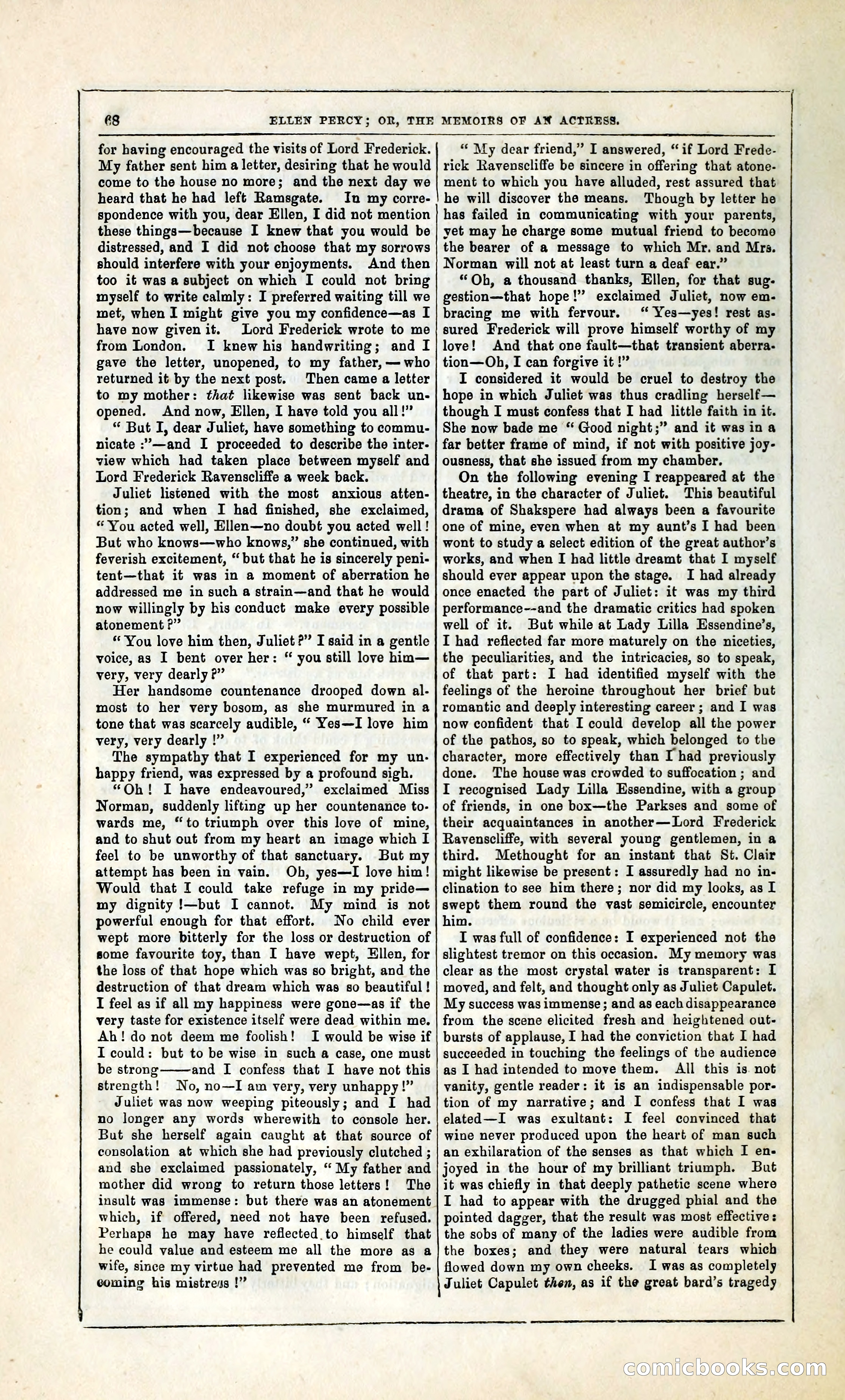
A restored page from Penny Dreadfuls, 1856. Page through the whole issue in the reader above.
📄 Transcribed text from this page (OCR, searchable)
Machine-transcribed from the original scan — historical spelling and the odd misread are preserved.
é8 for having encouraged the visits of Lord Frederick. My father sent him a letter, desiring that he would come to the house no more; and the next day we heard that he had left Ramsgate. In my corre- spondence with you, dear Ellen, I did not mention these things—because I knew that you would be distressed, and I did not choose that my sorrows should interfere with your enjoyments. And then too it was a subject on which I could not bring myself to write calmly: I preferred waiting till we met, when I might give you my confidence—as I have now givenit. Lord Frederick wrote to me from London. I knew his handwriting; and I gave the letter, unopened, to my father, — who returned it by the next post. Then came a letter to my mother: that likewise was sent back un- opened. And now, Ellen, I have told you all!” * But I, dear Juliet, have something to commu- nicate :’—and I proceeded to describe the inter- view which had taken place between myself and Lord Frederick Ravenscliffe a week back. Juliet listened with the most anxious atten- tion; and when I had finished, she exclaimed, “You acted well, Ellen—no doubt you acted well ! But who knows—who knows,” she continued, with feverish excitement, “but that he is sincerely peni- tent—that it was in a moment of aberration he addressed me in such a strain—and that he would now willingly by his conduct make every possible atonement P” * You love him then, Juliet ?” I said in a gentle voice, as I bent over her: “ you still love him— very, very dearly ?” Her handsome countenance drooped down al- most to her very bosom, as she murmured in a tone that was scarcely audible, “ Yes—I love him very, very dearly !” The sympathy that I experienced for my un- happy friend, was expressed by a profound sigh. “Oh! I have endeavoured,’ exclaimed Miss Norman, suddenly lifting up her countenance to- wards me, “to triumph over this love of mine, and to shut out from my heart an image which I feel to be unworthy of that sanctuary. But my attempt has been in vain. Oh, yes—I love him! Would that I could take refuge in my pride— my dignity !—but I cannot. My mind is not powerful enough for that effort. No child ever wept more bitterly for the loss or destruction of some favourite toy, than I have wept, Ellen, for the loss of that hope which was so bright, and the destruction of that dream which was so beautiful ! I feel as if all my happiness were gone—as if the very taste for existence itself were dead within me. Ah! do not deem me foolish! I would be wise if I could: but to be wise in such a case, one must be strong and I confess that I have not this strength! No, no—I am very, very unhappy!” Juliet was now weeping piteously; and I had no longer any words wherewith to console her. But she herself again caught at that source of consolation at which she had previously clutched ; and she exclaimed passionately, “ My father and mother did wrong to return those letters! The insult was immense: but there was an atonement which, if offered, need not have been refused. Perhaps he may have reflected.to himself that he could value and esteem me all the more as a wife, since my virtue had prevented me from be- coming his mistress !” Se erm cancssramea a: immasamiena ade AIGA ARE I AI iE ELLEN PERCY; OR, THE MEMOIRS OF AW ACTRESS. “« My dear friend,” I answered, “ if Lord Frede- rick Ravenscliffe be sincere in offering that atone- ment to which you have alluded, rest assured that he will discover the means. Though by letter he has failed in communicating with your parents, yet may he charge some mutual friend to become the bearer of a message to which Mr. and Mrs. Norman will not at least turn a deaf ear.” “Oh, a thousand thanks, Ellen, for that sug. gestion—that hope!” exclaimed Juliet, now em- bracing me with fervour. ‘“ Yes—yes! rest as- sured Frederick will prove himself worthy of my love! And that one fault—that transient aberra- tion—Oh, I can forgive it !” I considered it would be cruel to destroy the hope in which Juliet was thus cradling herself— though I must confess that I had little faith in it. She now bade me “ Good night;” and it was in a far better frame of mind, if not with positive joy- ousness, that she issued from my chamber. On the following evening I reappeared at the theatre, in the character of Juliet. This beautiful drama of Shakspere had always been a favourite one of mine, even when at my aunt’s I had been wont to study a select edition of the great author’s works, and when I had little dreamt that I myself should ever appear upon the stage. I had already once enacted the part of Juliet: it was my third performance--and the dramatic critics had spoken well of it. But while at Lady Lilla Essendine’s, I had refiected far more maturely on the niceties, the peculiarities, and the intricacies, so to speak, of that part: I had identified myself with the feelings of the heroine throughout her brief but romantic and deeply interesting career; and I was now confident that I could develop all the power of the pathos, so to speak, which belonged to the character, more effectively than I had previously done. The house was crowded to suffocation ; and I recognised Lady Lilla Essendine, with a group of friends, in one box—the Parkses and some of their acquaintances in another—Lord Frederick Ravenscliffe, with several young gentlemen, in a third. Methought for an instant that St. Clair might likewise be present: I assuredly had no in- clination to see him there; nor did my looks, as I swept them round the vast semicircle, encounter him. I was full of confidence: I experienced not the slightest tremor on this occasion. My memory was clear as the most crystal water is transparent: I moved, and felt, and thought only as Juliet Capulet. My success was immense; and as each disappearance from the scene elicited fresh and heightened out- bursts of applause, I had the conviction that I had succeeded in touching the feelings of the audience as I had intended to move them. All this is. not vanity, gentle reader: it is an indispensable por- tion of my narrative; and I confess that I was elated—I was exultant: I feel convinced that wine never produced upon the heart of man such an exhilaration of the senses as that which I en- joyed in the hour of my brilliant triumph. But it was chiefly in that deeply pathetic scene where I had to appear with the drugged phial and the pointed dagger, that the result was most effective: the sobs of many of the ladies were audible from the boxes; and they were natural tears which flowed down my own cheeks. I was as completely Juliet Capulet then, as if the great bard’s tragedy CONNIE IOO KS Com