
Penny Dreadfuls, 1856 · page 82 of 399
Ellen Percy; or, The Memoirs of an Actress — page 82: what you’re looking at
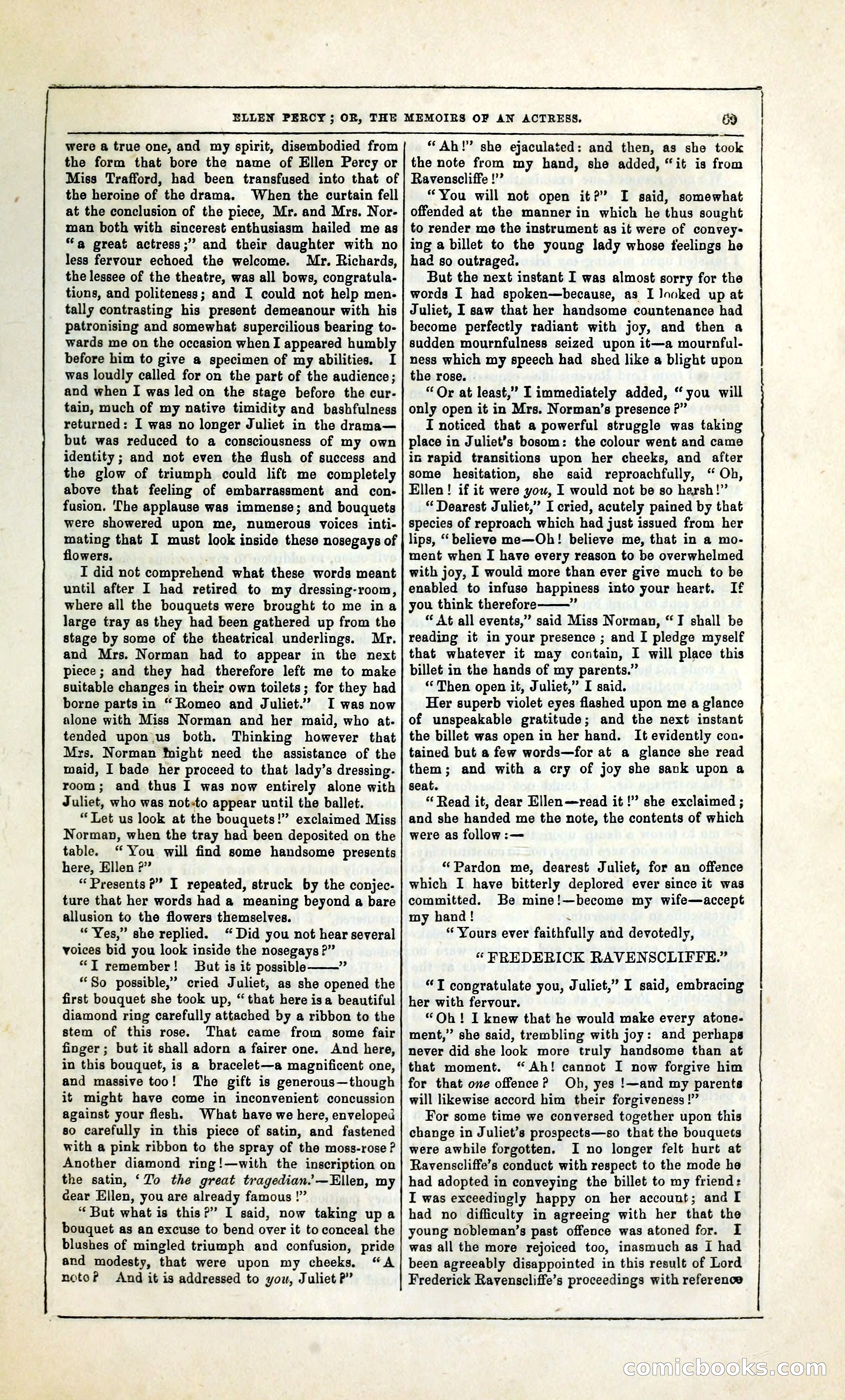
A restored page from Penny Dreadfuls, 1856. Page through the whole issue in the reader above.
📄 Transcribed text from this page (OCR, searchable)
Machine-transcribed from the original scan — historical spelling and the odd misread are preserved.
ELLEN PERCY; OR, THE MEMOIRS OF AN ACTRESS, were a true one, and my spirit, disembodied from the form that bore the name of Ellen Percy or Miss Trafford, had been transfused into that of the heroine of the drama. When the curtain fell at the conclusion of the piece, Mr. and Mrs. Nor- man both with sincerest enthusiasm hailed me as “a great actress;” and their daughter with no less fervour echoed the welcome. Mr. Richards, the lessee of the theatre, was all bows, congratula- tions, and politeness; and I could not help men- tally contrasting his present demeanour with his patronising and somewhat supercilious bearing to- wards me on the occasion when I appeared humbly before him to give a specimen of my abilities. I was loudly called for on the part of the audience; and when I was led on the stage before the cur- tain, much of my native timidity and bashfulness returned: I was no longer Juliet in the drama— but was reduced to a consciousness of my own identity; and not even the flush of success and the glow of triumph could lift me completely above that feeling of embarrassment and con- fusion. The applause was immense; and bouquets were showered upon me, numerous voices inti- mating that I must look inside these nosegays of flowers. I did not comprehend what these words meant until after I had retired to my dressing-room, where all the bouquets were brought to me ina large tray as they had been gathered up from the stage by some of the theatrical underlings. Mr. and Mrs. Norman had to appear in the next piece; and they had therefore left me to make suitable changes in their own toilets; for they had borne parts in “Romeo and Juliet.” I was now alone with Miss Norman and her maid, who at- tended upon us both. Thinking however that Mrs. Norman tnight need the assistance of the maid, I bade her proceed to that lady’s dressing- room; and thus I was now entirely alone with Juliet, who was notsto appear until the ballet. “Let us look at the bouquets!” exclaimed Miss Norman, when the tray had been deposited on the table. “ You will find some handsome presents here, Ellen ?” “Presents P’ I repeated, struck by the conjec- ture that her words had a meaning beyond a bare allusion to the flowers themselves. “Yes,” she replied. “Did you not hear several voices bid you look inside the nosegays ?” “IT remember! But is it possible ‘5 “So possible,’ cried Juliet, as she opened the first bouquet she took up, “that here isa beautiful diamond ring carefully attached by a ribbon to the stem of this rose. That came from some fair finger ; but it shall adorn a fairer one. And here, in this bouquet, is a bracelet-—a magnificent one, and massive too! The gift is generous—though it might have come in inconvenient concussion against your flesh. What have we here, enveloped so carefully in this piece of satin, and fastened with a pink ribbon to the spray of the moss-rose? Another diamond ring!—with the inscription on the satin, ‘To the great tragedian.”—Ellen, my cear Ellen, you are already famous !” “But what is this?” I said, now taking up a bouquet as an excuse to bend over it to conceal the blushes of mingled triumph and confusion, pride and modesty, that were upon my cheeks. “A noto? And it is addressed to you, Juliet P” 69 —_e_ “ Ah!’ she ejaculated: and then, as she took the note from my hand, she added, “it is from Ravenscliffe !’’ “You will noé open it?’ I said, somewhat offended at the manner in which he thus sought to render moe the instrument as it were of conveys ing a billet to the young lady whose teelings he had so outraged. But the next instant I was almost sorry for the words I had spoken—because, as I Jooked up at Juliet, I saw that her handsome countenance had become perfectly radiant with joy, and then a sudden mournfulness seized upon it—a mournful- ness which my speech had shed like a blight upon the rose. . “Or at least,” I immediately added, “you will only open it in Mrs. Norman’s presence P” I noticed that a powerful struggle was taking place in Juliet’s bosom: the colour went and came in rapid transitions upon her cheeks, and after some hesitation, she said reproachfully, ‘ Oh, Ellen! if it were you, I would not be so harsh!” “ Dearest Juliet,” I cried, acutely pained by that species of reproach which had just issued from her lips, “‘ believe me—Oh! believe me, that in a mo- ment when I have every reason to be overwhelmed with joy, I would more than ever give much to be enabled to infuse happiness into your heart. If you think therefore e “ At all events,” said Miss Norman, “I shall be reading if in your presence ; and I pledge myself that whatever it may contain, I will place this billet in the hands of my parents.” “Then open it, Juliet,” I said. Her superb violet eyes flashed upon me a glance of unspeakable gratitude; and the next instant the billet was open in her hand. It evidently con. tained but a few words—for at a glance she read them; and with a ery of joy she sank upon a seat. “Read it, dear Ellen-read it!” she exclaimed ; and she handed me the note, the contents of which were as follow :— “Pardon me, dearest Juliet, for an offence which I have bitterly deplored ever since it was committed. Be mine!—become my wife—accept my hand! : Yours ever faithfully and devotedly, “ FREDERICK RAVENSCLIFFE.” “T congratulate you, Juliet,” I said, embracing her with fervour. “Oh ! I knew that he would make every atone- ment,” she said, trembling with joy: and perhaps never did she look more truly handsome than at that moment. “Ah! cannot I now forgive him for that one offence? Oh, yes !~—and my parents will likewise accord him their forgiveness!” For some time we conversed together upon this change in Juliet’s prospects—so that the bouquets were awhile forgotten. I no longer felt hurt at Ravenscliffe’s conduct with respect to the mode he had adopted in conveying the billet to my friend: I was exceedingly happy on her account; and I had no difficulty in agreeing with her that the young nobleman’s past offence was atoned for. I was all the more rejoiced too, inasmuch as I had been agreeably disappointed in this result of Lord Frederick Ravenscliffe’s proceedings with reference ee ; — s GOmiGcdoo ‘S Com