
Penny Dreadfuls, 1856 · page 136 of 399
Ellen Percy; or, The Memoirs of an Actress — page 136: what you’re looking at
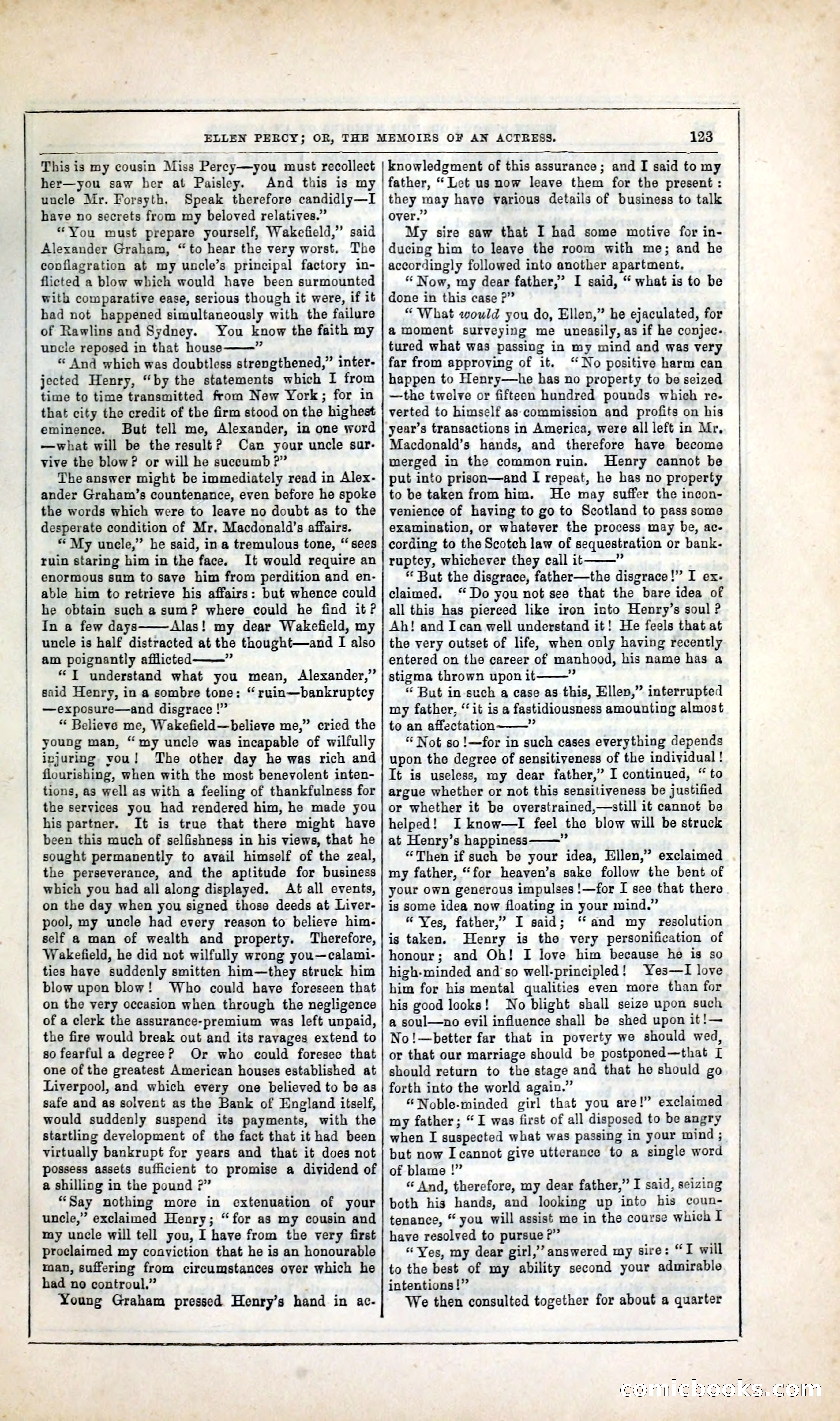
A restored page from Penny Dreadfuls, 1856. Page through the whole issue in the reader above.
📄 Transcribed text from this page (OCR, searchable)
Machine-transcribed from the original scan — historical spelling and the odd misread are preserved.
ELLEN PERCY; OR, THE MEMOIRS OF AN ACTRESS. This is my cousin Miss Percey—you must recollect her—you saw her at Paisley. And this is my uncle Mr. Forsyth. Speak therefore candidly—I have no secrets from my beloved relatives.” “You must prepare yourself, Wakefield,” said Alexander Graham, “to hear the very worst. The conflagration at my uncle’s principal factory in- flicted a blow which would have been surmounted with comparative ease, serious though it were, if it had not happened simultaneously with the failure of Rawlins and Sydney. You know the faith my uncle reposed in that house x “ And which was doubtless strengthened,” inter- jected Henry, “by the statements which I from time to time transmitted from New York; for in that city the credit of the firm stood on the highest eminence. But tell me, Alexander, in one word —what will be the result? Car your uncle sur- vive the blow? or will he succumb ?” The answer might be immediately read in Alex- ander Graham’s countenance, even before he spoke the words which were to leave no doubt as to the desperate condition of Mr, Macdonald’s affairs. “ My uncle,” he said, ina tremulous tone, “sees ruin staring him in the face. It would require an enormous sum to saye him from perdition and en- able him to retrieve his affairs: but whence could he obtain such a sum? where could he find itP In a few days Alas! my dear Wakefield, my uncle is half distracted at the thought—and I also am poignantly afflicted “ “TI understand what you mean, Alexander,” said Henry, in a sombre tone: “ ruin—bankruptcy —exposure—and disgrace !” “ Believe me, Wakefield—believe me,” cried the young man, “my uncle was incapable of wilfully injuring you! The other day he was rich and flourishing, when with the most benevolent inten- tions, as well as with a feeling of thankfulness for the services you had rendered him, he made you his partner. It is true that there might have been this much of selfishness in his views, that he sought permanently to avail himself of the zeal, the perseverance, and the aptitude for business which you had all along displayed. At all events, on the day when you signed those deeds at Liver- pool, my uncle had every reason to believe him- self a man of wealth and property. Therefore, Wakefield, he did not wilfully wrong you—calami- ties have suddenly smitten him—they struck him blow upon blow! Who could have foreseen that on the very occasion when through the negligence of a clerk the assurance-premium was left unpaid, the fire would break out and its ravages extend to so fearful a degree? Or who could foresee that one of the greatest American houses established at Liverpoo], and which every one believed to be as safe and as solvent as the Bank of England itself, would suddenly suspend its payments, with the startling development of the fact that it had been virtually bankrupt for years and that it does not possess assets sufficient to promise a dividend of a shilling in the pound ?” “Say nothing more in extenuation of your uncle,” exclaimed Henry; “for as my cousin and my uncle will tell you, I have from the very first proclaimed my conviction that he is an honourable man, suffering from circumstances over which he had no controul.” Young Graham pressed Henry’s hand in ac- 123 knowledgment of this assurance; and I said to my father, “ Let us now leave them for the present : they may have various details of business to talk over.” My sire saw that I had some motive for in- ducing him to leaye the room with me; and he accordingly followed into another apartment. “ Now, my dear father,’ I said, “ what is to be done in this case P” “ What would you do, Ellen,” be ejaculated, for a@ moment surveying me uneasily, as if he conjec- tured what was passing in my mind and was very far from approving of it. “No positive harm can happen to Henry—he has no property to be seized —the twelve or fifteen hundred pounds which re- verted to himself as commission and profits on his year’s transactions in America, were all left in Mr, Macdonald’s hands, and therefore have become merged in the commonruin. Henry cannot be put into prison—and I repeat, he has no property to be taken from him. He may suffer the incon- venience of having to go to Scotland to pass some examination, or whatever the process may be, ac- cording to the Scotch law of sequestration or bank. ruptcy, whichever they call it ze “ But the disgrace, father—the disgrace!” I ex- claimed. “Do you not see that the bare idea of all this has pierced like iron into Henry’s soul ? Ah! and I can well understand it! He feels that at the very outset of life, when only having recently entered on the career of manhood, his name has a stigma thrown upon it % “ But in such a case as this, Ellen,” interrupted my father, “it is a fastidiousness amounting almost to an affectation ds “ Not so!—for in such cases everything depends upon the degree of sensitiyeness of the individual! It is useless, my dear father,” I continued, “to argue whether or not this sensitiyeness be justified or whether it be overstrained,—still it cannot be helped! I know—I feel the blow will be struck at Henry’s happiness - “Then if such be your idea, Ellen,’ exclaimed my father, “for heaven’s sake follow the bent of your own generous impulses !—for I see that there is some idea now floating in your mind.” “ Yes, father,” I said; “and my resolution is taken. Henry is the very personification of honour; and Oh! I love him because he is so high-minded and'so well-principled! Yes—lI love him for his mental qualities even more than for his good looks! No blight shall seize upon such a soul—no evil influence shall be shed upon it!— No!—better far that in poverty we should wed, or that our marriage should be postponed—that I should return to the stage and that he should go forth into the world again.” “Noble-minded girl that you are!” exclaimed my father; “I was first of all disposed to be angry when I suspected what was passing in your mind ; but now I cannot give utterance to a single word of blame !” “ And, therefore, my dear father,” I said, seizing both his hands, and looking up into his coun- tenance, “ you will assist me in the course which I have resolved to pursue ?” “Yes, my dear girl,’’ answered my sire: “I will to the best of my ability second your admirable intentions!” We then consulted together for about a quarter COMA (C OOO) K (EO)