
Penny Dreadfuls, 1856 · page 137 of 399
Ellen Percy; or, The Memoirs of an Actress — page 137: what you’re looking at
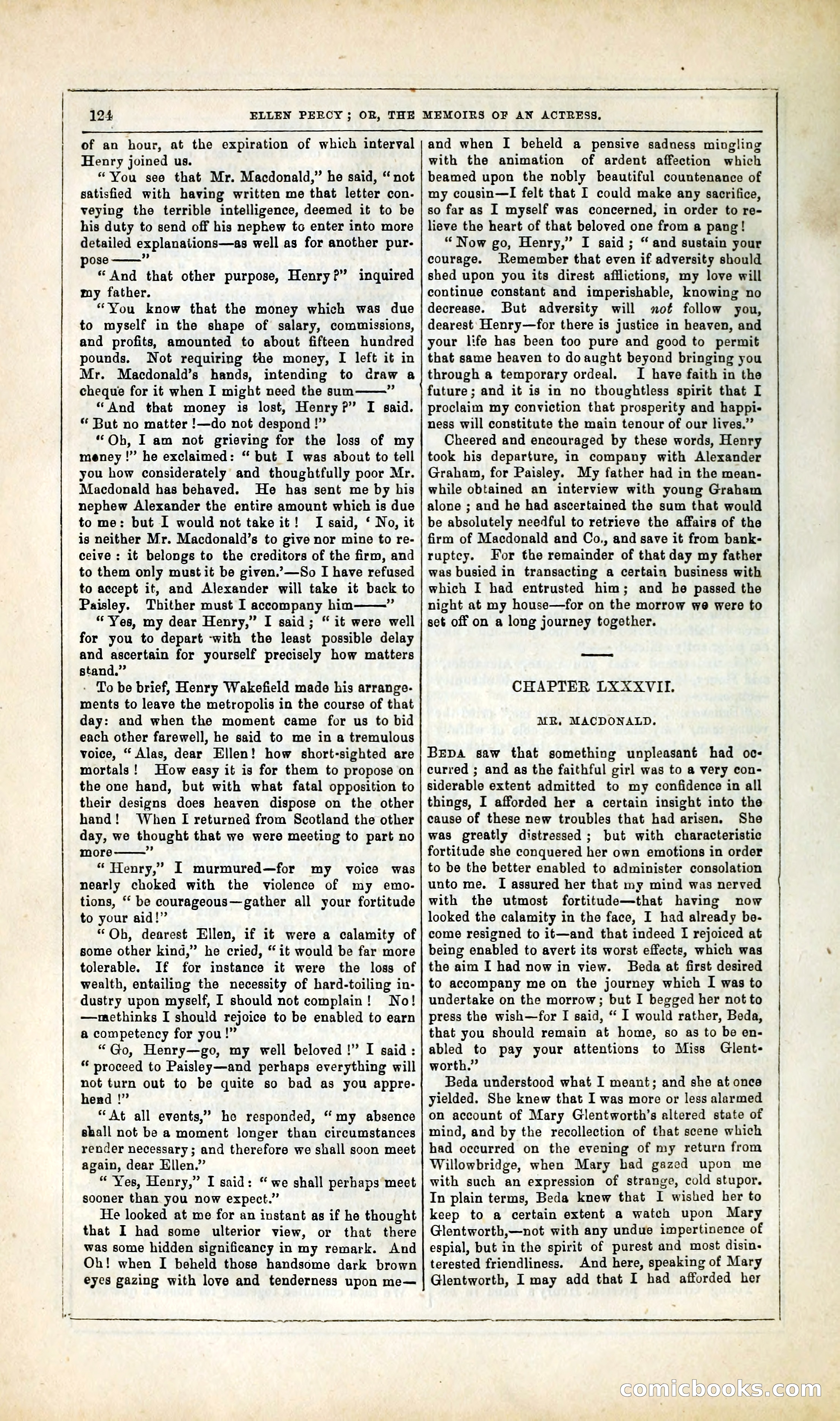
A restored page from Penny Dreadfuls, 1856. Page through the whole issue in the reader above.
📄 Transcribed text from this page (OCR, searchable)
Machine-transcribed from the original scan — historical spelling and the odd misread are preserved.
| | 124 of an hour, at the expiration of which interval Henry joined us. “You see that Mr. Macdonald,” he said, “ not satisfied with having written me that letter con. veying the terrible intelligence, deemed it to be his duty to send off his nephew to enter into more detailed explanations—as well as for another pur- pose “* “And that other purpose, Henry?” inquired my father. “You know that the money which was due to myself in the shape of salary, commissions, and profits, amounted to about fifteen hundred pounds. Not requiring the money, I left it in Mr. Macdonald’s hands, intending to craw a cheque for it when I might need the sum 4 “And that money is lost, Henry?” I said. * But no matter !—do not despond !” “Oh, I am not grieving for the loss of my meney !” he exclaimed: “ but I was about to tell you how considerately and thoughtfully poor Mr. Macdonald has behaved. He has sent me by his nephew Alexander the entire amount which is due to me: but I would not take it! I said, ‘ No, it is neither Mr. Macdonald’s to give nor mine to re- ceive : it belongs to the creditors of the firm, and to them only must it be given.’—So I have refused to accept it, and Alexander will take it back to Paisley. Thither must I accompany him 7 “Yes, my dear Henry,” I said; “it were well for you to depart ‘with the least possible delay and ascertain for yourself precisely how matters stand.” - To be brief, Henry Wakefield made his arrange- ments to leave the metropolis in the course of that day: and when the moment came for us to bid each other farewell, he said to me in a tremulous voice, “ Alas, dear Ellen! how short-sighted are mortals! How easy it is for them to propose on the one hand, but with what fatal opposition to their designs does heaven dispose on the other hand! When I returned from Scotland the other day, we thought that we were meeting to part no more a “ Henry,” I murmured—for my voice was nearly choked with the violence of my emo- tions, ‘ be courageous—gather all your fortitude to your aid!” “Oh, dearest Ellen, if it were a calamity of some other kind,” he cried, “it would be far more tolerable. If for instance it were the loss of wealth, entailing the necessity of hard-toiling in- dustry upon myself, I should not complain! No! —methinks I should rejoice to be enabled to earn a competency for you!” “Go, Henry—go, my well beloved!” I said: ** proceed to Paisley—and perhaps everything will not turn out to be quite so bad as you appre- hend !” . “At all events,” he responded, “my absence shall not be a moment longer than circumstances render necessary ; and therefore we shall soon meet again, dear Ellen.” “Yes, Henry,” I said: “ we shall perhaps meet sooner than you now expect.” He looked at me for an instant as if he thought that I had some ulterior view, or that there was some hidden significancy in my remark. And Oh! when I beheld those handsome dark brown eyes gazing with love and tenderness upon me— LES ELLEN PEECY ; OR, THE MEMOIRS OF AN ACTRESS, and when I beheld a pensive sadness mingling with the animation of ardent affection which beamed upon the nobly beautiful countenance of my cousin—I felt that I could make any sacrifice, so far as I myself was concerned, in order to re- lieve the heart of that beloved one from a pang! “Now go, Henry,” I said; “ and sustain your courage. Remember that even if adversity should shed upon you its direst afflictions, my love will continue constant and imperishable, knowing no decrease. But adversity will moé follow you, dearest’ Henry—for there is justice in heaven, and your life has been too pure and good to permit that same heaven to do aught beyond bringing you through a temporary ordeal. I have faith in the future; and it is in no thoughtless spirit that I proclaim my conviction that prosperity and happi- ness will constitute the main tenour of our lives.” Cheered and encouraged by these words, Henry took his departure, in company with Alexander Graham, for Paisley. My father had in the mean- while obtained an interview with young Graham alone ; and he had ascertained the sum that would be absolutely needful to retrieve the affairs of the firm of Macdonald and Co., and save it from bank- ruptcy. For the remainder of that day my father was busied in transacting a certain business with which I had entrusted him; and he passed the night at my house—for on the morrow we were fo set off on a long journey together. CHAPTER LXXXVII. MR, MACDONALD. BEpDA saw that something unpleasant had oc- curred ; and as the faithful girl was to a very con- siderable extent admitted to my confidence in all things, I afforded her a certain insight into the cause of these new troubles that had arisen. She was greatly distressed ; but with characteristic fortitude she conquered her own emotions in order to be the better enabled to administer consolation unto me. I assured her that my mind was nerved with the utmost fortitude—that having now looked the calamity in the face, I had already be- come resigned to it—and that indeed I rejoiced at being enabled to avert its worst effects, which was the aim I had now in view. Beda at first desired to accompany me on the journey which I was to undertake on the morrow; but I begged her not to press the wish—for I said, “ I would rather, Beda, that you should remain at home, so as to be en- abled to pay your attentions to Miss Glent- worth.” Beda understood what I meant; and she at once yielded. She knew that I was more or less alarmed on account of Mary Glentworth’s altered state of mind, and by the recollection of that scene which had occurred on the evening of my return from Willowbridge, when Mary had gazed upon me with such an expression of strange, cold stupor. In plain terms, Beda knew that I wished her to keep to a certain extent a watch upon Mary Glentworth,—not with any undue impertinence of espial, but in the spirit of purest and most disin- terested friendliness. And here, speaking of Mary Glentworth, I may add that I had afforded her Gomicbook (E)