
Penny Dreadfuls, 1889 · page 4 of 32
The Human Vampire; Or, The Elixir of Life — page 4: what you’re looking at
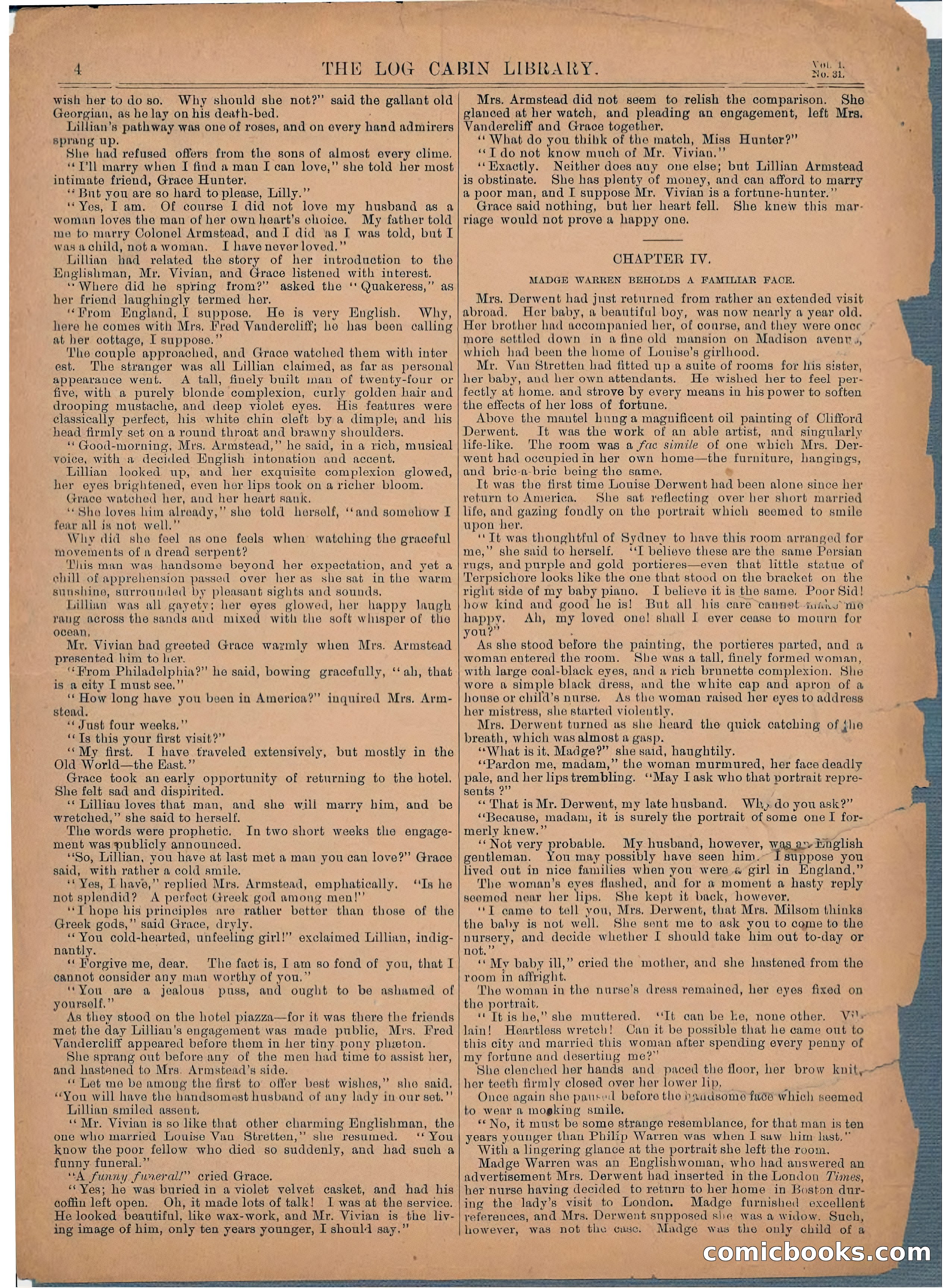
A restored page from Penny Dreadfuls, 1889. Page through the whole issue in the reader above.
📄 Transcribed text from this page (OCR, searchable)
Machine-transcribed from the original scan — historical spelling and the odd misread are preserved.
4 THE LOG CABIN LIBRARY. Volt No. 3h wish her to do so. Why should she not?” said the gallant old Georgian, as he lay on his death-bed. Lillian’s pathway was one of roses, and on every bund admirers sprang up. She had refused offers from the sons of almost every clime. “T’'ll marry when I find » man I can love,” she told her most intimate friend, Grace Hunter. ** But you are so hard to please, Lilly.” “Yes, Iam. Of course I did not love my husband as a woman loves the man of her own heart's choice, My father told me to marry Colonel Armstead, and I did as I was told, but I wos achild, nota woman, I have never loved,” Lillian had related the story of her introduction to the Englishman, My. Vivian, and Grace listened with interest. ‘Where did he spring from?” asked the ‘t Quakeress,” as her friend laughingly termed her. “Trom BEagland, [ suppose, He is very English. Why, here he comes with Mrs, ved Vandercliff; ho has been calling at her cotbage, I suppose.” The couple approached, and Grace watched them with inter est. The stranger was all Lillian claimed, as far as personal appearance went. A tall, finely built man of twenty-four or five, with a purely blonde complexion, curly golden hair and drooping mustache, and deep violet eyes. His features were classically perfect, his white chin cleft by a dimple, and his head firmly set on a round throat and brawny shoulders. * Good-morning, Mvs. Armstend,”’ he said, in a rich, musical voice, with a decided English intonation and accent, Lillian looked up, and her exquisite complexion glowed, her eyes brightened, eveu hor lips took on a richer bloom. Grace watched her, and her heart sani. “Sho loves him alroady,” she told hersolf, ‘and somehow I fear nil ix not well.” Why did sho feel ns one feals when watching the graceful movements of n dread serpent? ‘his man was handsome beyond her oxpectation, and yet a ehill of apprehension passed over heras she sat in the warm sunshine, surrounded by plegsant s sights and sounds, Lilliun was all gayety; her eyes glowed, her happy Inugh rang across the sands and mixed with the soft whisper of the ocean, Mv. Vivian bad greeted Grace wazmly when Mrs. Armstead presented him to her. “From Philadelphin?” he said, bowing gracefully, ‘ah, that is a city I must see.” ‘ How long have you been in American?” inquired Mrs. Arm- stend. “Just four weeks," ‘Ts this your first visit?” “My first. I have traveled extensively, but mostly in the Old World—the East.” Grace took an early opportunity of returning to the hotel, She felt sad and dispirited. ‘Villian loves that man, and she will marry him, and be wretched,” she said to herself. The words were prophetic, ment was publicly announeed. “So, Lillian, you have at last met a man you can love?” Grace said, with rather a cold smile, Yes, I have,” replied Mrs, Armstead, emphatically. not splendid? A perfoot Greek god xmong men!” “T hope his principles are rather better than those of the Greek gods,” said Grace, dryly, “You cold-hearted, unfeeling girl!” exclaimed Lillian, indig- nantly. “ Forgive me, dear. The fact is, I am 80 fond of you, that I cannot consider any man worthy of you,’ “You are a jealous puss, ond ought to be ashamed of yonrsolf,” As they stood on the hotel piazza—for it was there the friends met the day Lilliau's engagement was made public, Mrs. Fred Vandercliff appeared before them in her tiny pony phwton, She sprang out before any of the men had time to assist her, and hastened to Mrs. Armstead’s side. Let me be among the first to olfer best wishes,” sho said. “You will have the handsomest husband of any lady in our set.” Lillian smiled assent, ‘“Mr. Vivian is so like that other charming Englishman, the one who married Louise Vuo Stretten,’’ she resumed. ‘* You know the poor fellow who died so suddenly, and had such a funny. funeral. “A funny funerall” cried Grace. “Yes; he was buried in a violet velvet casket, and had his coffin left open. Oh, it made lots of talk! LI was at the service. In two short weeks the engage- “Ts he He looked beautiful, like wax-work, and Mr. Vivian is the liv- ing image of him, only ten years younger, I should say,”’ Mrs. Armstead did not seem to relish the comparison. She glanced at her watch, and pleading an engagement, left Mrs. Vandercliff and Grace together, “What do you thibk of the match, Miss Hunter?” “‘T do not know much of Mr. Vivian,”’ ““Tixactly. Neither does any one else; but Lillian Armstead is obstinate. She has plenty of money, and can afford to marry a poor man, and I suppose Mr, Vivian is a fortune-hunter.’ Grace said nothing, but her heart fell She knew this mar- riage would not prove a happy one. CHAPTER IY. MADGE WARREN BEHOLDS A FAMILIAR FACE. Mrs. Derwent had just returned from rather an extended visit abroad, Her baby, a beautiful boy, was now nearly a year old. Hor brother had accompanied her, of conrse, and they were onoc more settled down in a fine old mansion on Madison avenr. which had been the home of Lonise’s girlhood. Mr. Vun Stretten had fitted up a suite of rooms for his sister, her baby, and her own attendants. He wished her to feel per- feetly at home. and strove by every means in his power to soften the effects of her loss of fortune. Above the mantel hung a magnificent oil painting of Clifford Derwent. It was the work of an ablo artist, and singularly life-like. The room was a fac sinile of one which Mrs, Der- wont had oceupied in her own home—the furniture, hangings, and brie-a-bric being the same, It was the first time Louise Derwent bad been alone since her return to America. She sat reflecting over her short married life, and gazing fondly on the portrait which seemed to smile upon her. “Tt was thonghtful of Sydney to have this room arranged for me,” she said to herself. ‘‘I believe these are the same Persian rugs, and purple and gold portieres—even that little statue of Terpsichore looks like the one that stood on the bracket on the right side of my baby pinno. I believo it is the same, Poor Sid} how kind and good he is! But all his cnre cannot mans mo happy. Ah, my loved one! shall I ever cease to mourn for our” : As she stood before the painting, the portieres parted, ond a woman entered the room. She was a tall, finely formed woman, with large coal-black eyes, and a vich brunetta complexion, She wore a simple black dress, und the white cap and apron of a house or child’s nurse. As the woman raised her eyes to address her mistress, she started violently, Mrs. Derwent turned as she heard the quick catching of {he breath, which was almost a gasp. “What i is it, Madge?” she said, hanghtily. ‘Pardon me, madam,” the woman murmured, her face deadly pale, and her lips trembling. “May I ask who that portrait repre- sents 2?” « That is Mr. Derwent, my late husband. Wh, do you ask?” “Because, madam, it is surely the portrait of some one I for- merly knew,” “Not very probable. My husband, however, Was. a~ English gentleman. You mny possibly have seen him. T suppose you lived out in nice families when you were a girl in England,” The woman's eyes flushed, and for a moment a hasty reply soomod nour her lips. She kept it back, however, "T came to tell you, Mrs, Derwent, that Mrs, Milsom thinks the baby is not wall. She sent me to ask you to come to the nursery, and decide whether I should take him out to-day or not,” ‘“My baby ill,” cried the mother, and she hastened from the room in affright, The woman in the nurse's dress remained, her eyes fixed on the portrait, ‘Tt is he," she muttered. “It can be Le, none other. Vil» lain! Henrtless wretch! Cun it be possible that he came out to this city and married this woman after spending every penny of my fortune and deserting me?” ‘She clenched her hands and pac sel the floor, her brow knit.— her teeth firmly closed over her lower lip, Once again sho poured before tho baudsome f008 Which seemed to wear 1 mogking sinile, f© No, it must be somo strange resemblance, for that man is ten years younger than Philip Warren was when I suw him dust," With a lingering glance at the portrait she left the room. Madge Warren was on Hnglishwoman, who had answered an advertisement Mrs. Derwent had inserted in the London Times, her nurse having decided to return to her home in Boston dur- ing the lady’s visit to London. Madge furnished excellent references, and Mrs. Derwent supposed she was a widow. Such, however, was not the cusc. Madge was the only child of a comicbooks.ce