
Penny Dreadfuls, 1889 · page 9 of 32
The Human Vampire; Or, The Elixir of Life — page 9: what you’re looking at
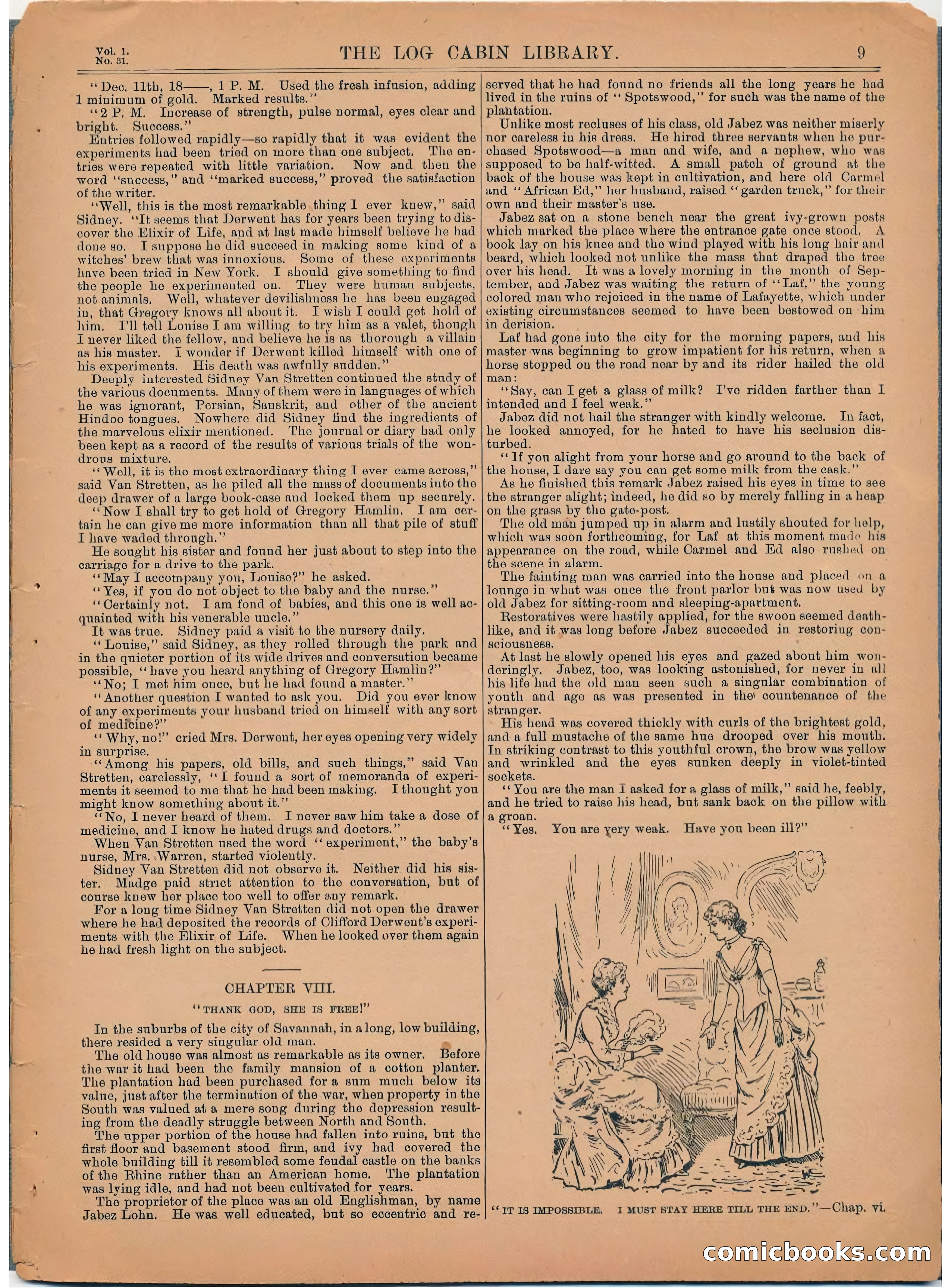
A restored page from Penny Dreadfuls, 1889. Page through the whole issue in the reader above.
📄 Transcribed text from this page (OCR, searchable)
Machine-transcribed from the original scan — historical spelling and the odd misread are preserved.
<a a VoL 1. No. 31, THE LOG CABIN LIBRARY. a “Deo, 11th, 18——, 1 P. M. Used the fresh infusion, adding 1 minimum of gold. Marked results.” “9 P, M. Inorease of strength, pulse normal, eyes clear and bright. Success,’’ Entries followed rapidly—so rapidly that it was evident the experiments had been tried on more than one subject. ‘The en- tries were repeated with little variation. Now and then the word ‘‘suecess,” and ‘‘marked success,” proved the satisfaction of the writer. “Well, this is the most remarkable thing I ever knew,” said Sidney. “It seems that Derwent has for years been trying to dis- cover the Elixir of Life, and ot last made himself believe he had done so, I suppose he did suceeed in making some kind of a witches’ brew that was innoxious. Some of these experiments have been tried in New York, I should give something to find the people he experimented on. They were human subjects, not animals, Well, whatever devilishness he has been engaged in, that Gregory knows all abontit. I wish I could get hold of him. Ill tell Louise I am willing to try him as a valet, though T never liked the fellow, and believe he is as thorough 4 villain as his master. I wonder if Derwent killed himself with ono of his experiments. His death was awfully sudden,” Deeply interested Sidney Van Stretten continued the study of the various documents. Many of them were in languages of which he was ignorant, Persian, Sanskrit, and other of the ancient Hindoo tongues. Nowhere did Sidney tind the ingredients of the marvelous elixir mentioned. The journal or diary had only been kept as a record of the results of various trials of the won- drovs mixture. ‘eWoll, it is tho most extraordinary thing I ever came across,” said Van Stretten, as he piled all the mass of documents into the deep drawer of a large book-case and locked them up securely. “Now I shall try to get hold of Gregory Hamlin. I am cer- tain he can give me more information than all that pile of stuff I have waded through.” He sought his sister and found her just about to step into the earriage for a drive to the park. “May I accompany you, Louise?” he asked. “Yes, if you do not object to the baby and the nurse,” ‘‘Oertainly not. Iam fond of babies, and this one is well ac- quainted with his venerable uncle.” It was true. Sidney paid a visit to the nursery daily. ‘‘Tionise,” said Sidney, as they rolled Aiton the park and in the qnieter portion of its wide drives and conversation became possible, ‘have you heard anything of Gregory Hamlin?” ‘No; I met him once, but ie liad found a master.” “ Another question I wanted to ask you. Did you ever know of any experiments your husband tried on himself with any sort of medicine?” “Why, no!” cried Mrs. Derwent, her eyes opening very widely in surprise. «Among his papers, old bills, and such things,” said Van Stretten, carelessly, ‘‘I found a sort of memoranda of experi- ments it seemed to me that he had been making. I thought you might know something about it.” “No, I never heard of them. I never saw him take a dose of medicine, and I know he hated drugs and doctors.” When Van Stretten used the word ‘‘ experiment,” the baby’s nurse, Mrs..\ Warren, started violently. Sidney Van Stretten did not observe it, Neither did his sis- ter. Mudge paid stnct attention to the conversation, but of course knew her place too well to offer any remark. For a long time Sidney Van Stretton did not open the drawer where he had deposited the records of Clifford Derwent’s experi- ments with the Hlixir of Life. When he looked over them again he had fresh light on the subject, ? OHAPTER VIII. “THANK GOD, 8HE IS FREE!” Tn the suburbs of the city of Savannah, in along, low building, there resided a very singular old man. = The old house was almost os remarkable as its owner. Before the war it had been the family mansion of a cotton planter. The plantation had been purchased fora sum much below its value, just after the termination of the war, when property in the South was valued at a mere song during the depression result- ing from the deadly struggle between North and South, The upper portion of the house had fallen into ruins, but the first floor and basement stood firm, and ivy had covered the whole building till it resembled some feudal castle on the banks of the Rhine rather than an American home. The plantation was lying idle, and had not been cultivated for years, The proprietor of the place was an old Englishman, by name Jabez Lohn, He was well educated, but so eccentric and re- seryed that he had found no friends all the long years he had lived in the ruins of ‘* Spotswood,"’ for such was the name of the plantation, Unlike most recluses of his class, old Jabez was neither miserly nor careless in his dress. He hired three servants when he pur- chased Spotswood—n man and wife, and a nephew, who was supposed to be half-witted. A small patch of ground at the back of the house was kept in cultivation, and here old Carmel and “ African Ed,” her husband, raised ‘‘ garden truck,” for their own and their master’s use. Jabez sat on a stone bench near the great ivy-grown posts which marked the place where the entrance gate once stood, A book lay on his knee and the wind played with his long hair and beard, which looked not unlike the mass that draped fle tree over his head. It was a lovely morning in the month of Sep- tember, and Jabez was waiting the return of ‘‘ Laf,” the young colored man who rejoiced in the name of Lafayette, which under existing circumstances seemed to have been bestowed on him in derision, Laf had gone into the city for the morning papers, and his master was beginning to grow impatient for his return, when a horse stopped on the road near by and its rider hailed the old man: ‘‘Say, can I get a glass of milk? I’ve ridden farther than I intended and I feel weak,” Jabez did not hail the stranger with kindly welcome. In fact, he looked annoyed, for he hated to have his seclusion dis- turbed. ‘Tf you alight from your horse and go around to the back of the house, I dare say you can get some milk from the cask.” As he finished this remark Jabez raised his eyes in time to see the stranger olight; indeed, he did so by merely falling in a heap on the grass by the gute-post. The old man jumped up in alarm and lustily shouted for help, which was soon forthcoming, for Laf at this moment made his appearance on the road, while Oarmel and Ed also rashed on the scene in alarm. The fainting man was carried into the house and placed on a lounge in what was once the front parlor but was now used by old Jabez for sitting-room and sleeping-apartment, Restoratives were hastily applied, for the swoon seemed death- like, and it was long before Jabez succeeded in restoriug con- sciousness. — At last he slowly opened his eyes and gazed about him won- deringly. Jabez, too, was looking astonished, for never in all his life had the old man seen such a singular combination of youth and age as was presented in the’ countenance of the stranger, His head was covered thickly with curls of the brightest gold, and a full mustache of the same hue drooped over his mouth. Tn striking contrast to this youthful crown, the brow was yellow and wrinkled and the eyes sunken deeply in violet-tinted sockets. “‘You are the man I asked fora, glass of milk,” said he, feebly, and he tried to raise his head, but sank back on the pillow with a groan. ‘Yes, You are yery weak. Have you been ill?” { \ \ »~ ‘77 18 IMPOSSIBLE, I MUST STAY HERE TILL THE END,’’—Chap. Yi. Ecomicbooks.com |