
Penny Dreadfuls, 1846 · page 102 of 399
The Mysteries of London, Vol. IV — page 102: what you’re looking at
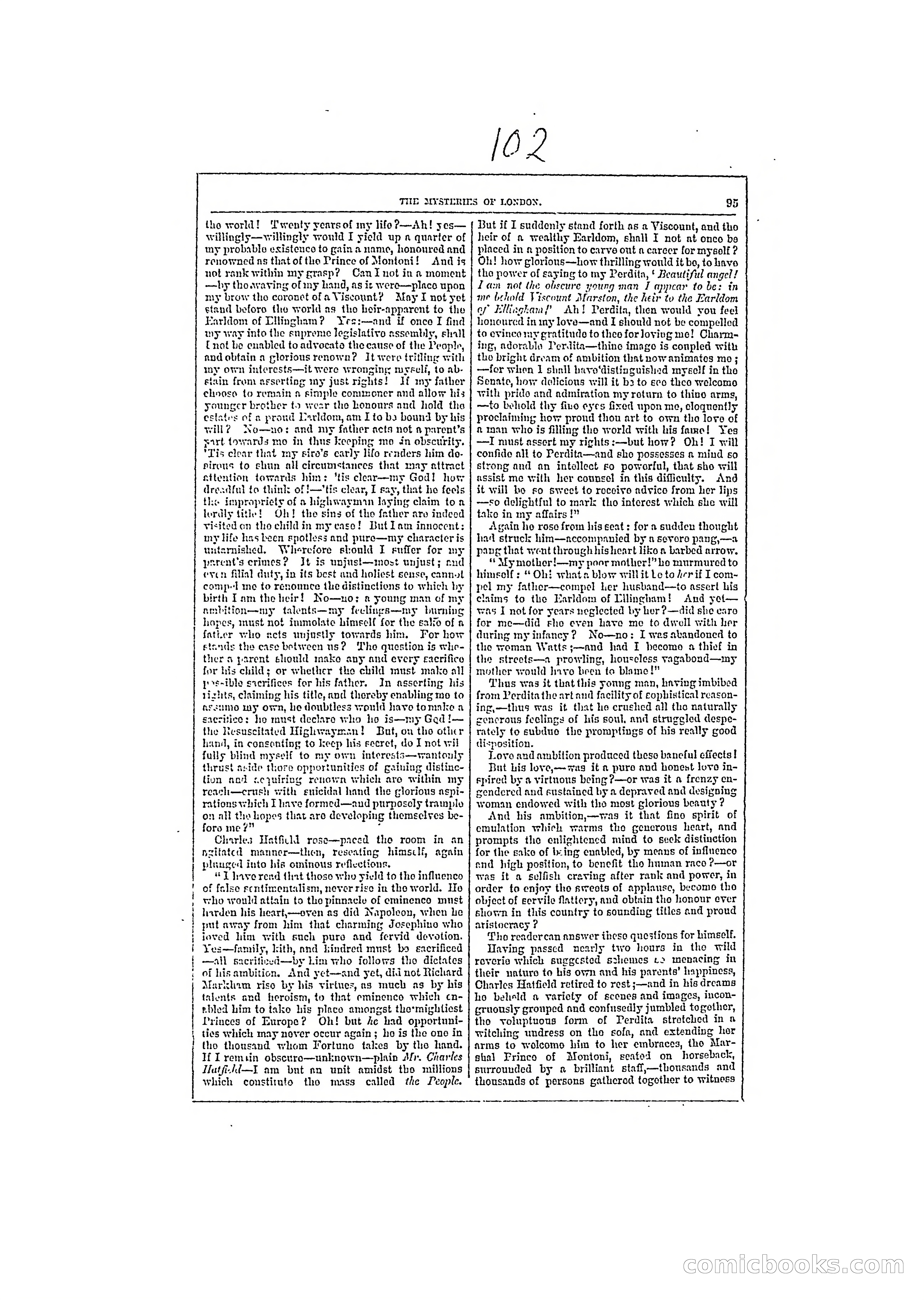
A restored page from Penny Dreadfuls, 1846. Page through the whole issue in the reader above.
📄 Transcribed text from this page (OCR, searchable)
Machine-transcribed from the original scan — historical spelling and the odd misread are preserved.
A a a a yl eg an tt EP ey 9 I tet PS lel ONO AEE EEE EE Ee ri Oe Ree ge tee ee THE MYSTERIES OF LONDON. tant, the world! ‘Uwenty yearsof my life ?—Ah! yes— wihingly—willingly would I yield up a quarter of my probable esistenco to gain a name, honoured and renowned as that of the Prince of Montoni! And is not rank within my grasp? Can I not in a moment —hy thoavaving of ny hand, as is were—place upon my brow the coronet ofa Viscount? Moy I not yet stand before tho world as tho heir-apparent to the Earldom of Cilingham? Yee:—and if once I find wy way into the supreme legislative assembly, shall Cnat be enabled to advecata the cause of the People, nnodobtain a plorious renown? It were trifling with iny own interests—it were wronging myvéeli, to ab- sinin from asserting my just rights! H{ ny father choose to remain a simple conumoner and allow his younger brother to wear the hononrs and hold the estates of a prond Larldom, am Ito bs bound by his will? No—no: and my father acts not a parent’s sirt towards mo in thus keeping mo in obscurity. ‘Tis clear that my siro’s carly lifo renders him do- piraus to chun all circumstances that may attract gitention tawards him: ‘ts clear-——-my God] hov- Areadful to think of !—'tis clear, I say, that hoa feels the impropriety of a highwayman Isying claim toa lordly title! Oh! the sins of the father are indeed visiteden tho ehitld in my case! ButIam innocent: my life has been epotless and pure—my character is uutsrnished, Wherefore shonld I suffer for my pnrent’s crimes? Jt is unjust—zmost unjust; ond even filial duty, in its best and holiest sense, cannot compl me to renonnce the distinctiens to which by birth Iam the heir! No—uo: a young man of my ainbition—my talents—my feclings—my burning hopes, must not inmolste himeclf for the salvo of s fatier who acts unjustly towards him. For how stands the case between us? Who question is whe- thers parent should make any and every eacrifico for his child; or whether the child must mako all yp s-ible sverifices for his father. In asserting his lizhts, claiming his title, and thereby enabling mo to assume my own, he doubtless would have tomake a saccitice: hho must declaro who ho is—my Ged !— the Resuscitated Highwaymsan? But, on tho other hand, in consonting to keep his seerct, do I not wil fully blind myself to my own interests—wantonly thrust aside thore opportunities of gaining distinc- tion aod sequiring renown which are within my reach—crush with enicidal hand the glorious aspi- rations which Lhave formed—aund purposely trample on all the hopes that are developing themselves be- foro me 7" . Charles Hatfiuld roso—paced the room in an nzitatcd manner—thon, reseating himself, again plunged into his ominous reflections, “T have rend (hat those who yield to the influenco f false ecntimentalism, never rise in the world. Ho who would attain to the pinnacle of cminenco must harden his heart,—oven as did Napoleon, when he put away from him that charming Josephine who ioved him with such puro and fervid devotion. Yes—family, kith, and hindred must bo sacrificed —all sacrificed—by Lim who follows tho dictates of hisambhtion. And yet—and yet, did not Richard Markham riso by his virtues, as much as by his tnients and heroism, to that eminenco which cn- pbled him to take his placo amongst tho-mightiest Princes of Europe? Oh! but Ae had opportuni- ties which may nover occur again; ho is the one in tho thousand whom Vortuno takes by the hand. If Lremiin obscuro—unknown—plain Jf. Charles Hatfiild—I am but on unit amidst tho millions which constimmfo tho mass called the People. te 8 [02 95 But if I suddenly stand forth as a Viscount, and tho heir of 2 wealthy Earldom, shall I not at onco be placed in a position to carve out a carcer for myself ? Oh! how glorious—how thrilling would it be, to have tha power of saying to my Perdita, § Beauttfil angel! Len not the obscure young man T appcar to be: in me behold Viscount Marston, the heir to the Earldom of Eltiaghamf’ Ah! Perdita, then would you feel honoured in iy love—and I should not be compelled to evinco my gratitude to thee forloviug me! Charm- ing, adorable Perdita—thine imago is conpled with the bright dream of ambition that now animates mo; —for when 1 shall havodistinguislied myeclf in the Senate, hov delicious will it b32 to eco thee welcome with prido and admiration my rotum to thine arms, —fo behold thy fine eyes fixed upon me, cloqnently proclaiming how proud thou art to own tho love of nr inan who is filling the world with his fame! Yes ~—~I must assert my rights :—but how? Oh! I will confide all to Perdita—and sho possesses a mind so strong and an intellect co poworful, that sho will assist me with her counsel in this difficulty. And it will bo so sweet to receive advico from her lips —so delightful to mark tho interest which she will take in my affairs !” Again he rose from his seat: for a sudden thought had struck him—accompanied by a sevore pang,—a pang that went through his heart like a barbed arrow. “ My mother!—my poor mother!” ho murmured to himself: “Oh! whats blow willit Le to dcr if I com- pel my father—compel her husband—to assert his elnims to the Earldom of Lilingham! And yet— was I not for years neglected by her ?—did she caro for me—did rho even have me to dwell with her during myinfancy ? No—no: I wes abandoned to the woman Watts sand had I become a thief in the streets—a prowling, houscless vagabond—my mother would have been to blame!" Thus was it thatthis yonng man, having imbibed from Perditathe artand facility of eophistical reason- ing,—thus was it that he crushed all tho naturally cencrous feelings of his soul, and struggled despe- rately to subdue the promptings of his really good disposition. Lovo and ambition produced these baneful effects! But his love,—-was it 2 pure and honest lovo in- epired by a virtuous being ?—or was it a frenzy en- gendered and sustained by a depraved and designing woman endowed with the most glorious beauty ? And his ambition,~vwas it that fino spirit of emulation whieh warms the generous heart, and prompts the enlightencd mind to seek distinction for the sako of bcing enabled, by means of influenco nnd high position, to benefit the human raco ?—or was it a selfish craving after rank and power, in order to enjoy tho sweets of applause, become tho object of geervile Mattery, and obtain tho honour ever shown in this country to sounding titles and proud aristocracy ? Tho readercan answer ihese questions for himself. Having passcd nearly two hours in the wild reverie which suggested schemes co menacing In their nature to bis own and hig parents’ happiness, Charles Hatfield retired to rest ;—and in his dreams ho beheld a variety of scenes and images, incon- gruously grouped ond confusedly jumbled together, tho voluptuous form of Perdita stretched in a witching undress on tho sofa, and extending her arms to wolcomo him to her embraces, tho Mar- shal Frinco of Montoni, seated on horseback, surrounded by a brilliant staff,—thousands and thousands of persons gatherod together to witness co G DOO SS (SO