
Penny Dreadfuls, 1846 · page 103 of 399
The Mysteries of London, Vol. IV — page 103: what you’re looking at
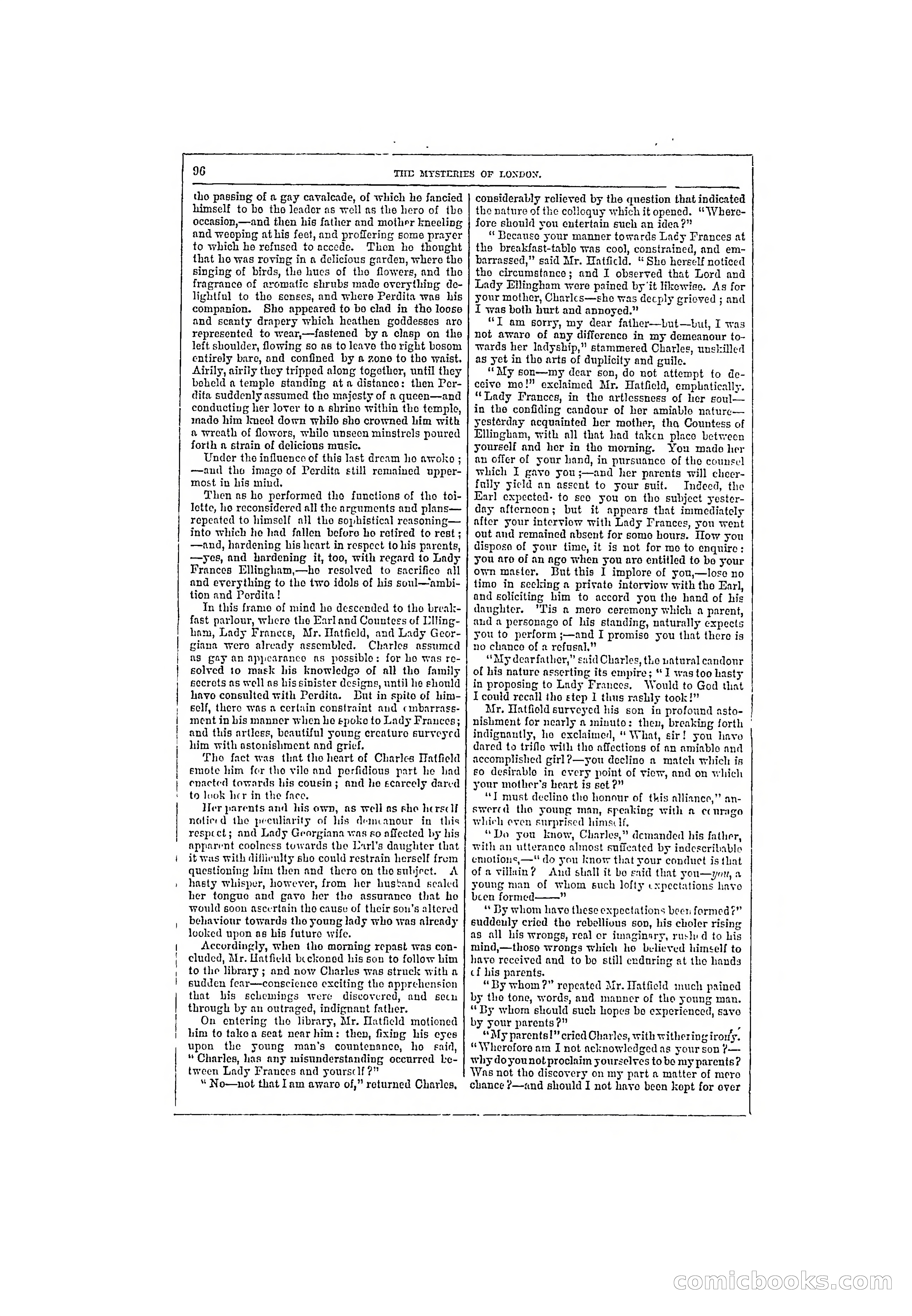
A restored page from Penny Dreadfuls, 1846. Page through the whole issue in the reader above.
📄 Transcribed text from this page (OCR, searchable)
Machine-transcribed from the original scan — historical spelling and the odd misread are preserved.
rr oe re — ee 96 THE MYSTCRIES OF LONDON. ag ee ee ee eee ee ae tho passing of a gay cavalcade, of which he fancied himself to be the leader as well as the hero of the occasion,—and then his father and mother knecling and weeping at his feet, and proflering some prayer to which he refused to accede. Then he thought that he was roving in a delicious garden, where tho singing of birds, the hues of the flowers, and tho fragrance of aromatic shrubs made overything de- lightf{ul to the senses, and where Perdita was his companion. She appeared to be clad in tho loose and scanty drapery which heathen goddesses aro represented to wear,—fastened by a clasp on the left shoulder, flowing so as to leave the right bosom entirely bare, and confined by a zone to tho waist. Airily, airily they tripped along together, until they beheld a temple standing ata distance: then Per- dita suddenly assumed the majesty of a queen—and conductiug her lover to a shrino within the temple, made him kneel down while she crowned him with a wreath of flowors, while unseon minstrels poured forth a strain of delicious music. Under the influence of this last dream ho awoko ; -—autl tho image of Perdita still remained upper- most in his mind, Then as ho performed tho fonctions of tho toi- Iette, ho reconsidered all the arguments and plans— repeated to himself all the sophistical reasoning— into which he had fallen before ho retired to rest ; —nnd, hardening his heart in respect to his parents, —yes, and hardening it, too, with regard to Lady Frances Ellingham,—he resolved to sacrifico a}l and everything to the two idols of his soul—ambi- tion and Perdita! In this frame of mind he descended to the break- fast parlour, where the Earland Countess of Llling- ham, Lady Franecs, Mr. Hatfield, and Lady Geor- gianna were already assembled. Charles assumed as gay an appcaranco as possible: for ho was re- solved to mask his knowledga of all tho family gecrots ns well as his sinister designs, until he ehonld havo consulted with Perdita. Dut in spite of him- self, thero was a certain constraint and cmbarrass- ment in his manner when he spoke to Lady Frances; and this articss, beautiful young ercaturo surveyed him with astonishment and gricf. Tho fact was that tho heart of Charles Iatfield emote him for the vile and perfidious part he had enacted towards his cousin; and ho ecarcely dared to look her in the face, Mer parents and his own, as well as she herself nolierd the peculiarity of his demcanour in this respcct; and Lady Georgiana was so affected by his apparent coolncss tuwards the Larl's daughter that if was with difiienlty suo could restrain herself from questioning him then and thero on thosubject. A hasty whisper, however, from her husband sealed her tonguo and gavo her tho assurance that ho would soon ascertain the cause of their sou’s altered behaviour towards tho young lady who was already looked upon as his future wife. Accordingly, when the morning repast was con- cluded, Mr. Hatfield bcekoned his son to follow him to the library ; and now Charles was struck with a sudden fear—conscicnce exciting the apprehension that his schemings were discovered, and secu through by an outraged, indignant father. On entering the library, Mr. Hatficld motioned him to take a seat near him: then, fixing his cyes upon the young man’s countenance, ho said, * Charles, has any misunderstanding occurred Le- tween Lady Frances and yoursclf ?” “ No—not that lam awaro of,” returned Charles, considerably relieved by the question that indicated the nature of the colloquy which it opened. “ Where- fore should you entertain such an idea?” ‘f Because your manner towards Lady Frances at the breakfast-table was cool, constrained, and em- barrassed,” said Mr. Uatficld. “She herself noticed the circumstance; and I observed that Lord and Lady Ellingham were pained by ‘it likewiee. Ag for your mother, Charlcs—she was decply grioved ; and I was both burt and annoyed.” ‘I am sorry, my dear father—but—but, I was not awaro of any difference in my demeanour to- wards her ladyship,” stammered Charles, unskilled as yet in tho arts of duplicity and guile. ‘‘My son—my dear son, do not attempt fo de- ceive mo!” exclaimed Mr. Hatfield, emphatically. ‘Lady Frances, in the artlessness of her coul— in the confiding candour of her amiable naturc— yestérday acquainted her mother, tha Countess of Eilingham, with oll that had taken place between youreclf and her in the morning. You mado her an offer of your hand, in pursuance of the counsel which I gave you;—and her parents will cheer- fully yicld an assent to your suit. Indeed, the Earl expected: to seo you on tho subject yester- day afternoon; but it appears that immediately after your interviow with Lady Frances, you went out and remained rbsent for some hours. Tow you dispose of your time, it is not for mo to enquire: you aro of an ago when you aro entitled to be your own master. But this I implore of you,—lose no fimo in seeking a private interviow with the Earl, and soliciting him to accord you the hand of his daughter. "Tis 2 moro ceremony which a parent, and a personage of his standing, uaturally expects you to perform ;—and I promise you that there is no chance of a refusal,” “My dearfather,” said Charles, the natural candonr of his nature asserting its empire; “I was too hasty in proposing to Lady Franees. Would to God that I could recall tho etep 1 thus rashly took!” Mr. Hatfiold surveyed his son in profound asto- nishment for nearly a minuto: then, breaking forth indignantly, ho exclaimed, * What, sir! you havo dared to triflo with tho affections of an amiable and accomplished girl ?—you decline a match which is fo desirablo in every point of view, and on which your mother’s heart is set ?” “TI must declino tho honour of this alliance,’ an- swercd the young man, speaking with a ccnrago whieh even surprised himsclf, “Do you know, Charles,” demanded his father, with an utterance almost suffeated by indescribablo cmotions,—“ do you know that your conduct is that ofa villuin? And shall it bo enid that yon—yon, a young man of whom such lofty expectations havo been formed - ‘By whom havo these expectations been formed?” euddenly cried tho rebellious son, his choler rising as all his wrongs, real or imaginary, rush d to his mind,—those wrongs which ho believed himeelf to havo received and to bo still enduring at the hands cf his parents. “By whom ?” repeated Mr. Hatfield much pained by the tone, words, and manner of the young man. “ By whom should suck hopes be experienced, save by your parents ?” , “My parents!” cried Charlos, with withering irory. “Wherefore am I not acknowledged as your son ?-— why doyounot proclaim yourselves to be my parents? Was not tho discovery on my part a matter of mero chance ?—and should I not havo been kept for over —— ee ee ~“ a tr PR Pe TU ky PS 7 h-2P 5} (SO) GIOOKS (SO) =