
Penny Dreadfuls, 1846 · page 205 of 399
The Mysteries of London, Vol. IV — page 205: what you’re looking at
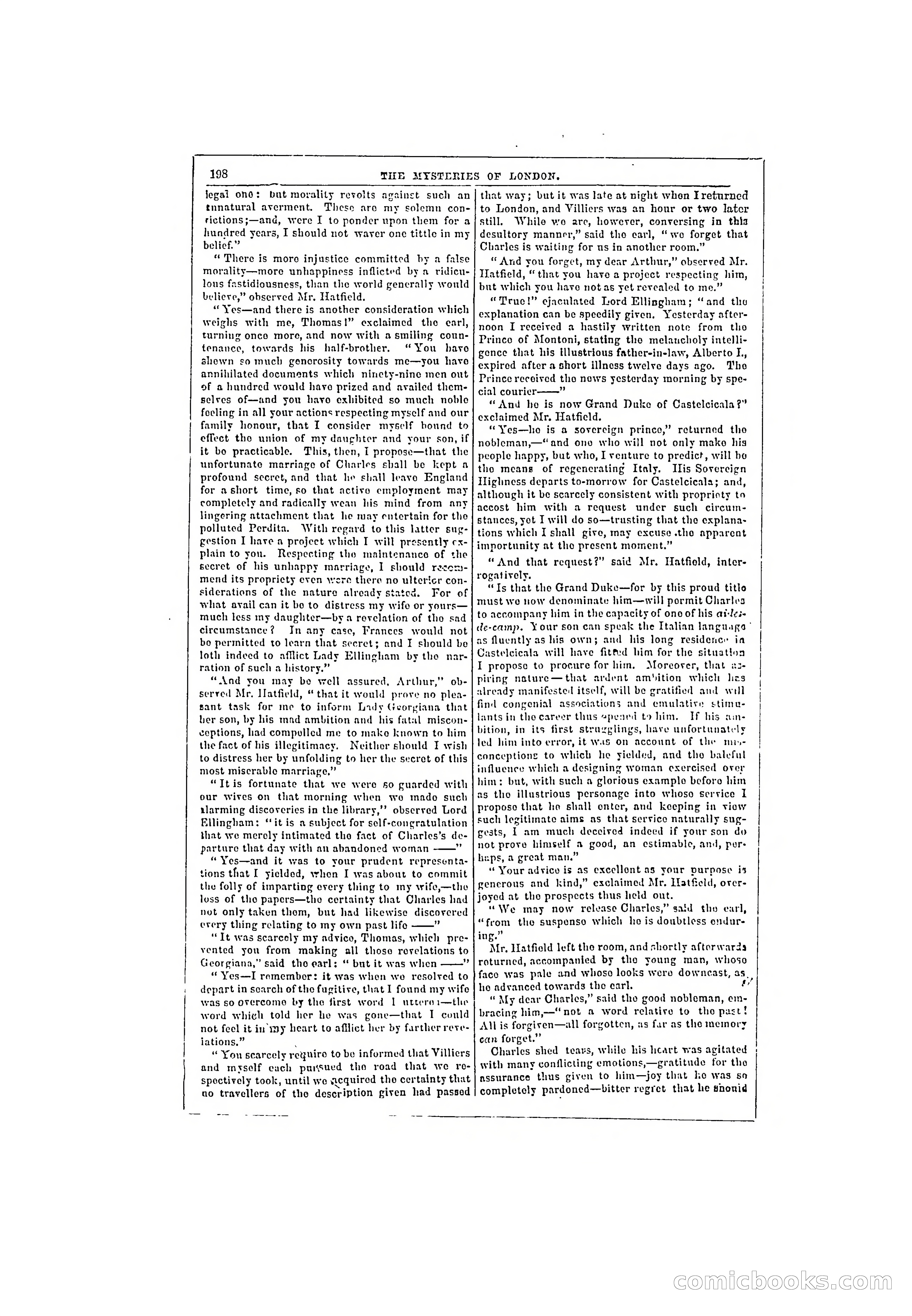
A restored page from Penny Dreadfuls, 1846. Page through the whole issue in the reader above.
📄 Transcribed text from this page (OCR, searchable)
Machine-transcribed from the original scan — historical spelling and the odd misread are preserved.
ce ee 198 TIIE A-YSTERIES OF LONDON. jegai ond: but morality revolts against such an tnnatural averment. These are my solemn con- rictions;—and, were I to ponder upon them for a hundred years, I should not waver onc tittle in my belief.” * There is more injustice committed by a false morality—more unhappiness inflicted by a ridicu- lous fastidfousness, than the world generally would believe,” observed Mr. Hatfield. “Yes—and there is another consideration which weighs with me, Thomas!” exclaimed the earl, turning once more, and now with a smiling coun- tenance, towards his half-brother. ‘You have shewn so much genorosity towards me—you have annihilated documants which ninety-nine men out of a hundred would have prized and availed them- selves of—and you havo exhibited so much noble feeling in all your actions respecting myself and our family honour, that [ consider myself bound to effect tho union of my daughter and your son, if it bo practicable. This, then, I propose—that the unfortunate marriage of Charles shall be kept a profound secret, and that he shall leave England for ashort time, so that active employment may completely and radically wean his mind from any lingering attachment that he may entertain for the polluted Perdita. With regard to this latter sug- gestion I have a project which I will presently cx- plain to you. Respecting the maintenance of the secret of his unhappy marriage, I should reser- mend its propricty even were there no ultericr con- siderations of the nature already stated. For of what avail can it be to distress my wifo or yours— much less ny daughter—by a revelation of tho sad circumstance? In any case, Frances would not bo permitted to learn that secret; and I should be loth indeed to afflict Lady Ellingham by the nar- ration of such a history.” “And you may be well assured, Arthur,’’ ob- served Mr. Ilatfield, “that it would prove no plea- sant task for me to inform Lady Georgiana that ber son, by his mad ambition and his fatal miscon- ceptions, had compolled me to make known to him the fact of his illegitimacy. Neithor should I wish to distress her by unfolding to her the secret of this most miscrablo marriage,” “Ttis fortunate that we were s0 guarded with our Wives on that morning when wo mado such rlarming discoveries in the library,’’ observed Lord Ellingham: “it is a subject for self-concratulation that we merely intimated tho fact of Chartes’s de- parturo that day with an abandoned woman “Yes—and it was to your prudent representa- tions that I yielded, whon I was about to commit the folly of imparting every thing to my wife,—the loss of the papers—tho certainty that Charles had not only taken thom, but had likewise discovered every thing relating to my own past lifo - “Tt was scarcely my advico, Thomas, which pre- vented you from making all thoso revelations to Georgiana,” said tho earl: “ but it was when : “ Yes—I remember: it was when we resolved to depart in soarch of the fugitive, that I found my wife was so overcome by the first word 1 uttere1—the word which told her he was gone—that I could not feel it in my heart to afflict her by farther reve- jations.” ' “You searcely reyuire to be informed that Villiers and myself euch parsued the road that we ro- spoctively took, until we acquired tho certainty that ao travellers of the description given had passed that way; but it was late at night when Ireturned to London, and Villiers was an hour or two latcr still. While we are, however, conversing in this desultory manner,” said the earl, “wo forget that Charles is waiting for us in another room.” “And you forget, my dear Arthur,” observed Mr. IWatfield, “that you have a project respecting him, but which you have notas yet revealed to me.” “Teue!l” ejaculated Lord Ellingham; “and thu | explanation can be speedily given. Yesterday after- | noon I received a hastily written note from tho Prince of Montoni, stating tho melancholy intelli- genee that his illustrious father-in-law, Alberto I, expired after a short illness twelve days ago. Tho Prince received tho nows yesterday morning by spe- cial courier e “And he is now Grand Duke of Castelcicala?” exclaimed Mr. Hatfield. “ Yes—ho is a sovereign prince,’ returned tho nobleman,—“ and one who will not only make his people happy, but who, I venture to predict, will bo tho means of regencrating Italy. ILis Sovercign Hligliness departs to-morrow for Castelcicala; and, although it be scarcely consistent with propristy to accost him with a request under such circum- stances, yot I will do so—trusting that the explana- tions which I shall give, may excuse .the apparent importunity at the present moment.” “And that request?” said Mr. Hatfiold, inter- | rogatively. “Ts that the Grand Duke—for by this proud title must we now denominate him—will pormit Charles to accompany him in the capacity of ono of his as-les- de-camp. Your son can speak the Italian languaga ° as fluently as his owns and his long residence in | Casteleicala will have fitted him for the situation | I propose to procure for him. Moreover, that a3- | | piring noture—that ardent ambition which lizs already manifested itself, will be gratified and wll find congenial associations and emulative stimu. lantsin tho career thus epeaed to him, If his aim- bition, in its first stragglings, have unfortunately led him into error, it Was on account of the mise conceptions to which he yielded, and the baleful influence which a designing woman cxercised over him: but, with such a glorious example before him as tho illustrious personage into whoso service I propose that he shall onter, and keeping in view such legitimate aims as that service naturally sug- gests, I am much deceived indeed if your son do | not prove himself a good, an estimable, and, por- heps, a great man.” ‘Your advice is as excellont as your vurpose is generous and kind,” exclaimed Mr. Lfatficld, over- joyed at the prospccts thus held out. “We may now release Charles,” said the earl, “from the suspense which ho is doubtless ondur- ing.” Mr. Hatfield left the room, and shortly afterwards roturned, accompanied by the young man, whoso faco was pale and whoso looks were downcast, as_, ho advanced towards tho earl. fr “My dear Charles,” said tho good nobleman, em- bracing him,—“ not a word relative to tho pase! Allis forgiven—all forgotten, as fur as the memory can forget.” Charles shed tears, while his hcart was agitated | with many conflicting emotions,—gratitude for tho assurance thus given to him—joy that ho was so completely pardoncd—bitter regret that he snonid 2 a EConnicloooks (SO)