
Penny Dreadfuls, 1846 · page 206 of 399
The Mysteries of London, Vol. IV — page 206: what you’re looking at
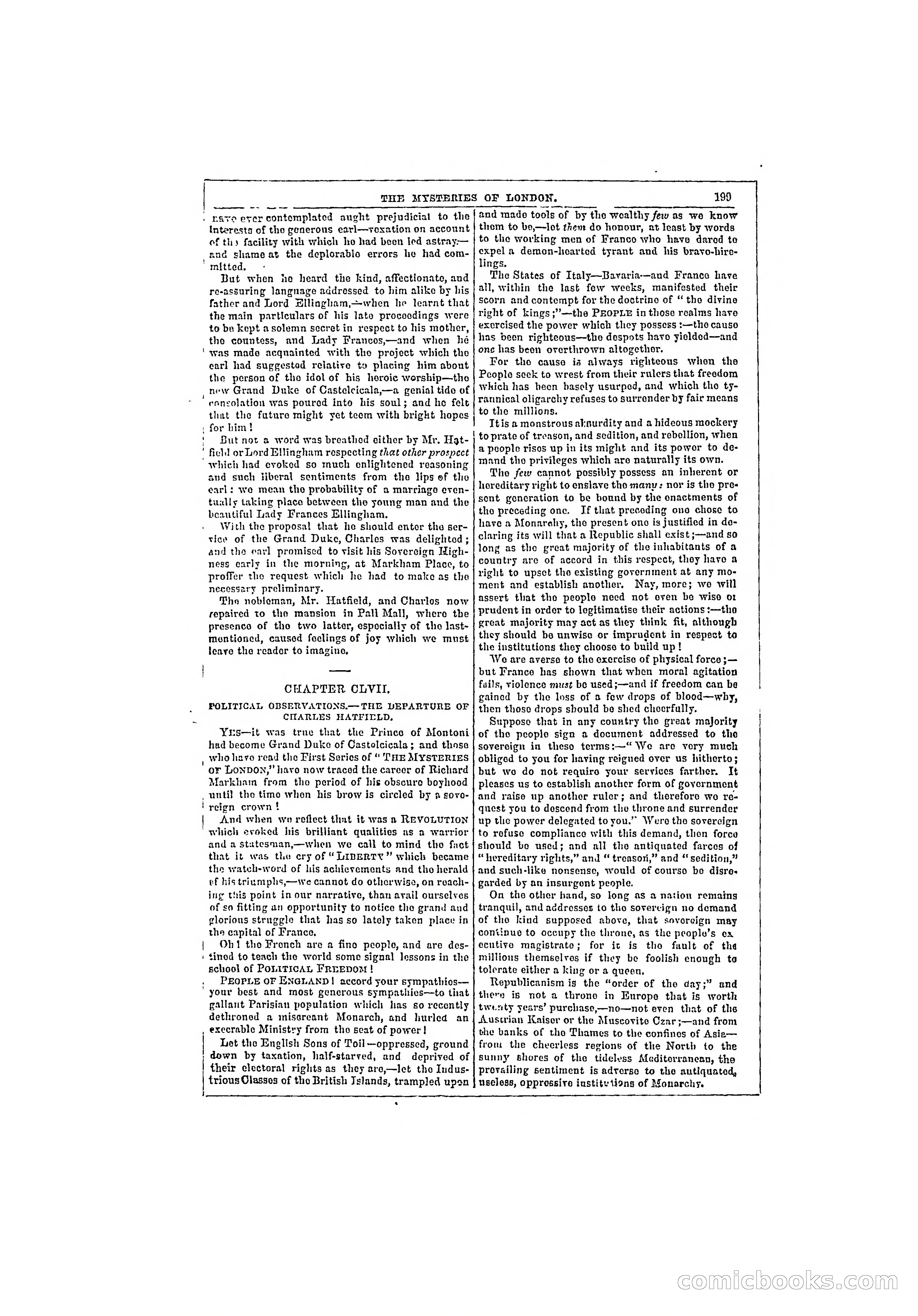
A restored page from Penny Dreadfuls, 1846. Page through the whole issue in the reader above.
📄 Transcribed text from this page (OCR, searchable)
Machine-transcribed from the original scan — historical spelling and the odd misread are preserved.
THE MYSTERIES OF LONDON. — — —- , rave ever contemplated aught prejudicial to the interests of the generous earl—vexation on account fths facility with which ho had been led astray— nnd shame at the deplorable errors lie had com- ' mitted. ine: But when he heard tie kind, affectionate, and re-assuring langnage addressed to him alike by his father and Lord Xllingham,—when he learnt that the main particulars of his late proceedings were to be kept asolemn secret in respect to his mother, the countess, and Lady Prancos,—and when hé was mado acquainted with the project which the earl had suggested relative to placing him abont the person of the idol of his heroic worship—tho _new Grand Duke of Castelcicala,—a genial tido of consolation was poured into his soul; and he felt that the fature might yet teem with bright hopes for him! But not a word was breathed either by Mr, Hat- ficld or Lord Eliingham respecting that other prospect which had evoked so much enlightened reasoning and such Hberal sentiments from the lips of the earl: woe mean the probability of a marriage even- tually taking place between the young man and the beautiful Lady Frances Ellingham, With the proposal that he should enter the ser- vice of the Grand Duke, Charles was delighted; and tho earl promised to visit his Sovereign High- ness early in the morning, at Markham Place, to proffer the request which he had to make as the necessary preliminary. The nobleman, Mr. Hatfield, and Charlos now repaired to the mansion in Pall Mall, where the presence of tho two latter, espocially of the last- mentioned, caused foelings of joy which we must leaye the reader to imagine, ed CHAPTER CLVII. POLITICAL OBSERVATIONS.— THE VEPARTURE OF CHARLES HATFICLD, Yurs—it was true that the Prince of Montoni had become Grand Duke of Castolcicala; and those . who have read the First Series of “ TrE ALYSTERIES or LONDON,” havo now traced the career of Richard Markham from tho period of his obscure boyhood , unti? the time when his brow is circled by a sovo- | ae a sear reign crown And when wo reflect that it was a REVOLUTION which evoked his brilliant qualities as a warrior and a Statesman,—when we call to mind tho fact that it was the cry of “LIBERTY” which became the wateh-word of his achievements and tho herald of his triumphs,—we cannot do otherwise, on reach- ing this point in our narrative, than avail ourselves of so fitting an opportunity to notice the grand and glorious struggle that has so lately taken place in the capital of France, Ohi the French are a fine people, and are des- fined to teach the world some signal lessons in the school of PoLITicAL Frrepom ! PEOPLE OF ENGLAND! accord your sympathioes— your best and most gencrous sympathies—to that gallant Parisian population which has so recently dethroned a misereant Monarch, and hurled an execrable Ministry from tho seat of power ! Lot the English Sons of Toil—oppressed, ground down by taxation, half-starved, and deprived of their electoral rights as they are,—Ict tho Indus- trious Olasses of tho British Jslands, trampled upon 199 and made tools of by the wealthy few as we know them to be,—lot trent do honour, at least by words to the working men of Franco who have darod te expel a demon-learted tyrant and his bravo-hire- lings. The States of Italy—Bavaria-—and Franco have all, within the last few weeks, manifested their scorn and contempt for the doctrine of “ the divine right of kings ;”—the PEOPLE in those realms have exercised the power which they possess :—the causo has been righteous—the despots have yielded—and onc has been overthrown altogether. For the cause is always righteous whon the People seck to wrest from their rulers that freedom which has heen hbasely usurped, and which tho ty- rannical oligarchy refuses to surrender by fair means to the millions. Tt is a monstrous absurdity and a hideous mockery ' to prate of treason, and sedition, and rebellion, when a people risos up in its might and its powor to de- mand the privileges which are naturally its own. The few cannot possibly possess an inherent or hereditary right to enslave the many: nor is the pre« sent generation to be bound by the onactments of tho preceding onc. If that preceding ono chose to have a Monarshy, the present one is justified in do- celaring its will that a Republic shall exist ;—and so long as the great majority of the inhabitants of a country are of accord in this respect, they have a right to upset the existing government at any mo- ment and establish another. Nay, more; we will assert that the people need not even be wise or prudent in order to legitimatise their actions :—tho great majority may act as they think fit, althongh they should be unwise or imprudent in respect to the institutions they choose to build up ! Wo are averse to the exercise of physical force ;— but France has shown that when moral agitation fails, violence must be used ;—and if freedom can be gained by the loss of a few drops of blood—why, then those drops should be shed cheerfully. Suppose that in any country the great majority of tho peoplo sign a document addressed to the sovercign in theso terms:~—“ We are very much obliged to you for having reigned over us hitherto; but we do not requiro your services farther. It pleases us to establish another form of government and raise up another ruler; and therefore wo re- quest you to descend from the throne and surrender up tle power delegated toyou.”” Were the sovercign to refuse compliance with this demand, tlion force should be used; and all the antiquated farces of “hereditary rights,” and “ treason,” and “ sedition,” and such-like nonsense, would of course be disre- garded by an insurgont people. On the other hand, so long as a nation remains tranquil, and addresses to tho sovereign no demand of the kind supposed above, that sovorcign may continue to occupy the throne, as the people’s ex ecutive magistrate; for ict is tho fault of the millious themselves if they be foolish enough to tolerate either a king or a queen, Republicanism is the “order of tho day;” und there is not a throne in Europe that is worth twenty years’ purchase,—no—not even that of the Austrian Kaiser or the Muscovite Czar;—and from the banks of tho Thames to the confines of Asie— from the cheerless regions of the North to the sunny shores of the tideless Mediterranean, the prevailing sentiment is adverse to the autiquated, useless, oppressive instity tions of Monarchy. a (C(O) (C DOO <S LL (SO)