
Penny Dreadfuls, 1846 · page 383 of 399
The Mysteries of London, Vol. IV — page 383: what you’re looking at
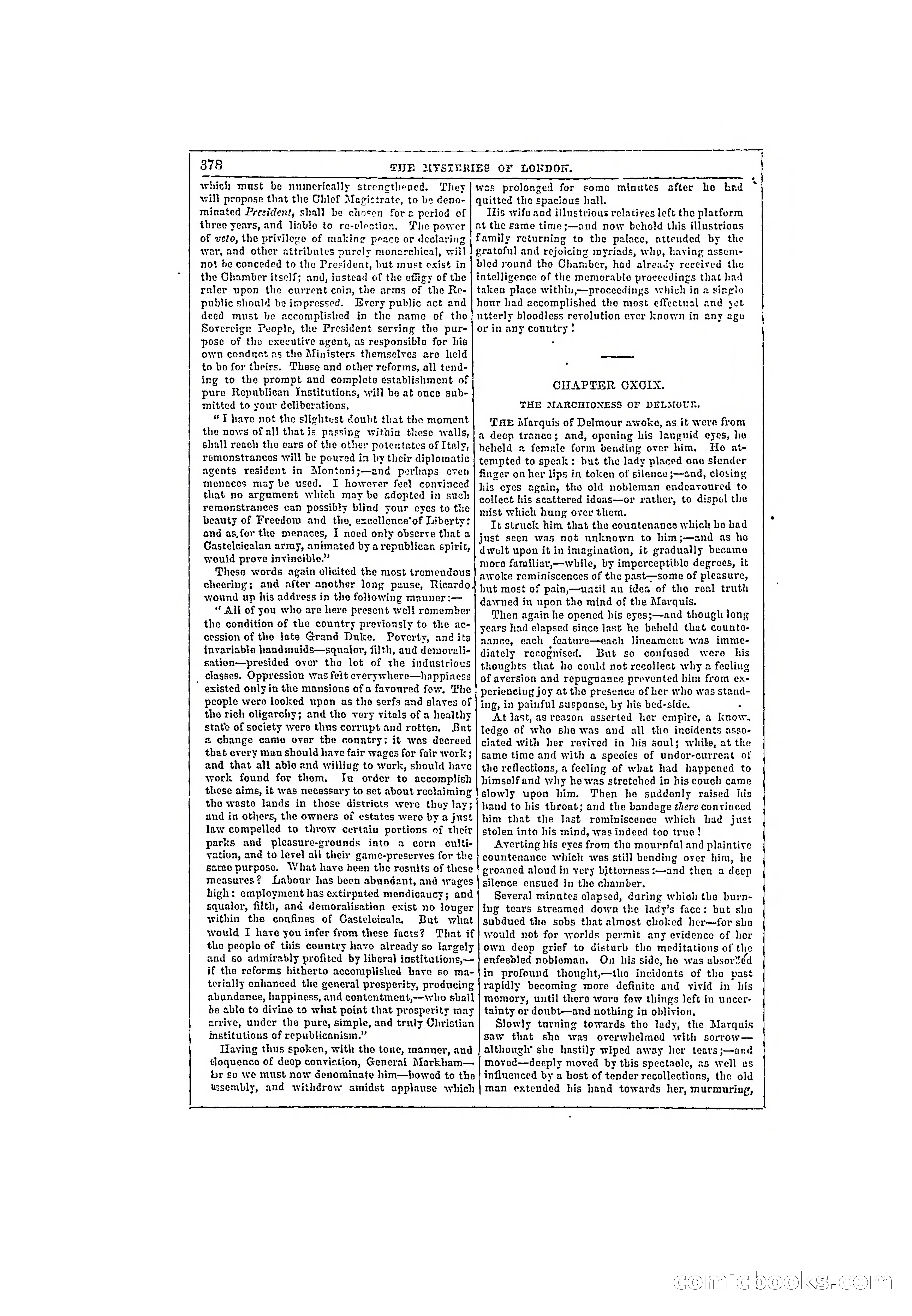
A restored page from Penny Dreadfuls, 1846. Page through the whole issue in the reader above.
📄 Transcribed text from this page (OCR, searchable)
Machine-transcribed from the original scan — historical spelling and the odd misread are preserved.
oe 3878 SUE MYSTERIES OF LONDON. Se ee, a ee ee ee which must bo numerically strengthened. They vill propose that the Chief Magistrate, to be deno- minated President, shall be chocen fora period of three years, and liable to re-election. The power of veto, the privilege of making peace or declaring war, and other attributes purely monarchical, will not be conceded to the President, but must exist in the Chamber itself; and, instead of the effigy of the ruler upon the current coin, the arms of the Re- public should be impressed. Every public act and deed must be accomplished in the name of tho sovereign People, the President serving the pur- pose of the executive agent, as responsible for his own conduct as the Ministers themselves are held to be for theirs. These and other reforms, all tend- ing to the prompt and complete establishment of purses Republican Institutions, will be at once sub- mitted to your deliberations, “T have not the slightest doubt that the moment the nows of all thatis passing within these walls, shall reach the ears of the other potentates of Italy, remonstrances will be poured in by their diplomatic agents resident in Montonis;—and perhaps eren menaces may be used. I however feel convinced that no argument which may bo adopted in such remonstrances can possibly blind your eyes to the beauty of Freedom and the, excellence’of Liberty: ond as,for the menaces, I need only observe that a Castelcicalan army, animated by a republican spirit, would prove invincible.” These words again elicited tho most tromendous cheering; and after another long wound up his address in the following manner:— “* All of you who are here present well remember the condition of the country previously to the ac- cession of the late Grand Duke. Poverty, and its invariable handmaids—squalor, filth, and demorali- sation—presided over the lot of the industrious _ classes. Oppression was felt everywhere—happiness existed onlyin the mansions ofa favoured fow, The people were looked upon as the serfs and slaves of the rich oligarchy; and the very vitals of a healthy state of society were thus corrupt and rotten. But a change came over the country: it was decreed that every man should have fair wages for fair work; and that all able and willing to work, should have work found for them. In order to accomplish these aims, it was necessary to set about reclaiming the wasto lands in those districts were they Jay; and in others, the owners of estates were by a just law compelled to throw certain portions of their parks and pleasure-grounds into a corn culti- vation, and to level all their game-preserves for the sare purpose. What have been the results of these measures? Labour has been abundant, and wages high: employment has extirpated mendicancy; and squalor, filth, and demoralisation exist no longer within the confines of Castelcicala, But what would I have you infer from these facts? That if the people of this country havo already so largely and so admirably profited by liberal institutions,— if the reforms hitherto accomplished have so ma- terially enhanced the general prosperity, producing abundance, happiness, and contentment,—wwho shall be ablo to divine to what point that prosperity may acrive, under the pure, simple, and truly Christian institutions of republicanism.” Taving thus spoken, with the tone, manner, and cloquence of decp conviction, General Markham— dr so we must now denominate him—bowed to the ussembly, and withdrew amidst applause which ause, Ricardo. ae A wes prolonged for some minutes after ho hard quitted the spacious hall, His wife and illustrious relatives left the platform at the same time ;—and now behold this illustrious family returning to the palace, attended by the grateful and rejoicing myriads, who, having assem- bled round the Chamber, had already reecived the intelligence of the memorable procecdings that had taken place withiu,—proceedings which in a single hour had accomplished the most effectual and set utterly bloodless revolution ever known in any age or in any country! CHAPTER CXCINX. THE MARCHIONESS OF DELMOUN, THE Marquis of Delmour awoke, as it were from a deep trance; and, opening his languid eyes, ho beheld a female form bending over him, Ho at- tempted to speak: but the lady placed one slender finger on her lips in token of silence ;—and, closing lis eyes again, the old nobleman endeavoured to collect his scattered idcas—or rather, to dispol the mist which hung over them. It steuck him that the countenance which he had just seen was not unknown to him;—and as ho dwelt upon it in imagination, it gradually became more familiar,-while, by imperceptiblo degrees, it awolce reminiscences of the past—some of pleasure, but most of pain,—until an idea of the real truth dawned in upon the mind of the Marquis. Then again he opened his eyes;—and though long years had elapsed since last he beheld that counte- nance, each feature—each lineament was immc- diately recognised. But so confused were his thoughts that ho could not recollect why a feeling of aversion and repuguance prevented him from ex- periencing joy at the presence of her who was stand- ing, in painful suspense, by his bed-side. : At last, as reason asserted her empire, a know. ledgo of who she was and all the incidents asso- ciated with her revived in his souls while, at the same time and with a species of undor-current of the reflections, a feoling of what had happencd to himself and why he was stretched in his couch came slowly upon him. Then he suddenly raised his hand to bis throat; and the bandage there convinced him that the last reminiscence which had just stolen into his mind, was indeed too true! Ayerting his eyes from the mournful and plaintive countenance which was still bending over him, he groaned aloud jn very bjtterness :—and then a deep silence ensucd in the chamber. Several minutes elapsed, during which the burn- ing tears streamed down the lady’s face: but she subdued tle sobs that almost choked her—for she would not for worlds permit any evidence of her own deop grief to disturb the meditations of the enfeebled nobleman, On his side, he was absor‘éd in profound thought,—tho incidents of the past rapidly becoming more definite and vivid in his momory, until there wore few things left in uncer- tainty or doubt—and nothing in oblivion, Slowly turning towards the Jady, the Marquis saw that she was overwhelmed with sorrow— although’ she hastily wiped away her tears ;—and moved—deeply moved by this spectacle, as well as influenced by a host of tender recollections, the old man extended his hand towards her, murmuring, EConnicloooks (CO)