
Penny Dreadfuls, 1846 · page 384 of 399
The Mysteries of London, Vol. IV — page 384: what you’re looking at
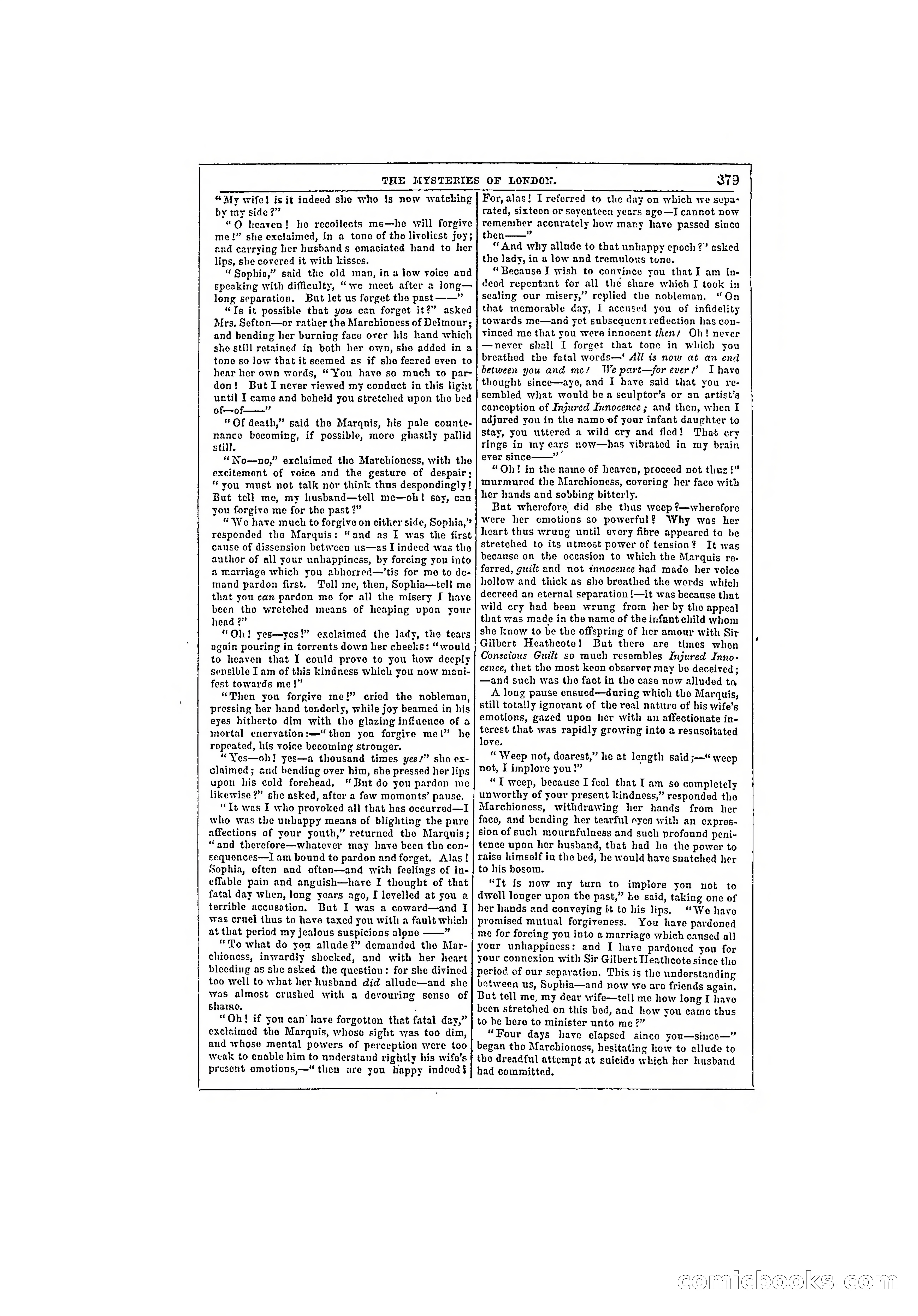
A restored page from Penny Dreadfuls, 1846. Page through the whole issue in the reader above.
📄 Transcribed text from this page (OCR, searchable)
Machine-transcribed from the original scan — historical spelling and the odd misread are preserved.
‘ rl Sy A he PA es THE MYSTERIES OF LONDON. “My wife! is it indeed she who is now watching by my side ?” “OQ heaven! ho recoilects me—he will forgive me!” she exclaimed, in a tone of tho liveliest joy; ond carrying her husbands emaciated hand to her lips, she covered it with kisses. ‘ Sophia,” said the old man, in a low voice and speaking with difficulty, “we meet after a long— long separation. But let us forget the past ——” “Ts it possible that you can forget it?” asked Mrs, Sefton—or rather the Marchioness of Delmour; and bending her burning face over his hand which she still retained in both her own, she added in a tone s0 low that it seemed as if she feared even to hear her own words, “You have so munch to par- don} But I never viewed my conduct in this light until I came and beheld you stretched upon the bed of—of——” “Of death,” said the Marquis, his pale counte- nance becoming, if possible, more ghastly pallid still. * No—no,” axclaimed tho Marchioncss, with the excitement of voice and the gesture of despair: “you must not talk nor think thus despondingly! But tcll me, my husband—tell me—oh! say, can you forgive me for the past 2?” “Wo have much to forgive on cither side, Sophia,” responded tho Marquis: “and as I was the first cause of dissension between us—as I indeed was the author of all your unhappiness, by forcing you into a marriage which you abhorrec—’tis for me to de- mand pardon first. Tell me, then, Sophia—tell mo that you can pardon me for all the misery I have been the wretched means of heaping upon your head 2” “Oh! yes—yes!” exclaimed the lady, the tears again pouring in torrents down her cheeks: “would to heavon that I could prove to you how deeply sensible I am of this kindness which you now mani- fast towards mo!” ‘Then you forgive me!’ cried the nobleman, pressing her hand tendorly, while joy beamed in his eyes hitherto dim with the glazing influence of a mortal enervation:=<“then you forgive me!” he repeated, his voice becoming stronger. “Yes—oh! yes—a thousand times yes/” she ex- claimed; and bending over him, she pressed her lips upon his cold forehead. ‘ But do you pardon me likewise ?” she asked, after a few moments’ pause. “It was I who provoked all that has occurred—I who was the unhappy means of blighting the puro affections of your youth,” returned the Marquis; “and thorefore—whatever may have been the con- sequences—I am bound to pardon and forget. Alas! Sophia, often and often—and with feelings of in- effable pain and anguish—have I thought of that fatal day when, long years ago, I levelled at you a terrible accusation. But I was a coward—and I was cruel thus to have taxed you with a fault which at that period my jealous suspicions alone ——” “To what do you allude?” demanded the Mar- chioness, inwardly shocked, and with her heart bleeding as she asked the question: for she divined too well to what her husband did allude—and she was almost crushed with a devouring sonse of sharne, “Oh! if you can’ have forgotten that fatal day,” exclaimed the Marquis, whose sight was too dim, aud whose mental powers of perception were too weak to enable him to understand rightly his wife’s presont emotions,—“ then are you happy indeed j 379 For, alas! I referred to the day on which we sepa- rated, sixteen or Seyenteen years ago—I cannot now remember accurately how many have passed since then-———” “And why allude to that unhappy epoch 2” asked the lady, in a low and tremulous touno. “ Because I wish to convince you that I am in- deed repentant for all the share which I took in scaling our misery,” replied the nobleman. “On that memorable day, I accused you of infidelity towards me—and yet subsequent reflection has con- vinced me that you were innocent then/ Oh! never —never shell I forget that tone in which you breathed the fatal words—‘ All is now at an end between you and me! We part—for ever?’ I havo thought since—aye, and I have said that vou re- sembled what would be a sculptor’s or an artist’s conception of Injured Innocence ; and then, when I adjured you in the namo of your infant daughter to stay, you uttered a wild cry and fled! That ery rings in my cars now—has vibrated in my brain ever since———”” “Oh! in the namo of heaven, proceed not thus!” murmured the Marchioncss, covering her face with her hands and sobbing bitterly. But wherefore did she thus weep f—wherofore were her emotions so powerful? Why was her heart thus wrung until every fibre appeared to be stretched to its utmost power of tension? It was because on the occasion to which the Marquis re. ferred, guilt and not tnnocence had mado her voice hollow and thick as she breathed the words which decreed an eternal separation !—it was because that wild cry had been wrung from her by the appeal that was made in the name of the infant child whom she know to be the offspring of her amour with Sir Gilbert Heathcote! But there are times whon Conscious Guilt so much resembles Injured Inno- cence, that the most keen obsorver may bo deceived; —and such was the fact in the case now alluded ta A long pause ensued—during which the Marquis, still totally ignorant of the real nature of his wife’s emotions, gazed upon her with an affectionate in- terest that was rapidly growing into a resuscitated love. “Weep not, dearest,” he at length said ;-—* weep not, J implore you !” “I weep, because I feol that I am so completely unworthy of your present kindness,” responded the Marchioness, withdrawing her hands from her face, and bending her tearful eyes with an expres- sion of such mournfulness and such profound poni- tence upon her husband, that had he the power to raise himself in the bed, he would have snatched her to his bosom. “Tt is now my turn to implore you not to dwoll longer upon the past,” he said, taking one of her hands and conveying it to his lips. “We have promised mutual forgiveness. You have pardoned me for forcing you into a marriage which caused al} your unhappiness: and I have pardoned you for your connexion with Sir Gilbert Ileathcote since the period of our separation. This is the understanding batween us, Suphia—and now wo are friends again. But tell me, my dear wife—toll mo how long I have been stretched on this bed, and how you came thus to be here to minister unto me 2?” “Four days have elapsed since you—since—” began the Marchioness, hesitating how to allude to the dreadful attempt at suicide which her husband had committed. (C(O) (C DOO <S LL (SO)