
Penny Dreadfuls, 1846 · page 43 of 399
The Mysteries of London, Vol. IV — page 43: what you’re looking at
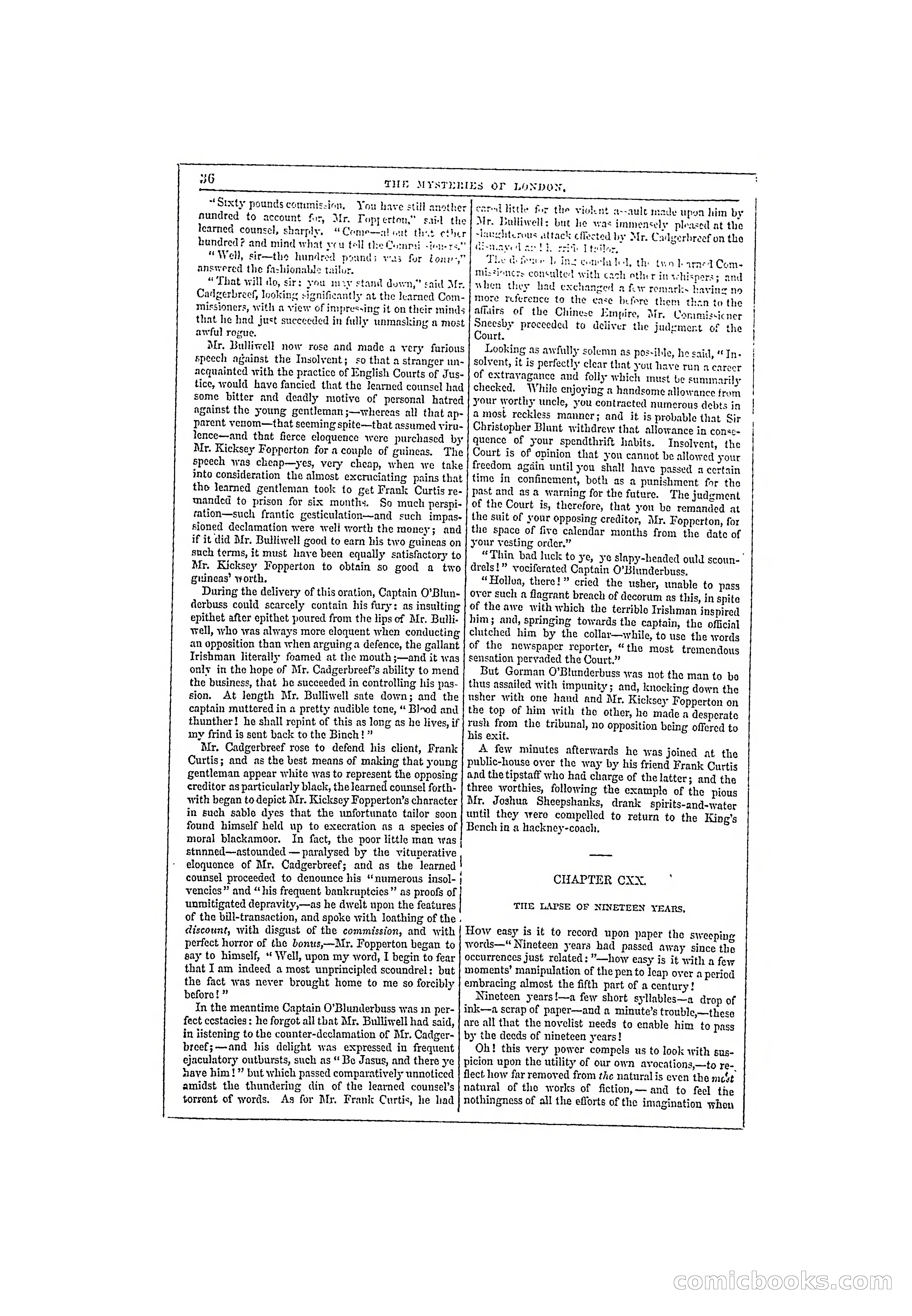
A restored page from Penny Dreadfuls, 1846. Page through the whole issue in the reader above.
📄 Transcribed text from this page (OCR, searchable)
Machine-transcribed from the original scan — historical spelling and the odd misread are preserved.
est , a THE MYSTERIES OF LONDC ae “Sixty pounds commis-ion, You have still another nundred to account for, Mr. Popyerton,” sail the learned counsel, sharply. “Come—aliut thet cther hundred? and mind what veu tell the Comme) leners,” “Well, sir—the hundred pounds was fur tenv:,” answered the fashionable tailor. “That will do, sir: you may stand duwn,” said Mr. Cadgerbreef, looking significantly at the learned Com- missioners, with a view of impressing it on their minds that he had just succeeded in fully unmasking a most awful rojrue. Mr. Bulliwell now rose and made a very furious speech against the Insolvent; so that a stranger un- acquainted with the practice of English Courts of Jus- tice, would have fancied that the Jearned counsel had some bitter and deadly motive of personal hatred against the young gentleman ;—whereas all that ap- parent venom—that seeming spite—that assumed viru- lence—and that fierce eloquence were purchased by Mr. Kicksey Fopperton for a couple of guineas. The speech was cheap—yes, very cheap, when we take into consideration the almost excruciating pains that the learned gentleman took to get Frank Curtis re- manded fo prison for six months. So much perspi- ration—such frantic gesticulation—and such impas- sioned declamation were well worth the money; and if it did Mr. Bulliwell good to earn his two guineas on such terms, it must haye been equally satisfactory to Mr. Kicksey Fopperton to obtain so good a two guineas’ worth, During the delivery of this oration, Captain O’Blun- derbuss could scarcely contain his fury: as insulting epithet after epithet poured from the lips of Mr. Bulli- well, who was always more eloquent when conducting in opposition than when arguing a defence, the gallant Irishman. literally foamed at the mouth ;—and it was only in the hope of Mr. Cadgerbreef’s ability to mend the business, that he succeeded in controlling his pas- sion. At length Mr. Bulliwell sate down; and the captain muttered in a pretty audible tone, “ Blood and thunther! he shall repint of this as long as he lives, if inv frind is sent back to the Binch!” Mr. Cadgerbreef rose to defend his client, Frank Curtis; and as the best means of making that young gentleman appear white was to represent the opposing creditor as particularly black, the learned counsel forth- with began to depict Mr. Kicksey Fopperton’s character in such sable dyes that the unfortunate tailor soon found himself held up to execration as a species of moral blackamoor. In fact, the poor little man Was | stnnned—astounded — paralysed by the vituperative eloquence of Mr. Cadgerbreef; and as the learned counsel proceeded to denounce his “numerous insol- vencies” and “his frequent bankruptcies” as proofs of unmitigated depravity,—as he dwelt npon the features of the bill-transaction, and spoke with loathing of the . discount, with disgust of the commission, and with perfect horror of the bontus,—Mr. Fopperton began to say to himself, ‘ Well, upon my word, I begin to fear that Jam indeed a most unprincipled scoundrel: but the fact was never brought home to me so forcibly before!” In the meantime Captain O’Blunderbuss was in per- fect cestacies: he forgot all that Mr. Bulliwell had said, in iistening to the counter-declamation of Mr. Cadger- breef;—and his delight was expressed in frequent ejaculatory outbursts, such as “ Be Jasus, and there ye save him!” but which passed comparatively unnoticed amidst the thundering din of the learned counsel’s torrent of words. As for Mr. Frank Curtis, he liad cored litde for the violnt a--aule made upon him by Mr. Dulliwell: but he was immensely pleased at the -lauchterous attack cflected by Mr. Cadverhreef on the Gismaved arth srl. Ltailar, The diene Loins conelated, the tro bared Com- Mizoners consulted with cach ether in sehispers; and When they had exchanged a fow remarks having no more reference to the ease bufre them then to the affairs of the Chinese Empire, Mr. Coramissicner Sneesby proceeded to deliver the jJudement of the Court. Looking as awfully solemn as pos-ible, he said, “In- solvent, it is perfectly clear that you have run a career of extravagance and folly which must be summarily checked. While enjoying a handsome allowance from your worthy uncle, you contracted numerous debts in a most reckless manner; and it is probable that Sir Christopher Blunt withdrew that allowance in conse- quence of your spendthrift habits. Insolvent, the Court is of opinion that you cannot be allowed your freedom agdin until you shall have passed a certain time in confinement, both as a punishment for the past and as a warning for the future. The judgement of the Court is, therefore, that you be remanded at the suit of your opposing creditor, Mr. Fopperton, for the space of five calendar months from the dato of your vesting order.” “Thin bad luck to ye, ye slapy-headed ould scoun-’ drels!” vociferated Captain O’Blunderbuss, “Holla, there!” cried the usher, tunable to pass over such a flagrant breach of decorum as this, in spite of the awe with which the terrible Irishman inspired him; and, springing towards the captain, the official clutched him by the collar—while, to use the words of the newspaper reporter, “the most tremendous sensation pervaded the Court.” But Gorman O’Blunderbuss was not the man to bo thus assailed with impunity; and, knocking down the usher with one hand and Mr, Kicksey Fopperton on the top of him with the other, he madea desperate rush from the tribunal, no opposition being offered to his exit. A. few minutes afterwards he was joined at the public-house over the way by his friend Frank Curtis and the tipstaff who had charge of the latter; and the three worthies, following the example of the pious Mr. Joshua Sheepshanks, drank spirits-and-water until they were compelled to return to the King’s Bench in a hackney-coach, ee a CHAPTER CXX. THE LAPSE OF NINETEEN YEARS, How easy is it to record upon paper the sweeping words—“ Nineteen years had passed away since the occurrences just related: ”—how easy is it with a few moments’ manipulation of the pen to leap over a period embracing almost the fifth part of a century! Nineteen years!—a few short syllables—a drop of ink—a scrap of paper~—and a minute’s trouble,—these are all that the novelist needs to enable him to pass by the deeds of nineteen years! Oh! this very power compels us to look with sug- picion upon the utility of our own avocations,—to re-, flect how far removed from the natural is even the mct natural of the works of fiction, —and to feel the nothingness of all the efforts of the imagination whon —m—we- —— me ee ew ee eee (SO) GIOOKS (SO)