
Penny Dreadfuls, 1846 · page 44 of 399
The Mysteries of London, Vol. IV — page 44: what you’re looking at
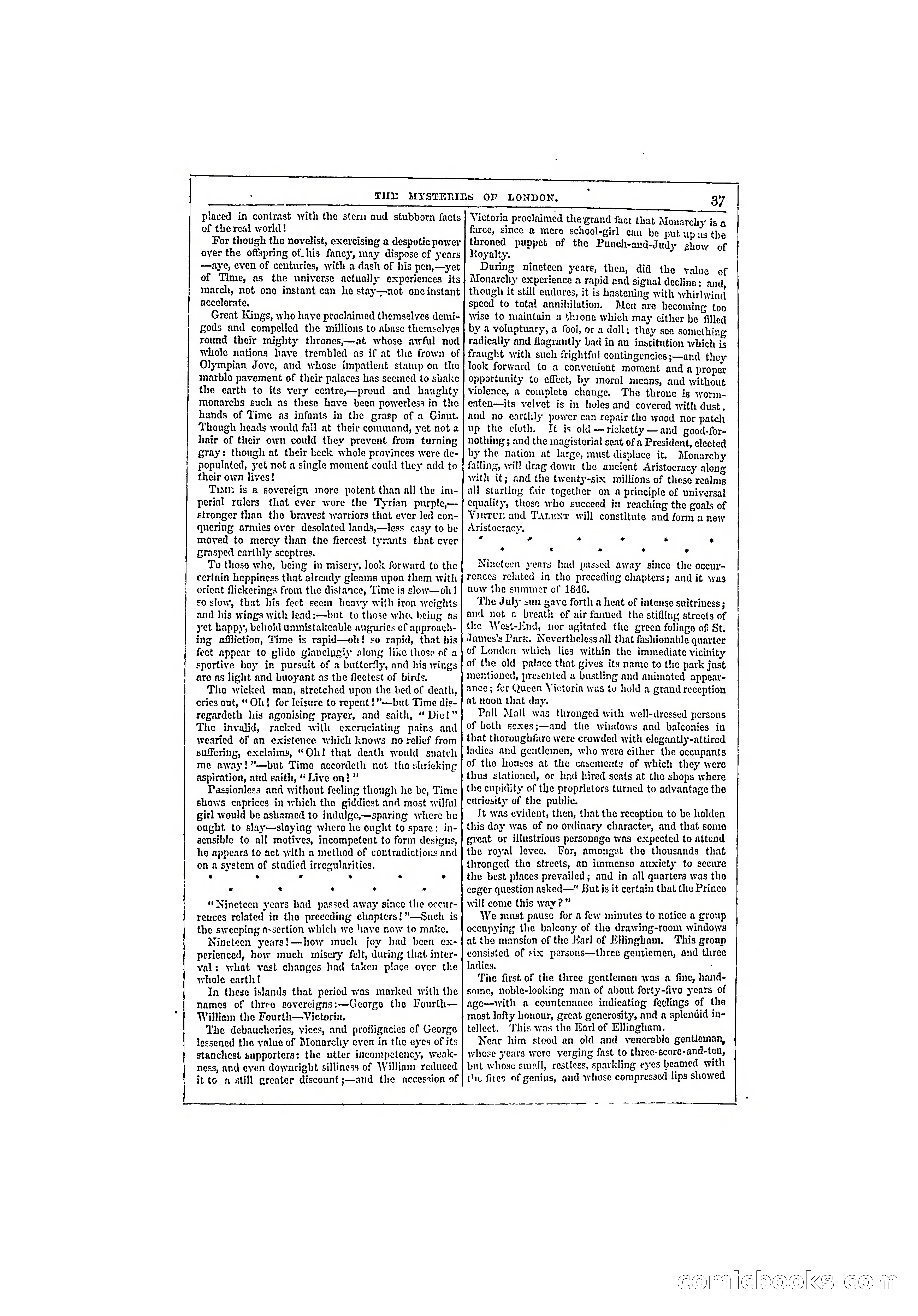
A restored page from Penny Dreadfuls, 1846. Page through the whole issue in the reader above.
📄 Transcribed text from this page (OCR, searchable)
Machine-transcribed from the original scan — historical spelling and the odd misread are preserved.
@ eee THE MYSTERINS OF LONDON, oy tS placed in contrast with the stern and stubborn facts of the real world! For though the novelist, exercising a despotic power over the offspring of. his fancy, may dispose of years ——aye, even of centuries, with a dash of his pen,—yet of Time, as the universe actually experiences its march, not one instant can he stay—not one instant accelerate, Great Kings, who have proclaimed themselves demi- gods and compelled the millions to abase themselves round their mighty thrones,—at whose awful nod whole nations have trembled as if at the frown of Olympian Jove, and whose impatient stamp on the marble pavement of their palaces has seemed to snake the earth to its very centre,—proud and haughty monarchs such as these have been powerless in the hands of Time as infants in the grasp of a Giant. Though heads would fall at their command, yet not a hair of their own could they prevent from turning gray: though at their beck whole provinces were de- populated, yet not a single moment could they add to their own lives! TiMgr is a sovereign more potent than all the im- perial rulers that ever wore the Tyrian purple— stronger than the bravest warriors that ever led con- quering armies over desolated lands,—less casy to be moved to mercy than the fiercest tyrants that ever grasped earthly seeptres. To those who, being in misery, look forward to the certain happiness that alrendy gleams upon them with orient flickerings from the distance, Time is slow—oh ! so slow, that his feet seem heavy with iron weights and his wings with Jead:—but to those who, being as yet happy, behold unmistakeable auguries of approach- ing affliction, Time is rapid—oh! so rapid, that his fect appear to glide glancingly along like those of a sportive boy in pursuit of a butterfly, and his wings are as light and buoyant as the flectest of birds. The wicked man, stretched upon the bed of death, cries out, “Oh! for leisure to repent !”—but Time dis- regardeth lis agonising prayer, and saith, ‘ Die!” The invalid, racked with excruciating pains and wearied Of an existence which knows no relief from suffering, exclaims, “Oh! that death would snatch me away!”"—but Timo accordeth not the shricking aspiration, and saith, “ Live on!” Passionless and without fecling though he be, Time shows caprices in which the giddiest and most wilful girl would be ashamed to indulge,—sparing where he onght to slay—slaying whiero he ought to sparc: in- eensible to all motives, incompetent to form designs, he appears to act with a method of contradictions and on a system of studied irregularities. * s x * ~ 2 = s x * ” “Nineteen years had passed away since the occur- reuces related in the preeeding chapters!”—Such is the sweeping a-sertion which we have now to make. Nincteen years!—how much joy had been ex- perienced, how much misery felt, during that inter- val: what vast changes had taken place over the whole carth! In these islands that period was marked with the Names of three sovercigns:—George the Fourth— William the Fourth—Victoria. The debaucheries, vices, and profligacies of George lessened the value of Monarchy even in the eyes of its stanchest supporters: the utter incompetency, weak- ness, nnd even downright silliness of William reduced itto a still greater discount;—and the accesston of Victoria proclaimed the grand fact that Monarchy is a farce, since 2 mere school-girl can be put up as the throned puppet of the Punch-and-Judy show of Royalty. During nineteen years, then, did the value of Monarchy experience a rapid and signal decline: and, though it still endures, it is hastening with whirlwind speed to total annihilation. Men are becoming too wise to maintain a throne which may either be filled by a voluptuary, a fool, or a doll; they see something radically and flagrantly bad in an inscitution which is fraught with such frightful contingencies ;—and they look forward to a conyenient moment and a proper opportunity to effect, by moral means, and without Violence, a complete change. The throne is worm- eaten—its velvet is in holes and covered with dust. and no earthly power can repair the wood nor patch up the cloth. It is old—ricketty—and good-for« nothing ; and the magisterial seat of a President, elected by the nation at large, must displace it. Monarchy falling, will drag down the ancient Aristocracy along with it; and the twenty-six millions of these realms all starting fair together on a principle of universal equality, those who succeed in reaching the goals of Vintun and TaLent will constitute and form a new Aristocracy. « ¥ * * * x * * x * * Nineteen years had passed away since the occur- rences related in the preceding chapters; and it was now the summer of 1846. The July sun gave forth a heat of intense sultriness ; and not a breath of air fanued the stifling streets of the West-Itud, nor agitated the green foliage oft St. James’s Park, Nevertheless all that fashionable quarter of London which lies within the immediate vicinity of the old palace that gives its name to the park just mentioned, presented a bustling and animated appear- ance ; fur Queen Victoria was to hold a grand reception at noon that day, Pall Mall was thronged with well-dressed persons of both sexes;~and the windows and balconies in that thoroughfare were crowded with elegantly-attired ladies and gentlemen, who were either the occupants of the houses at the cascments of which they were thus stationed, or had hired seats at the shops where the cupidity of the proprietors turned to advantage the curiosity of the public. It was evident, then, that the reception to be holden this day was of no ordinary character, and that some great or illustrious personage was expected to attend the royal levee. Tor, amongst the thousands that thronged the streets, an immense anxiety to secure the best places prevailed; and in all quarters was tho eager question asked—" But is it certain that the Prince will come this way?” We must pause for a few minutes to notice a group occupying the balcony of the drawing-room windows at the mansion of the Karl of Elingham. This group consisted of six persons—three gentiemen, and three ladies. : The first of the three gentlemen was a fine, hand- some, noble-looking man of about forty-five years of age-—with a countenance indicating feclings of the most lofty honour, great generosity, and a splendid in- tellect. ‘This was the Earl of Ellingham. Near him steod an old and venerable gentleman, whose years were verging fast to three- score-and-ten, but whose small, restless, sparkling eyes beamed with the fires of genins, and whose compressed lips showed te ee ee ~ — ay | (C(O) (C DOO <S LL (SO)