
Penny Dreadfuls, 1846 · page 49 of 399
The Mysteries of London, Vol. IV — page 49: what you’re looking at
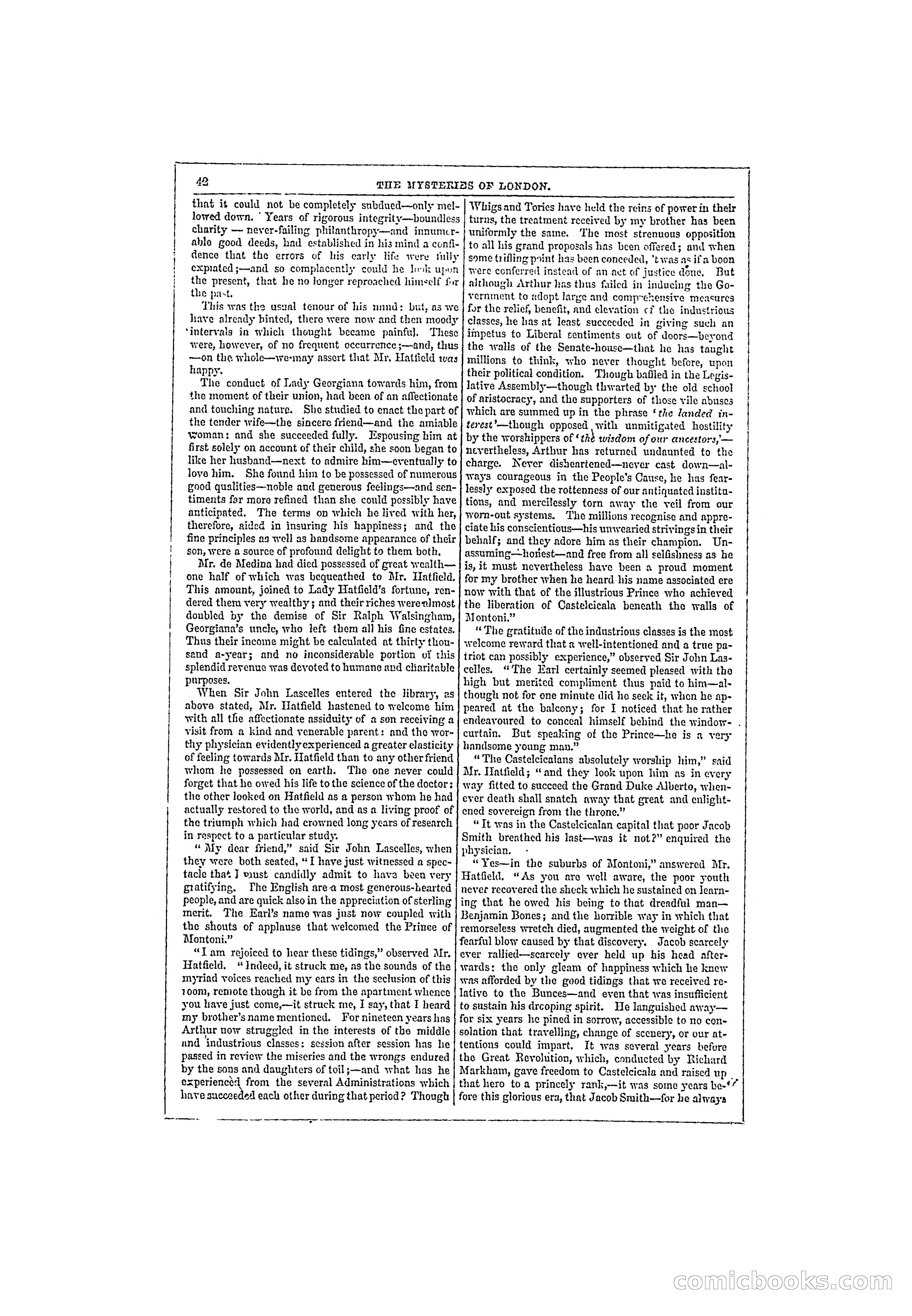
A restored page from Penny Dreadfuls, 1846. Page through the whole issue in the reader above.
📄 Transcribed text from this page (OCR, searchable)
Machine-transcribed from the original scan — historical spelling and the odd misread are preserved.
awe ee ee lL A ee 8, — 42, that it could not be completely snbdued—only mel- lowed down. ' Years of rigorous integrity—boundless charity —~ never-failing philanthropy—and innumcr- able good deeds, had established in his mind a confi- dence that the errors of his carly life were fully expiated ;—and so complacently could he Jook upon the present, that he ne longer reproached himeelf for the past. This was the usual tenour of his nind: but, as we liave already hinted, there were now and then moody ‘intervais in which thought became painful. These were, however, of no frequent occurrence ;—and, thus —on the whole—we-may assert that Mr, EHattield was happy. The conduct of Lady Georgiana towards him, from the moment of their union, had been of an affectionate and touching nature. She studied to enact the part of the tender wife—the sincere friend—and the amiable woman: and she succeeded fully. Espousing him at first solely on account of their child, she soon began to like her husband—next to admire him—eventually to love him. She found him to be possessed of numerous good qualities—noble and generous feelings—and sen- timents far more refined than she could possibly have anticipated. The terms on which he lived with her, therefore, aided in insuring his happiness; and the fine principles as well as handsome appearance of their son, were a source of profound delight to them both. Mr, de Medina had dicd possessed of great wealth— one half of which was bequeathed to Mr. Iatfield. This amount, joined to Lady Hatfield’s fortune, ren- dered them very wealthy; and their riches werealmost doubled by the demise of Sir Ralph Walsingham, Georgiana’s uncle, who left them all his fine estates. Thus their income might be calculated at thirty thou- send a-year; and no inconsiderable portion vf this splendid revenue was devoted to humane and charitable purposes. When Sir John Lascelles entered the library, as above stated, Mr. Hatfield hastened to welcome him with all the affectionate assiduity of a son receiving a visit from a kind and venerable parent: and the wor- thy physician evidently experienced a greater elasticity of feeling towards Mr. Hatfield than to any other friend whom he possessed on earth. The one never could forget that he owed his life tothe science of the doctor: the other looked on Hatfield as a person whom he had actually restored to the world, and as a living proof of the triumph which had crowned long years of research in respect to a particular study. “My dear friend,” said Sir John Lascelles, when they were both seated, “f have just witnessed a spec- tacle that J vaust candidly admit to hava been very gratifying. The English area most generous-hearted people, and are quick also in the appreciation of sterling merit. The Earl’s name was just now coupled with the shouts of applause that welcomed the Prince of Montoni.” “Tam rejoiced to hear these tidings,” observed Mr. Hatfield. “Indeed, it struck me, as the sounds of the myriad voices reached my ears in the seclusion of this 100m, remote though it be from the apartment whence you have just come,—it struck me, I say, that I heard my brother’s name mentioned. For nineteen years has Arthur now struggled in the interests of the middle and industrious classes: session after session has he passed in review the miseries and the wrongs endured by the sons and daughters of toil;—and what has he experienced from the several Administrations which have succeeded each other during that period? Though Sd THE WYSTERIOS OF LONDON. Whigs and Tories have held the reins of power in thelr turns, the treatment received by my brother has been uniformly the same. The most strenuous opposition to all his grand proposals has Deen offered; and when some trifling point has been conceded, ‘twas as ifa boon were conferred instead of an avt of justice done, But although srthur has thus failed in inducing the Go- vernment to adopt large and comprehensive measures for the relief, benefit, and elevation cf the industrious classes, he has at least succecded in giving such an impetus to Liberal sentiments out of doors—berond the walls of the Senate-housc—that he has taught millions to think, who never thought befere, upon their political condition. Though baffled in the Legis- lative Assembly—though thwarted by the old school of aristocracy, and the supporters of those vile abuses which are summed up in the phrase ‘the landed in- terest’—though opposed with unmitigated hostility by the worshippers of ¢ the wisdom of our ancestors, — nevertheless, Arthur has returned undaunted to the charge. Never disheartened—neyer cast down—al- ways courageous in the People’s Cause, he has fear- lessly exposed the rottenness of our antiquated instita- tions, and mercilessly torn away the veil from our worn-out systems. The millions recognise and appre- ciate his conscientious—his unwearied strivings in their behalf; and they adore him as their champion. Un- assuming—honest—and free from all selfishness as he is, if must nevertheless have been a proud moment for my brother when he heard his name associated ere now with that of the illustrious Prince who achieved the liberation of Castelcicala beneath the walls of Montoni.” “The gratitude of the industrious classes is the most welcome reward that a well-intentioned and a true pa- triot can possibly experience,” observed Sir John Las- celles, “The Karl certainly seemed pleased with tho high but merited compliment thus paid to him—al- though not for one minute did he seck it, when he ap- peared at the balcony; for I noticed that he rather endeavoured to conceal himself behind the window- curtain. But speaking of the Prince—he is a very handsome young map.” “The Castelcicalans absolutely worship him,” said Mr. Hatfield; “and they look upon him as in every way fitted to succeed the Grand Duke Alberto, when- ever death shall snatch away that great and enlight- ened sovereign from the throne.” “Tt was in the Castelcicalan capital that poor Jacob Smith breathed his last—was it not?” enquired the physician. “Yes—in the suburbs of Montoni,” answered Mr. Hatfield. “As you are well aware, the poor youth never recovered the sheck which he sustained on Jearn- ing that he owed his being to that dreadful man— Benjamin Bones; and the horrible way in which that remorseless wretch died, augmented the weight of the fearful blow caused by that discovery. Jacob scarcely ever rallied—scarcely ever held up his head after- wards: the only gleam of happiness which he knew was afforded by the geod tidings that we received re- lative to the Bunces—and even that was insufficient to sustain his drcoping spirit. He Janguished away— for six years he pined in sorrow, accessible to no con- solation that travelling, change of scenery, or our at- tentions could impart. It was several years befure the Great Revolution, which, conducted by Richard Markham, gave freedom to Castelcicala and raised up | that hero toa princely rank,—it was some years bet? | fore this glorious era, that Jacob Smith—for he always ER fe (SO) GIOOKS (SO)