
Penny Dreadfuls, 1846 · page 50 of 399
The Mysteries of London, Vol. IV — page 50: what you’re looking at
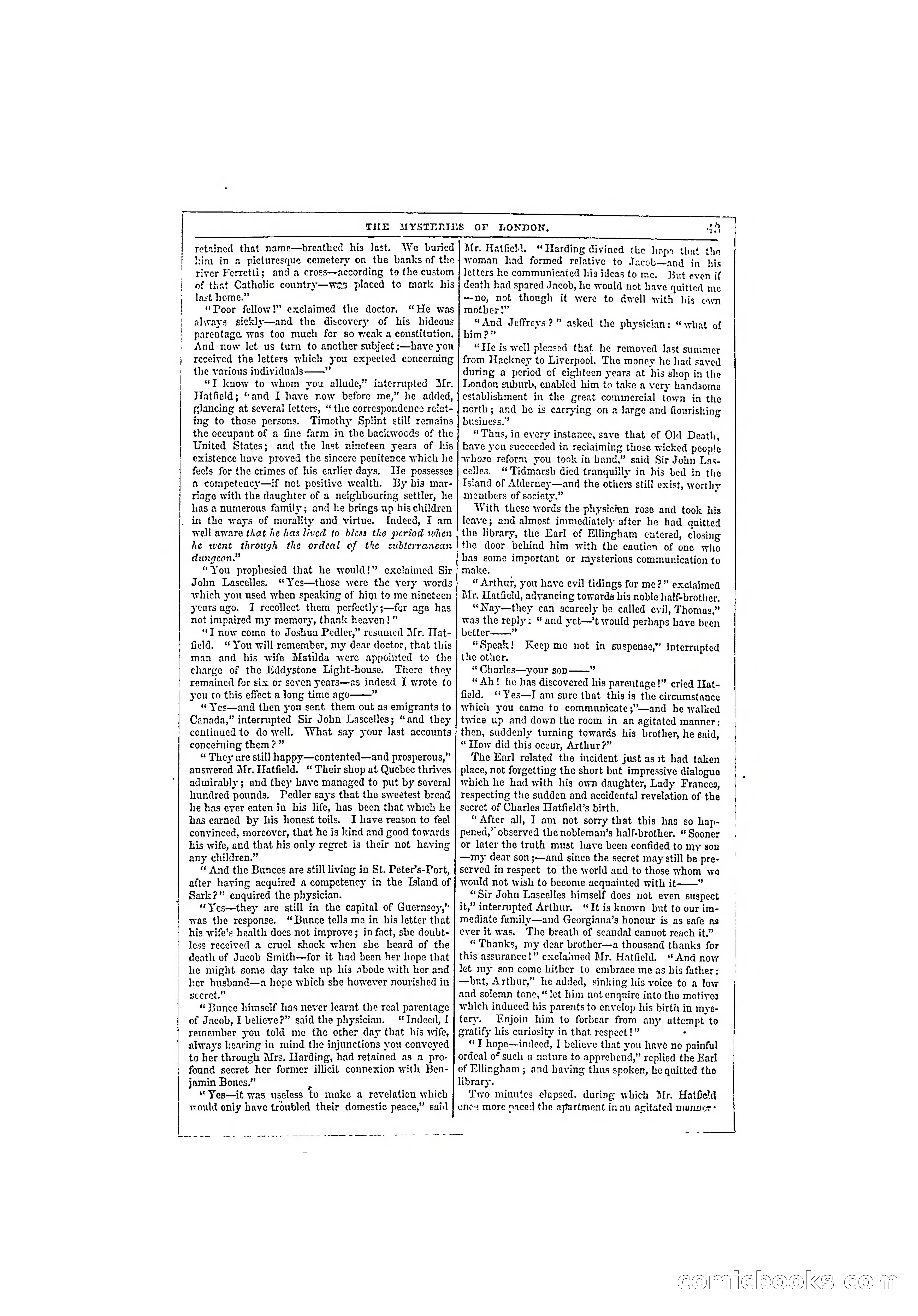
A restored page from Penny Dreadfuls, 1846. Page through the whole issue in the reader above.
📄 Transcribed text from this page (OCR, searchable)
Machine-transcribed from the original scan — historical spelling and the odd misread are preserved.
seen ne eh pay rn in rte yg yee tpt SU a . eee eh THE MYSTHENINS OFT LONDON, “bet retained that name—breathed his last. We buried him in a picturesque cemetery on the banks of the river Ferretti; and a cross—according to the custom of that Catholic country—wes placed te mark his last home.” “Poor fellow!” exclaimed the doctor. “He was always sickly—and the discovery of his hideous parentage was too much fcr so weak a constitution. And now Iet us turn to another subject :—have you received the letters which you expected concerning the various individuals a “T know to whom you allude,” interrupted Mr. Hatfield; “and I have now before me,” he added, glancing at severai letters, “the correspondence relat- ing to those persons. Timothy Splint still remains the occupant of a fine farm in the backwocds of the United States; and the last nincteen years of his existence have proved the sincere penitence which he fecls for the crimes of his earlier days. We possesses a competency—if not positive wealth. By his mar- riage with the daughter of a neighbouring settler, he has a numerous family; and he brings up his children in the ways of morality and virtue. {ndeed, I am well aware that he has lived to bless the period when he went through the ordeal of the subterranean dungeon.” “You prophesied that he would!” exclaimed Sir John Lascelles. ‘“ Yes-—those were the very words which you used when speaking of him to me nineteen years ago. T recollect them perfectly ;—for age has not impaired my memory, thank heaven!” ‘‘T now come to Joshua Pedler,” resumed Mr. ITat- field. “ You will remember, my dear doctor, that this man and his wife Matilda were appointed to the charge of the Eddystone Light-house. There they remnined for six or seven years—as indeed I wrote to you to this effect a Jong time ago——” “ Yes—and then you sent them out as emigrants to Canada,” interrupted Sir John Lascelles; “and they continued to do well. What say your last accounts concerning them ? ” “ They are still happy—contented—and prosperous,” answered Mr. Hatfield. ‘“ Their shop at Quebec thrives admirably; and they have managed to put by several hundred pounds. YPedler says that the sweetest bread he has eyer eaten in his life, has been that which he has carned by his honest toils. J have reason to feel conyinced, moreover, that he is kind and good towards his wife, and that his only regret is their not having any children.” “And the Bunces are still living in St. Peter’s-Port, after having acquired a competency in the Island of Sark??? enquired the physician. “Yes—they are still in the capital of Guernsey,” was the response. ‘Bunce tells me in his letter that his wife’s health does not improve; in fact, she doubt- less received a crucl shock when she heard of the death of Jacob Smith—for it had been her hope that he might some day take up his abode with her and her husband—a hope which she however nourished in secret.” “ Bunce himself has never learnt the real parentage of Jacob, I believe?” said the physician. “Indecd, I reinember you told me the other day that his wife, always bearing in mind the injunctions you conveyed to her through Mrs. Harding, had retained as a pro- found secret her former illicit connexion with Ben- jamin Bones.” “Yes—it was useless rrould only bave troubled their domestic peace, e os « to make a revelation which ” Bail Mr. Hatfield. “Harding divined the hops that ths woman had formed relative to Jacob—and in his letters he communicated his ideas to me. But even if death had spared Jacob, he would not have quitted me ——no, not though it were to dwell with his own motber!” “And Jeffreys?” asked the physician: “what of him?” “Ye is well pleased that he removed last summer from Hackney to Liverpool. The money he had saved during a period of eighteen years at his shop in the London suburb, enabled him to take a very handsome establishment in the great commercial town in the north; and he is carrying on a large and flourishing business.” “Thus, in every instance, save that of Old Death, have you succeeded in reclaiming those wicked people whose reform you took in hand,” said Sir John Las- celles. “ Tidmarsh died tranquilly in his bed in the Island of Alderney—and the others still exist, worthy members of society.” With these words the physicmn rose and took his leave; and almost immediately after he had quitted the library, the Earl of Ellingham entered, closing the door behind him with the cauticn of one who has some important or mysterious communication to make, “ Arthur, you have evil tidings for me?” exclaimed Mr. Hatfield, advancing towards his noble half-brother, ‘“‘Nay—they can scarcely be called evil, Thomas,” was the reply: “and yct—t would perhaps have been better——” “Speak! Keep me not in suspense,” interrupted the other. “ Charles—your son———” “Ah! he has discovered his parentage!” cried Hat- field. ‘*Yes—I am sure that this is the circumstance which you came to communicate ;”—and he walked twice up and down the room in an agitated manner: then, suddenly turning towards his brother, he said, “ Wow did this occur, Arthur?” The Earl related the incident just as it had taken place, not forgetting the short but impressive dialogue which he had with his own daughter, Lady Franceg, respecting the sudden and accidental revelation of the secret of Charles Hatfield’s birth. “After all, I am not sorry that this has so hap- pened,’ observed the nobleman’s half-brother. “Sooner or later the truth must have been confided to my son —my dear son ;—and since the secret may still be pre- served in respect to the world and to those whom we would not wish to become acquainted with it-—” “Sir John Lascelles himself does not even suspect it,” interrupted Arthur. “It is known but to our im- mediate family—and Georgiana’s honour is as safe ns ever it was. The breath of scandal cannot reach it,” “Thanks, my dear brother—a thousand thanks for this assurance!” exclaimed Mr. Hatfield. “And now let my son come hither to embrace me as his father: —but, Arthur,” he added, sinking his voice to a low and solemn tone, “let him not enquire into the motivo; which induced his parents to envelop his birth in mys- tery. Lnjoin him to forbear from any attempt to gratify his curiosity in that respect!” F “T hope—indeed, I believe that you have no painful ordeal o* such a nature to apprehend,” replied the Earl of Ellingham; and having thus spoken, he quitted the library. Two minutes elapsed, during which Mr. Hatfield ones more naced the apartment in an agitated munuce- ~—] (C(O) (C DOO <S LL (SO)