
Penny Dreadfuls, 1846 · page 58 of 399
The Mysteries of London, Vol. IV — page 58: what you’re looking at
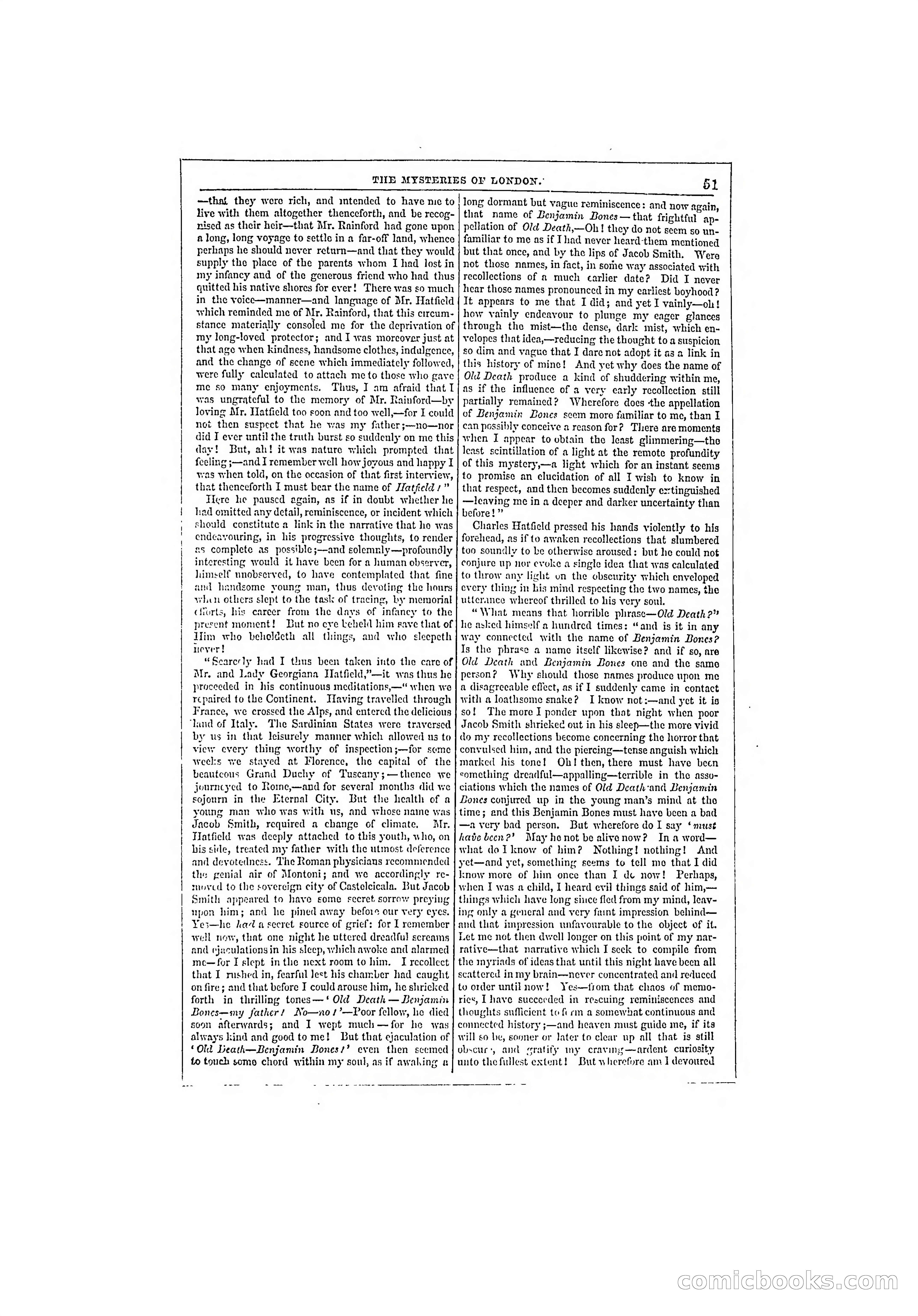
A restored page from Penny Dreadfuls, 1846. Page through the whole issue in the reader above.
📄 Transcribed text from this page (OCR, searchable)
Machine-transcribed from the original scan — historical spelling and the odd misread are preserved.
a LT I A SG heer menace pemamahdeintrenamay THE MYSTERIES Ol LONDON.’ —thnat they were rich, and mtended to have nie to | long dormant but vague reminiscence: live with them altogether thenceforth, and be recog- nised as their heir—that Mr. Rainford had gone upon 2 long, long voyage to settle in a far-off land, whence perhaps he should never return—and that they would supply the place of the parents whom I had lost in my infancy and of the generous friend who had thus quitted his native shores for ever! There was so much in the voice—manner—and language of Mr. Hatfield svhich reminded me of Mr. Rainford, that this crrcum- stance materially consoled me for the deprivation of my long-loved protector; and I was morcover just at that age when kindness, handsome clothes, indulgence, and the change of scene which immediatcly followed, were fully calculated to attach me to those who gave me so many enjoyments. Thus, J] am afraid that I was ungrateful to the memory of Mr. Rainford—by loving Mr. Watfield too soon and too well,—for I could not then suspect that he was my father ;—~no—nor did I ever until the truth burst so suddenly on me this day! But, ah! it was nature which prompted that feeling ;—and I remember well how joyous and happy I was when told, on the occasion of that first interview, that thenceforth I must bear the name of Hatfield 1” Were he pauscd again, as if in doubt whether he had omitted any detail, reminiscence, or incident which should constitute a link in the narrative that ho was endcavouring, in his progressive thoughts, to render ss complete as possible ;—and solemnly —profoundly interesting would it have been for a liuman observer, himself unobserved, to have contemplated that fine and handsome young man, thus devoting the hours whin others slept to the task of tracing, by memorial cfiurts, his career from the days of infancy to the present moment! But no eye beheld him save that of Hiim who beheldeth all things, and who sleepeth never! “Searerly had I thus been taken into the care of Mr. and Lady Georgiana Hatfield,”—it was thus he proceeded in his continuous meditations,—" when we repaired to (he Continent. Having travelled through France, we crossed the Alps, and entercd the delicious ‘land of Italy. The Sardinian States were traversed by us in that leisurely manner which allowed us to view every thing worthy of inspection ;—for seme weeks we stayed at Florence, the capital of the beautcous Grand Duchy of Tuscany;—thenco we journcyed to Rome,—and for several months did we sojourn in the Eternal City. But the licalth of a young man whowas with us, and whose naine was Jacob Smith, required a change of climate, Mr. Hatfield was deeply attached to this youth, who, on his side, treated my father with the utmost deference and deyotedness. The Roman physicians recommended the genial air of Montoni; and we accordingly re- moved to the sovercign city of Castelcicala. But Jacob Smith appeared to have come secret. sorrow preying upon him; and he pined away before our very eyes. Yes—he had a secret source of grief: for I remember well now, that one night he uttered dreadful screams and ejaculationgin his sleep, which awoke and alarmed me—for I slept inthe next room to him. I recollect that I rushed in, fearful Jest his chamber had caught on fire; and that before I could arouse him, he shricked forth in thrilling tones—‘ Old Death — Benjamin Bones—my father! No—ao?’—Poor fellow, ho died soon afterwards; and I wept much—for he was always kind and goodto me! Lut that ejaculation of ‘Old Leath—Benjamin Bones?’ even then scemed fo touch somo chord within my soul, as if awahing a ee ee rn mr nee bt and novw again, that name of Benjamin Bones — that frightful ap- pellation of Old Death,—Oh! they do not seem so un- familiar to me as if Thad never heard-them mentioned but that once, and by the lips of Jacob Smith. Were not those names, in fact, in some way associated with recollections of 2 much earlier date? Did I never hear those names pronounced in my earliest boyhood ? It appears to me that I did; and yet I vainly—oh! how vainly endeavour to plunge my eager glances through the mist—the dense, dark mist, which en- velopes that idea,—reducing the thought to a suspicion so dim and vague that I dare not adopt it as a link in this history of mine! And yet why does the name of Old Death produce a kind of shuddering within me, as if the influence of a very early recollection still partially remained? ‘Wherefore does the appellation of Benjamin Bones scem more familiar to me, than I can possibly conceive a reason for? There are moments when I appear to obtain the least glimmering—the least scintillation of a light at the remote profundity of this mystery,—a light which for an instant seems to promise an clucidation of all I wish to know in that respect, and then becomes suddenly extinguished —leaving me in a deeper and darker uncertainty than before!” Charles Hatfield pressed his hands violently to his forehead, as if to awaken recollections that slumbered too soundly to ke otherwise aroused: but he could not conjure up nor evoke a single idea that was calculated to throw any light on the obscurity which enveloped every thing in Lis mind respecting the two names, the uttcrance whercof thrilled to his very soul. “What means that horrible phrase—Old Death?” he asked himself a hundred times: “and is it in any way connected with the name of Benjamin Bones? Is the phrase a name itself likewise? and if so, are Old Death and Benjamin Bones one and the same person? Why should those names produce upon me a disagreeable effect, as if I suddenly came in contact with a loathsome snake? I know not:—and yet it is so! The more I ponder upon that night when poor Jacob Smith shriekec out in his sleep—the more vivid do my recollections become concerning the horror that convulsed him, and the piercing—tense anguish which marked his tone! Ob! then, there must have been something dreadful—appalling—terrible in the asso- ciations which the names of Old Death:and Benjamin Lones conjured up in the young man’s mind at the time; end this Benjamin Bones must have been a bad —a very bad person. But wherefore dol say ‘must hate been?’ May honot be alivenow? Ina word— what doT know of him? Nothing! nothing! And yet—and yet, somethings seems to tell me that I did know more of him once than I de now! Perhaps, when I was a child, I heard evil things said of him,— things which have long siuce fled from my mind, leav- ing only a general and very faint impression behind— and that impression unfavourable to the object of it. Let me not then dwell longer on this point of my nar- rative—that narrutive which I seck to compile from the myriads of ideas that until this night have been all scattered in my brain—never concentrated and reduced tv order until now! Yes—trom that chaos of memo- ries, have succeeded in rescuing reminiscences and thoughts sufficient to firm a somewhat continuous and connected history ;—and heaven must guide me, if its will so be, sooner or later to clear up all that is still obscur’, and «ratify my craving;—~ardent curiosity unto the fullest extent! But wherefore am J devoured re ee ee eee (C(O) (C DOO <S LL (SO)