
Penny Dreadfuls, 1846 · page 59 of 399
The Mysteries of London, Vol. IV — page 59: what you’re looking at
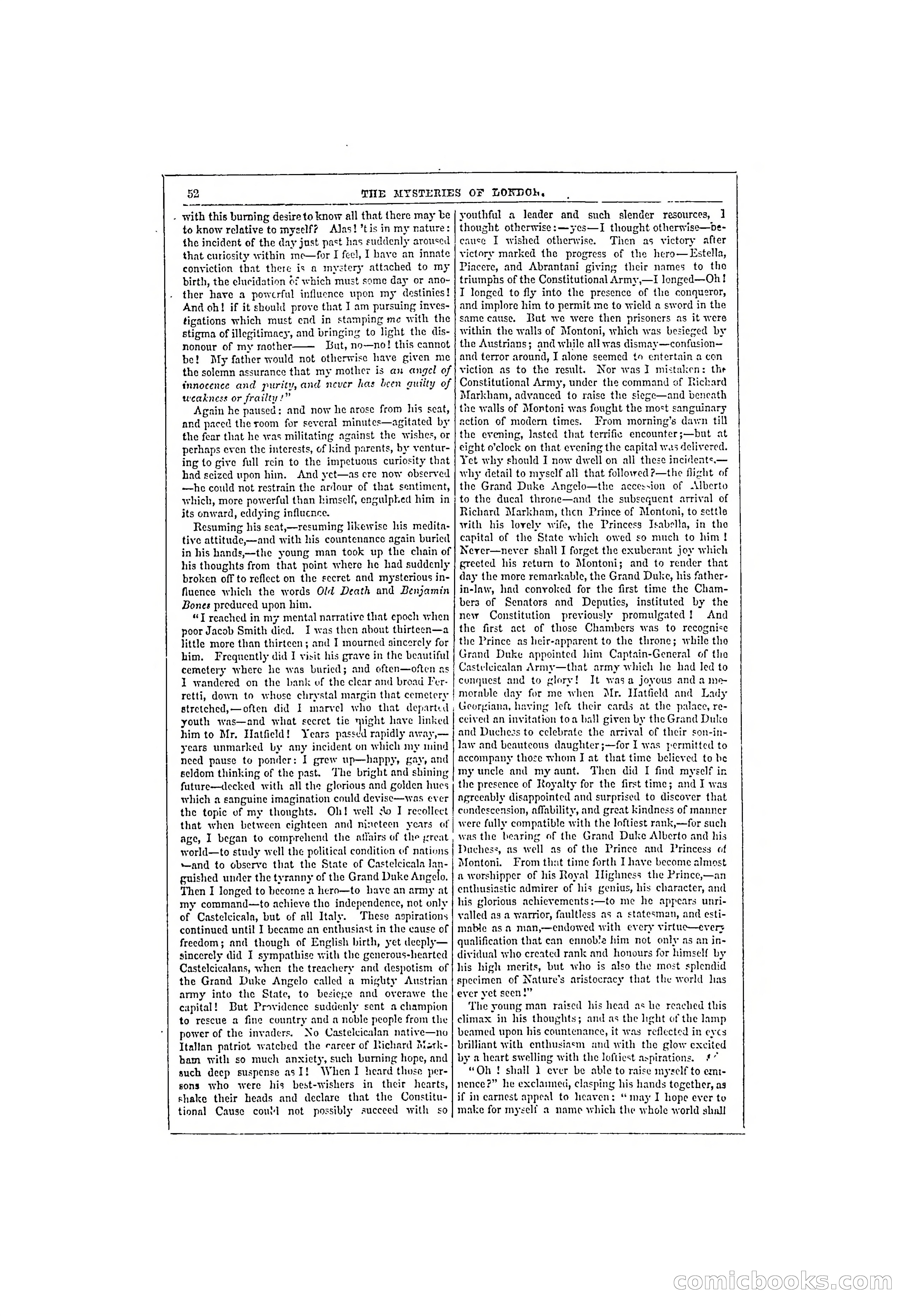
A restored page from Penny Dreadfuls, 1846. Page through the whole issue in the reader above.
📄 Transcribed text from this page (OCR, searchable)
Machine-transcribed from the original scan — historical spelling and the odd misread are preserved.
52 — THE MYSTERIES OF LORDO, one oer Ee . with this burning desire to know all that there may be | youthful a leader and such slender resources, 1] to know relative to myself? Alas! ’tis in my nature: | thought otherwise: —yces—I thought otherwise—be- the incident of the day just past has suddenly aroused | cause I wished otherwise. that curiosity within me—for I feel, T have an innate conviction that there is a mystery attached to my birth, the elucidation of which must some day or ano~ ther have a powcrful influence upon my destinies! And oh! if it should prove that I am pursuing inves- tigations which must end in stamping me with the stigma of illegitimacy, and bringing to light the dis- nonour of my snother Lut, no—no! this cannot be! My father would not otherwise have given me the solemn assurance that my mother is an angel of tnnocence and purity, and never has been guiity of weakness or frailty!” Again he paused: and now he arose from his scat, and paced the room for several minutes—agitated by the fear that he was militating against the wishes, or perhaps even the interests, of kind parents, by ventur- ing to give full rein to the impetuous curiosity that had seized upon hin. And yct—as ere now observed —he could not restrain the ardour of that sentiment, which, more powerful than himself, engulpled him in its onward, eddying influcnee. Resuming his seat,—resuming likewise lis medita- tive attitude,—and with his countenance again buried in his hands,—the young man took up the chain of his thoughts from that point where he had suddenly broken off to reflect on the secret and mysterious in- fluence which the words Old Death and Benjamin Bones produced upon him. “T reached in my mental narrative that epoch when poor Jacob Smith died. I was then ahout thirteen—a little more than thirteen; and I mourned sincerely for him. Frequently did I visit his grave in the beautiful cemetery where he was buried; and often—often as 1 wandered on the bank of the clear and broad Fer- retti, down to whose chrystal margin that cemetery stretched,—often did I marvel who that departed youth was—and what secret tic might have linked him to Mr. Hatfield! Years passed rapidly away,— years unmarked by any incident on which my mind need pause to ponder: I grew up—happy, gay, and seldom thinking of the past. The bright and shining future—decked with all the glorious and golden hues which a ganguine imagination could devise—was ever the topic of my thonghts. Oh! well So I recollect that when between cighteen and muacteen years of | age, I began to comprehend the atfairs of the great world—to study well the political condition of nations “and to observe that the State of Castelcicala Jan- guished under the tyranny of the Grand Duke Angelo. Then I longed to become a hero—to have an army at my command—to achieve tho independence, not only of Castelcicala, but of all Italy. These aspirations continued until I became an enthusiast in the cause of freedom; and though of English birth, yet decply— sincerely did I sympathise with the generous-hearted Castelcicalans, when the treachery and despotism of the Grand Duke Angelo called a mighty Austrian army into the State, to besiege and overawe the capital! But Providence suddenly sent a champion to rescue a fine country and a noble people from the power of the invaders. No Castelcicalan native—no Itallan patriot watched the career of Richard Matk- bam with so much anxiety, such buming hope, and such deep suspense as I! When I heard those per- sons who were his best-wishers in their hearts, shake their heads and declare that the Constitu- tional Cause contd not possibly succeed with so Then as victory after victory marked the progress of the hero— Estella, Piacere, and Abrantani giving thcir names to the triumphs of the Constitutional Army,—I longed—Oh! I longed to fly into the presence of the conqueror, and implore him to permit me to wield a sword in the same cause. But we were then prisoners as it were within the walls of Montoni, which was besieged by the Austrians; and while all was dismay—confusion— and terror around, I alone seemed tn entertain a con viction as to the result. Nor was I mistaken: the Constitutional Army, under the command of Richard Markham, advanced to raise the siege—and beneath the walls of Montoni was fought the most sanguinary action of modern times. From morning’s dawn till the evening, lasted that terrific encounter;—but at eight o’clock on that evening the capital was delivered. Yet why should I now dwell on all these incidents.— why detail to myself all that followed ?—the flight of the Grand Duke Angelo—the accession of Alberto to the ducal throne—and the subsequent arrival of Richard Markham, then Prince of Montoni, to settle with his lovely wife, the Princess Isabella, in the capital of the State which owed so much to him! Never—never shall J forget the exuberant joy which greeted his return to Montoni; and to render that day the more remarkable, the Grand Duke, his father- in-Jaw, had conyroked for the first time the Cham- bers of Senators and Deputies, instituted by the new Constitution previously promulgated ! And the first act of those Chambers was to recognise the Prince as heir-apparent to the throne; while the Grand Duke appointed him Captain-General of the Castelcicalan Army—that army which he had led to conquest and to glory! It wasa joyous and a me- morable day for me when Mr. Hatfield and Lady Georyiana, having left their cards at the palace, re- ceived an invitation toa ball given by the Grand Duke and Duchess to celebrate the arrival of their son-in- law and beauteous daughter;—for Iwas permitted to accompany those whom J at that time believed to be my uncle and my aunt. Then did I[ find myself in the presence of Royalty for the first time; and I was agreeably disappointed and surprised to discover that condescension, affability, and great kindness of manner were fully compatible with the loftiest rank,—for such was the bearing of the Grand Duke Alberto and his Duchess, as well as of the Prince and Princess of Montoni. From that time forth Ihave become almost a worshipper of his Royal Highness the Prince,—an enthusiastic admirer of his gentus, his character, and his glorious achievements:—to me he appears unri- valled as a warrior, faultless as a statesman, and esti- mable asa man,—endowed with every virtue—every qualification that can ennob‘a him not only as an in- dividual who created rank and honours for himself by his high merits, but who is also the most splendid specimen of Nature's aristocracy that the world has ever yet scen:” The young man raised his head as he reached this climax in his thoughts; and as the light of the lamp beamed upon his countenance, it was reflected in eycs brilliant with enthusiasm and with the glow excited by a heart swelling with the loftiest aspirations. #7 “Oh ! shall 1 ever be able to raise myself to emt- nence?” he exclarmed, clasping his hands together, as if in carnest appeal to heaven: “may I hope ever to make for myself a name which the whole world shall ee (SO) GIOOKS (SO)