
Penny Dreadfuls, 1846 · page 60 of 399
The Mysteries of London, Vol. IV — page 60: what you’re looking at
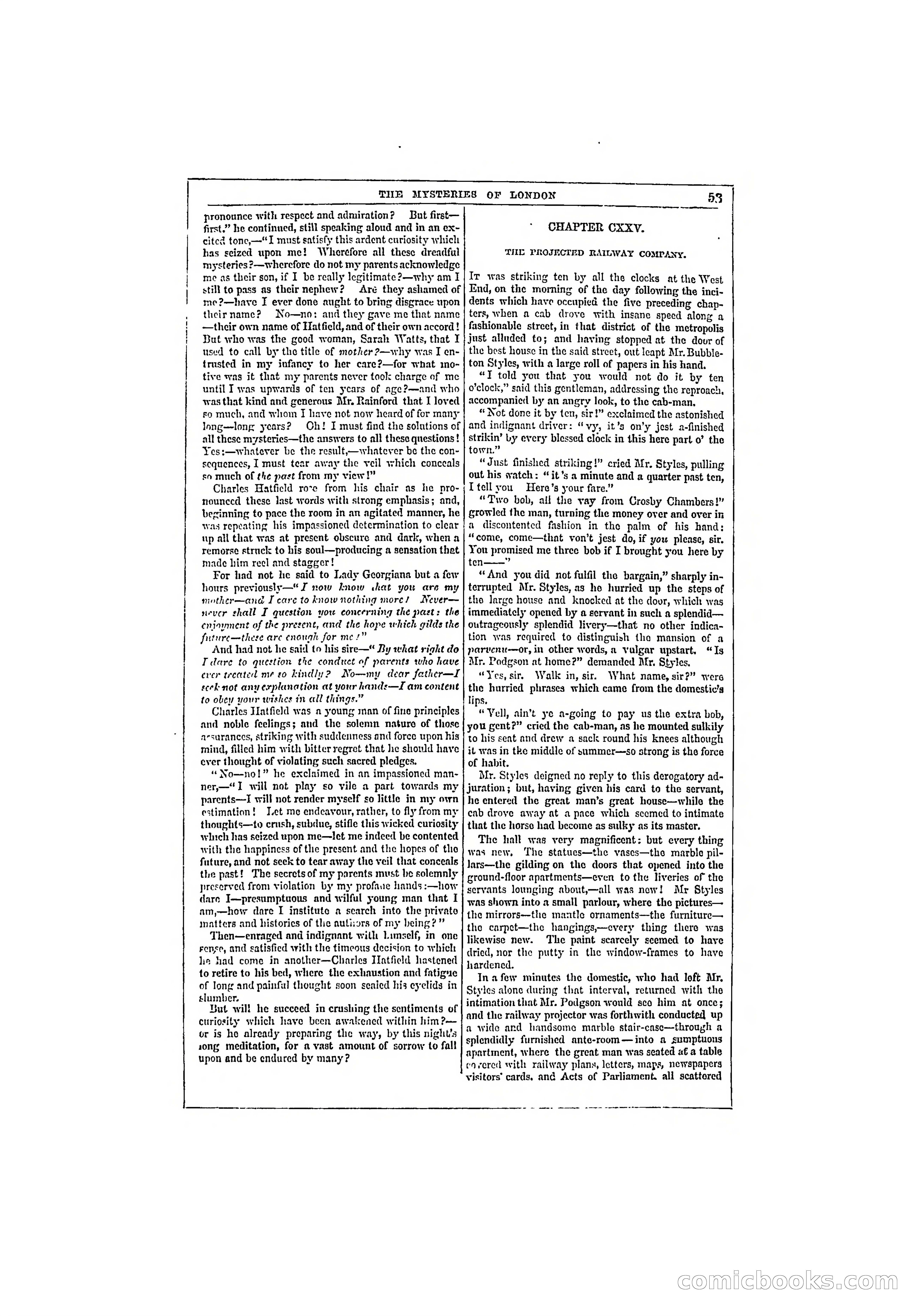
A restored page from Penny Dreadfuls, 1846. Page through the whole issue in the reader above.
📄 Transcribed text from this page (OCR, searchable)
Machine-transcribed from the original scan — historical spelling and the odd misread are preserved.
a MYSTERIES OF THE pronounce with respect and admiration? But first— first.” he continued, still speaking aloud and in an ex- cited tonc,—“I must satisfy this ardent curiosity which has seized upon me! Wherefore all these dreadful mysteries ?—wherefore do not my parents acknowledge me as their son, if I be really legitimate ?—why am I still to pass as their nephew? Aré they ashamed of me?—have I ever done aught to bring disgrace upon theirname? No—no: and they gave me that name —their own name of Hatfield, and of their own accord! Dut who was the good woman, Sarah Watts, that I used to call by the title of mother 2—why was I en- trusted in my infancy to her care?—for what ino- tive was it that my parents never took charge of me until I was upwards of ten ycars of age?—and who was that kind and generous Mr. Rainford that I loved co much, and whom I have not now heard of for many long—-long years? Oh! I must find the solutions of all these m:steries—the answers to all these questions ! Yes:—whatever be the result,—whatever be the con- sequences, I must tear away the veil which conceals so much of the past from my view!” Charles Hatficld rove from his chair as he pro- nounced these last words with strong emphasis; and, beginning to pace the room in an agitated manner, he was repeating his impassioned determination to clear up all that was at present obscure and dark, when a remorse struck to his soul—producing a sensation thet made him reel and stagger! For had not he said to Lady Georgiana but a few hours previously—"“ J mow know chet you are my mother—and I care to know nothing more? Never— seucr shall I question you concerning the past: the enjoyment of the present, and the hope which gilds the Jutrre—theee are enough for mes” And had not he said to his sire—“ By wheat right do I dare to question the conduct of parents who have ever treated nv eo kindly? No—muy dear father—I seok not anverplanation at your hands—J am content to obey your wishes in all ings.” Charles Hatfield was a young ian of fine principles and noble feelings; and the solemn nature of those arsurances, atriking with suddenness and force upon his mind, filled him with bitter regret that he shold have ever thought of violating such sacred pledges. “No—nol” he exclaimed in an impassioned man- ner,—“JT will not play so vile a part towards my parents—I will not render myself so little in my own estimation! J.et me endeavour, rather, to fly from my thoughts—to crush, subdue, stifle this wicked curiosity which has seized upon me—let me indeed be contented with the happiness of the present and the hopes of the future, and not seck to tear away the veil that conceals the past! The secrets of my parents must be solemnly preserved from violation by my profaue hands :—how dare IJ—presumptuous and wilful young man that I am,—how dare I institute a search into the private inatters and histories of the auliors of my being?” Then—enraged and indignant wilh Limself, in one rence, and satisfied with the timeous decision to which hie had come in another—Charles Iatfield hastened to retire to his bed, where the exhaustion and fatigue of long and painful thought soon seaied his eyelids in tlumber. But wilt he succeed in crushing the sentiments of curiosity which have been awakened within him ?— vr is he already preparing the way, by this night’s songs meditation, for a vast amount of sorrow to fall! upon and be endured by many? LONDON 53 CHAPTER CXXV. THE PROJECTED RAILWAY COMPANY. Ir was striking ten by all the clocks at the West Ind, on the morning of the day following the inci- dents which have occupied the five preceding chap- ters, when a cab drove with insane speed along a fashionable street, in that district of the metropolis just alluded to; and having stopped at the door of the best house in the said street, out leapt Mr. Bubble- ton Styles, with a large roll of papers in his hand. “T told you that you would not do it by ten o’clock,” said this gentleman, addressing the reproach, accompanied by an angry look, to the cab-man, “Not done it by ten, sir!” exclaimed the astonished and indignant driver: “vy, it’s on’y jest a-finished strikin’ by every blessed clock in this here part o’ the town.” “Just finished striking!” cried Mr. Styles, pulling out his watch: “it’s a minute and a quarter past ten, Ttell you Here’s your fare.” “Two bob, all the vay from Crosby Chambers!” growled the man, turning the money over and over in a discontented fashion in the palm of his hand: “come, come—thnat von’t jest do, if you please, sir. You promised me three bob if I brought you here by ten———” “And you did not fulfil the bargain,” sharply in- terrupted Mr. Styles, as he hurried up the steps of the large house and knocked at the dovr, which was immediately opened by a servant in such a splendid— outrageously splendid livery—that no other indica- tion was required to distinguish the mansion of a parvenu-—-or, in other words, a vulgar upstart, “Is Mr. Padgson at home?” demanded Mr, Styles. “Yes, sir, Walk in, sir. What name, sir?” wers the hurried phrases which came from the domestic’s lips. “Vell, ain’t ye a-going to pay us the extra bob, you gent?” cried the cab-man, as he mounted sulkily to his seat and drew a sack round his knees although it was in the middle of summer—-so strong is the force of habit. Mr. Styles deigned no reply to this derogatory ad- juration; but, having given his card to the servant, he entered the great man’s great house—while the cab drove away at apace which scemed to intimate that the horse had become as sulky as its master. The hall was very magnificent: but every thing was new, The statues—the vases—the marble pil- Jars—the gilding on the doors that opened into the ground-floor apartments—even to the liveries of the servants lounging about,—all was new! Mr Styles was shown into 2 small parlour, where the pictures— the mirrors—the mantle ornaments—the furniture— the carpet—the hangings,—cvery thing there was likewise new. ‘The paint scarcely seemed to have dried, nor the putty in the window-frames to have hardened. In afew minutes the domestic, who had loft Mr. Styles alone during that interval, returned with the intimation that Mr. Podgson would sco him at once; and the railway projector was forthwith conducted up a wide and handsome marble stair-case—through a splendidly furnished ante-room—inte a sumptuous apartment, where the great man was seated af a table eavered with railway plans, letters, maps, newspapers visitors’ cards, and Acts of Parliament. all scattered —— Cen ee eee ee 2 ee (C(O) (C DOO <S LL (SO)