
Penny Dreadfuls, 1846 · page 94 of 399
The Mysteries of London, Vol. IV — page 94: what you’re looking at
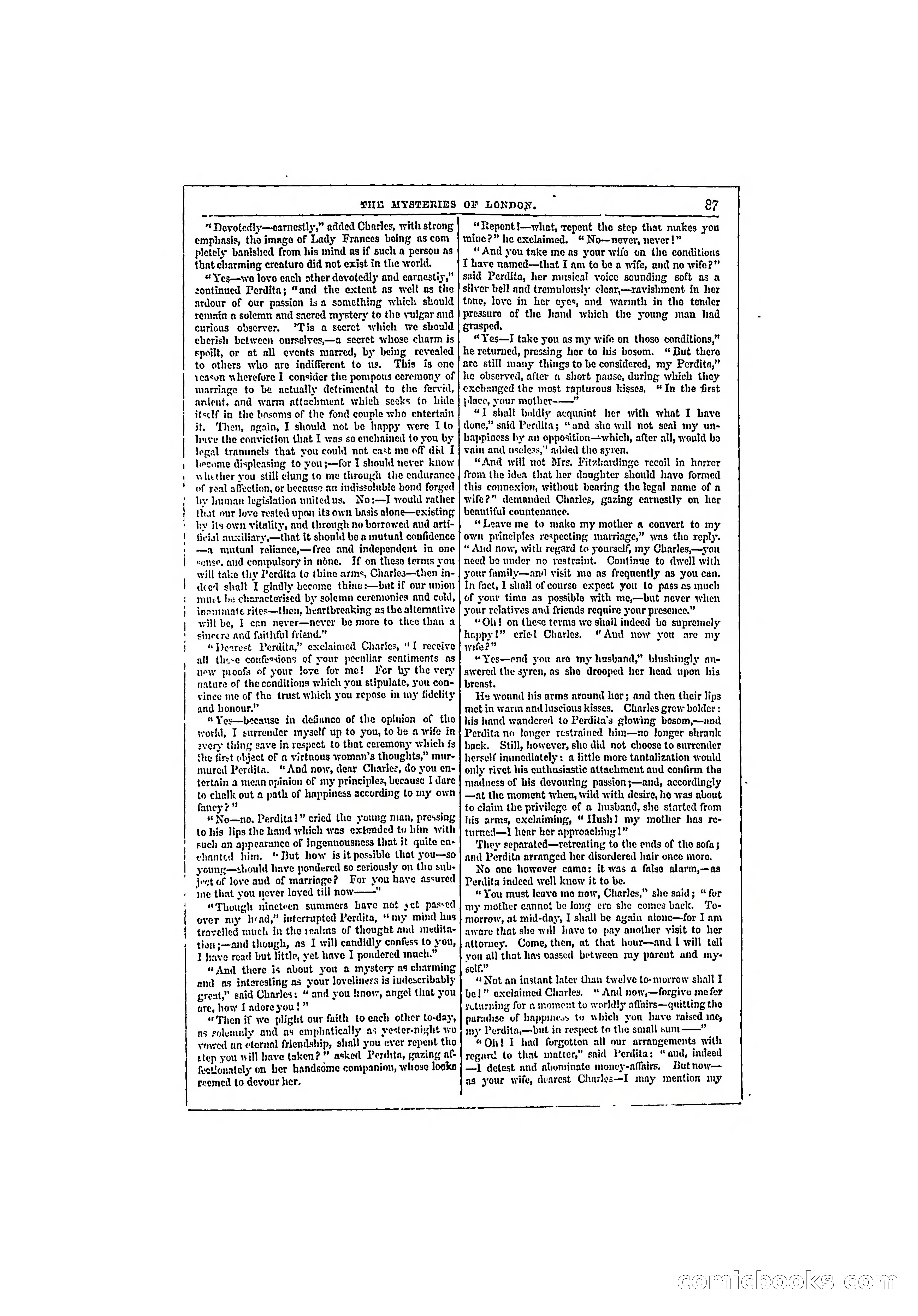
A restored page from Penny Dreadfuls, 1846. Page through the whole issue in the reader above.
📄 Transcribed text from this page (OCR, searchable)
Machine-transcribed from the original scan — historical spelling and the odd misread are preserved.
mmm a mm ary weer eee ree er en a ee a GE ST os SO ay re aD ee = THE WYSTERIES OF LONDON. =~ “ Dovotedly—earnestly,” added Charles, with strong emphasis, tha imago of Lady Frances being as com pletely banished from his mind as if such a person as that charming crenturo did not exist in the world. * Yes—we love ench sther devotedly and earnestly,” continued Perdita; “and the extent as well as the ardour of our passion isa something which should remain a solemn and sacred mystery to the yulgar and curions observer. *Tis a seeret which we should cherish between onrselyes,—a secret whose charm is spoilt, or at all events marred, by being revealed to others who are indifferent to us. This is one reason wherefure I consider the pompous ceremony of marriage to be actually detrimental to the fervid, ardent, and warm attachment which seeks fo hide itsclf in the bosoms of the fond couple who entertain it. Then, again, I should not be happy were I to have the conviction that I was so enchained to you by legal trammels that you could not cast me off did I become displeasing to you ;—for I should never know whether you still clung to me through the endurance of real affection, or because an indissoluble bond forged hy human legislation unitedus. No:—I would rather that our love rested upan its own basis alone—existing hy its own vitality, and through no borrowed and arti- ficial auxiliary,—that it should be a mutual confidence —a mutual reliance,—free and independent in one canse, and compulsory in ndne. If on these terms you will take (hy Perdita to thine arms, Charles—then in- deel shall I gindly become thine:—but if our union must be characterised by solemn ceremonies and culd, inemmate rites—then, heartbreaking as the alternative will be, J] ean never—never be more to thee than a sinecre and faithful friend.” “Peorrest Perdita,” exclaimed Charles, ‘I receive all these confessions of your peculiar sentiments as uew proofs of your love for me! For hy the very nature of thecsnditions which you stipulate, you con- vince me of the trust which you repose in my fidelity and honour.” “Yos—becanuse in defiance of the opluion of the world, I surrender myself up to you, to be a wife in avery thing save in respect to that ceremony which is che first abject of a virtuous woman’s thoughts,” mur- mured Perdita. “And now, dear Charies, do you en- tertain a mean opinion of my principles, because I dare to chalk out a path of happiness according to my own fancy 2” “No—no. Perdita!” cried the young man, pressing to his lips the hand which was extended to him with such an appearance of ingenuousness that it quite en- chanted him. © But how is it possible that you—so young—should have pondered 60 seriously on the sub- ject of love and of marriage? For you have assured mi that you never loyed till now-——” “Though ninetecn summers bave not yct passed over my hrad,” interrupted Perdita, “my mind has travelled much in the realms of thought and medita- tionj;—and though, as I will candidly confess to you, I have read but little, yet have I pondered much.” “And there is about you a mystery as charming and 2s interesting as your loveliness is indescribably great,” said Charles: “and you know, angel that you are, how I adore yout” “Then if we plight our faith to cach other to-day, as solemnly and as emphatically as yester-night we vowed an eternal friendship, shall you ever repent the step you will have taken?” asked Perdita, gazing af- feetionately on her handsome companion, whose looks eeemed to devour her. lo naunhentnamntl 8&7 “Repent !—what, repent the step that makes you mine?” he exclaimed. ‘“ No~never, never!” “And you take me as your wife on the conditions T have named—that I am to be a wife, and no wife?” said Perdita, her musical voice sounding soft as a stlyer bell and tremulously clear,—ravishment in her tone, love in her eyes, and warmth in the tender pressure of the hand which the young man had grasped, “Yes—I take you as my wife on those conditions,” he returned, pressing her to his bosom. “ But there are still many things to be considered, my Perdita,” he observed, after a short pause, during which they exchanged the mest rapturous kisses, “In the ‘first place, your mother-——” “7 shall boldly acquaint her with what I have done,” said Perdita; “and she will not seal my un- happiacss by an epposition—which, after all, would bo vain and useless,” added the syren. “And will not Mrs, Fitzhardinge recoil in horror from the idea that her daughter should have formed this connexion, without bearing the legal name of a wife?” demanded Charles, gazing carnestly on her beautiful countenance. ‘Leave me to make my mother a convert to my owl principles respecting marriage,” was the reply. “ Aud now, with regard to yourself, my Charles,—you necd be under no restraint. Continue to dwell with your family—anl visit me as frequently as you can. In fact, I shall of course expect you to pass as much of your time as possible with me,—but never when your relatives and friends require your presence.” “Oh! on these terms wo shail indeed be supremely happy!” cried Charles, “And now you are my wife?” *Yes—and you are my husband,” blushingly an- swered the syren, as sho drooped her lead upon his breast. He wound his arms around her; and then their lips met in warm and luscious kisses. Charles grew bolder; his hand wandered to Perdita’s glowing bosom,—and Perdita no longer restrained him—no longer shrank back. Still, however, she did not choose to surrender herself innnediately : a little more tantalization would only rivet his enthusiastic attachment and confirm the madness of his devouring passion ;—and, accordingly —at the moment when, wild with desire, he was about to claim the privilege of a husband, she started from his arma, exclaiming, “ Tush! my mother has re- turned—I hear her approaching!” They separated—retreating to the ends of the sofa; ant! Perdita arranged her disordered hair once more. No one however came: it was a false alarm,—as Perdita indeed well knew it to be. “You must leave me now, Charles,” she said; “ far my mother cannot be long ere slic comes back. ‘To- morrow, at mid-day, I shall be again atone—for ] am aware that she will have to pay another visit to her attorney. Come, then, at that hour—and I will tell you all that has vasscd between my parout and my- self.” “sNot an instant Jater (han twelve to-morrow shall I be!” exclaimed Charles, “ And now,—forgive me fer returning for a moment to worldly aflairs—quitting the paradise of happinces to which you have raised me my Perdita,—but in respect to the small sum——” “Oh! 1 had forgotten all our arrangements with regarc. to that matter,” said Perdita: “and, indeed —] detest and abuminate moncy-affairs. But now— as your wile, dearest Charles—I may mention my en ET © ES IT - ee gerne A ee, (C(O) (C DOO <S LL (SO)