
Penny Dreadfuls, 1846 · page 95 of 399
The Mysteries of London, Vol. IV — page 95: what you’re looking at
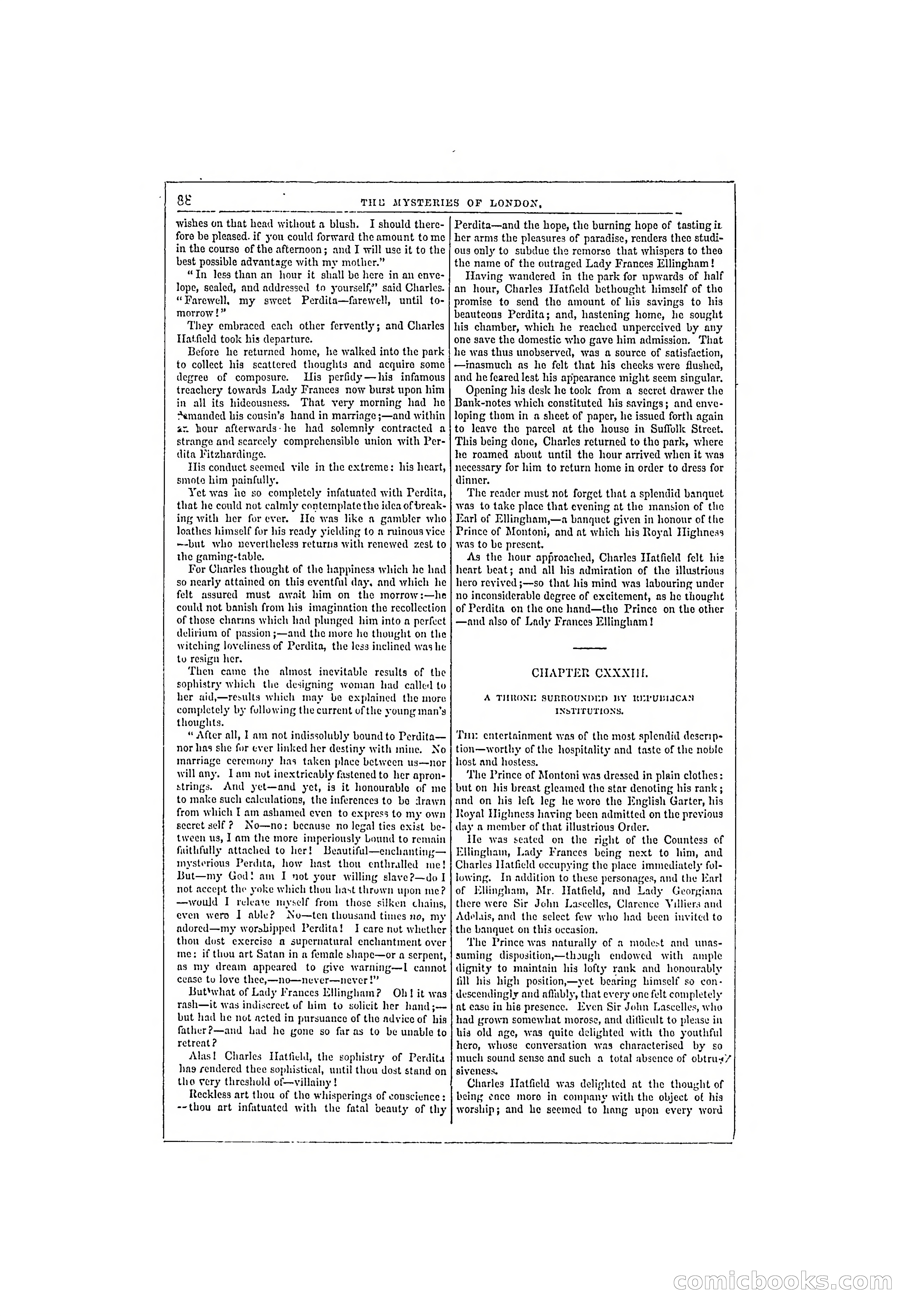
A restored page from Penny Dreadfuls, 1846. Page through the whole issue in the reader above.
📄 Transcribed text from this page (OCR, searchable)
Machine-transcribed from the original scan — historical spelling and the odd misread are preserved.
BE wishes on that head without a blush. I should there- fore be pleased. if you could forward the amount to me in the course of the afternoon; and I will use it to the best possible advantage with my mother.” “Jn less than an hour it shall be here in an enve- lope, sealed, and addressed to yourself,’ said Charles. “Farewell, my sweet Perdita—farewell, until to- morrow !” They embraced each other fervently; and Charles Hatfield took his departure. Before he returned home, he walked into the park to collect his scattered thoughts and acquire some degree of composure. His perfidy—his infamous treachery towards Lady Frances now burst upon him in all its hideousness. That very morning had he Semanded his cousin’s hand in marriage ;—and within az. hour afterwards-he had solemnly contracted a strange and scarcely comprehensible union with Per- dita litzhardinge. His conduct seemed vile in the extreme: his heart, smote him painfully. Yet was ine so completely infatuated with Perdita, that he could not calmly contemplate the idea of break- ing with her for ever. He was Jike a gambler who loathes himself for his ready yielding to a ruinous vice --but who nevertheless returns with renewed zest to the gaming-table. For Charles thought of the happiness which he had so nearly attained on this eventful day, and which he felt assured must await him on the morrow:—he could not banish from his imagination the recollection of those charms which had plunged him into a perfect delirium of passion ;—and the more he thought on the witching loveliness of Perdita, the less inclined was he tu resign her. Then came the almost inevitable results of the sophistry which the designing woman had called to her aidj—results which may be explained the more completely by fullowing the current ofthe young man’s thouglits. “ After all, Iam not indissolubly bound to Perdita— nor has she for cver linked her destiny with mine. No marriage ceremony has taken place between us—nor will any. Iam nut inextricably fastencd to her apron- strings. And yet—and yet, is it honourable of me to make sucli calculations, the inferences to be Arawn from which I am ashamed even to express to my own secret self ? No—no: because no legal tics exist be- tween us, Yam the more imperiously Lound to remain faithfully attached to her! Beautiful—enchanting— mysterious Perdita, how hast thou enthralled me! But—my God! am I not your willing slave?—do I not accept the yoke which thou hast thrown upon me? —would I release myself from those silken chains, even wero J able? No—ten thousand times no, my adored—my worshipped Perdita! I care nut whether thon dost exerciso a supernatural enchantment over me: if thou art Satan in a female shape—or a serpent, as my dream appeared to give warning—I cannot cease tu love thee,—no—never—never!” But‘what of Lady Frances Ellingham? Oh! it was rash—it was indiscrect of Lim to solicit her hand;— but had he not acted in pursuance of the advice of his father?—and bad he gone so far as to be unable to retreat? Alas! Charles Hatficld, the sophistry of Perdita hag sendered thee sophistieal, until thou dost stand on tho very threshold of—villainy ! Reckless art thou of tho whisperings of conscience: --thou art infatuated with the fatal beauty of thy PET OS 2 0 eter pty ee ee ee eee eee TIL MYSTERI“US OF LONDON, Perdita—and the hope, the burning hope of tasting iz her arms the pleasures of paradise, renders thee studi- ous only to subdue the remorse that whispers to thee the name of the outraged Lady Frances Ellingham! Waving wandcred in the park for upwards of half an hour, Charles Hatfield bethought himself of tho promise to send the amount of his savings to his beauteous Perdita; and, hastening home, he sought his chamber, which he reached unperccived by any one save the domestic who gave him admission. That he was thus unobserved, was a source of satisfaction, —inasmuch as he felt that his checks were flushed, and he feared lest his appearance might seem singular. Opening his desk he took from a secret drawer the Bank-notes which constituted his savings; and enye- loping thom in a sheet of paper, he issued forth again to leave the parcel at tho house in Suffolk Street. This being done, Charles returned to the park, where he roamed about until the hour arrived when it was necessary for him to return home in order to dress for dinner. The reader must not forget that a splendid banquet was to take place that evening at the mansion of thie Earl of Ellingham,—a banquet given in honour of the Prince of Montoni, and at which his Royal Highness was to be present. As the hour approached, Charles Hatfield felt his heart beat; and all his admiration of the illustrious hero revived ;—so that his mind was labouring under no inconsiderable degree of excitement, as he thought of Perdita on the one hand—the Prince on the other —and also of Lady Frances Ellingham ! CHAPTER CXXAXIHE, A THRONE SURROUNDED BY REPULLICAN INSTITUTIONS, Tn: entertainment was of the most splendid deserp- ttion—worthy of the hospitality and taste of the noble host and hostess. The Prince of Montoni was dressed in plain clothes: but on his breast gleamed the star denoting his rank ; and on his left leg he wore the English Garter, his Royal Wighness having been admitted on the previous day a member of that illustrious Order. HTe was seated on the right of the Countess of Ellingham, Lady Frances being next to him, and Charles Hatfield occupying the place immediately fol- lowing. In addition to these personages, and the Karl of Ellingham, Mr. Hatfield, and Lady Georgiana there were Sir John Lascelles, Clarence Villiers and Adelais, and the select few who had been invited to the banquet on this occasion. The Prince was naturally of 2 modest and unns- suming dispositionm—though endowed with ample dignity to maintain his lofty rank and honourably fill his high position—yet bearing himself so con- descendingly and aflubly, that every unc felt completely nt ease in hie presence. Even Sir John Lascelles, who had grown somewhat morose, and difticult to please in lis old age, was quite delighted with tho youthful hero, whose conversation was characterised by so much sound sense and such a total absence of obtru-«/ siveness. Charles Iatficld was delighted at the thought of being eace more in company with the object of his worship; and he seemed to hang upon every word (SO) GIOOKS (SO)