
Penny Dreadfuls, 1846 · page 97 of 399
The Mysteries of London, Vol. IV — page 97: what you’re looking at
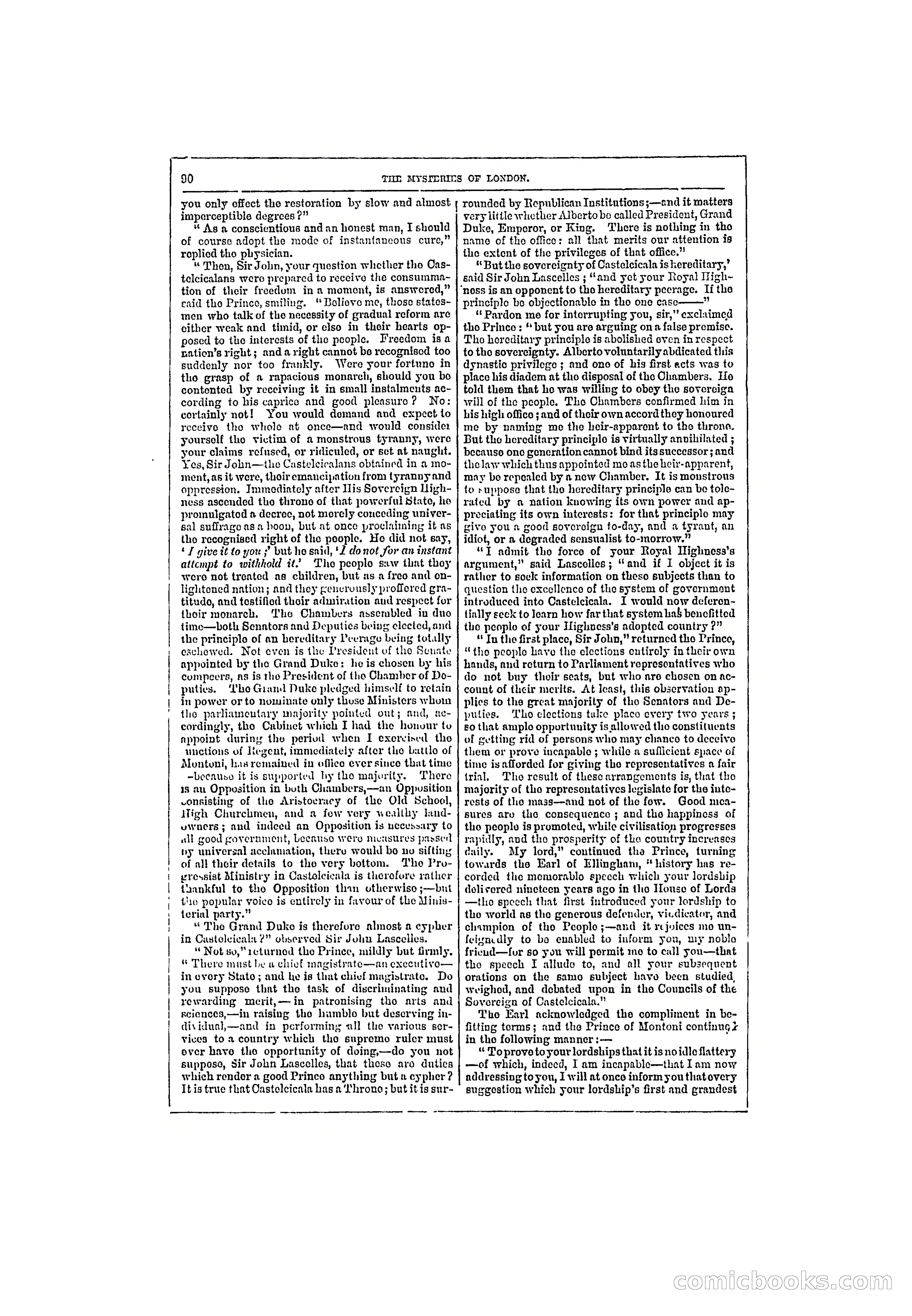
A restored page from Penny Dreadfuls, 1846. Page through the whole issue in the reader above.
📄 Transcribed text from this page (OCR, searchable)
Machine-transcribed from the original scan — historical spelling and the odd misread are preserved.
oe PR A a ey pa rer gp Sc re me cee re a re ge rr —— ee —_ 90 THE MYSICRIMS OF LONDON. you only effect the restoration by slow and almost imperceptible degrees ?” “ Aga conscientious and an honest man, I should of course adopt the mode of instantaneous cure,” replied the physician. Then, Sir John, your question whether the Cas- telcicalans were prepared to receive the consumma- tion of their freedum in a moment, is answered,” eaid the Princo, smiling. “ Bolieve me, those states~ men who talk of the necessity of gradual reform are cither weak and timid, or clso in their hearts op- posed to the interests of the people. Freedom is a nation’s right; anda right cannot be recognised too suddenly nor too frankly. Were your fortuno in tho grasp of a rapacious monarch, should you bo contented by receiving it in small instalments ac- cording to his caprice and good pleasure? No: certainly not! You would domand and expect to receive tho whole rt once—and would consider yourself the victim of a monstrous tyranny, were your claims refused, or ridiculed, or set at naught. Yes, Sir John—the Casteleicalans obtained in a mo- ment, as it were, thoir emancipation from tyranny and oppression. Immediately after is Sovereign Ligh- ness ascended the throno of that powerful State, he promulgated a decree, not merely conceding univer- sal suffrago asa hoon, but at once proclafining it as tho recognised right of the people. Ho did not say, ‘ F give tt to you; but he said, ‘2 donot for an instant attcmpt to withhold it,” The people saw that thoy wero not treated as children, but as a freo and on- lightened nation; and they generously proffered gra- titudo, and testified their admiration and respect for thoir monarch, ‘The Chambers assembled in duo time—both Senators and Deputies being elected, and the principlo of an hereditary Peerage being totally eschewed. Not even is the President of tho Scuate appointed by the Grand Duke: he is chosen by his eompeers, as is the President of the Chamber of Do- puties. ho Giand Duke pledged himself to retain in power or to nominate only thuse Ministers whoin tlie parliamentary majority pointed out; and, ac- cordingly, tho Cabinet which I had the honuur to rppoint during the period when I exercised the unctions of Regent, immediately after the batt of Montoni, has remained in office ever since that time —-becauso it is supported by tho majority. There 18 au Opposition in both Chambers,—an Oppusition consisting of the Aristocracy of the Old School, High Churchmen, and a few very wealthy land- vwners ; and indeed an Opposition is necessary to all good government, because wero musnsures passed by universal acclamation, there would bo no sifting of all their details to the very bottom. Tho Pro- vressist Ministry in Castolcicala is therefore rather thankful to the Opposition than otherwiso ;—but the popular voico is entirely in favour of the Minis- terial party.” “ The Grand Duke is therefore almost a cypher in Castelcivala ?” observed Sir Jolin Lascelles. Not so,"1cturnod the Prince, mildly but firmly. © There must be a chief magistrate—an executive— in cyory Stato; and he is that chief magistrate. Do you suppose that the task of discriminating and rewarding merit,—in patronising tho arts and gciences,—in raising the hamblo but deserving in- dividual,—and in performing all tho various ser- vices to a country which tho supremo ruler must ever have the opportunity of doing,—do you not suppose, Sir John Lascelles, that theso aro dutics which render a good Princo anything but « cypher? It is true that Castelcicala has a ‘Lhrono; but it is sur- ——w wee rounded by Republican Institutions ;—and it matters verp little whether Alberto be called President, Grand Duke, Emperor, or King. There is nothing in tho name of the office: all that merits our attention is the extent of the privileges of that office.” “But the sovereignty of Castelcicala is kereditary,’ said Sir John Lascelles ; “and yet your Royal High~ ‘noss is an opponent to tho hereditary pecrage. Ti the principle be objectionable in tho one case am ‘ Pardon me for interrupting you, sir,”’ exclaimed the Prince: * but you are arguing ona false premise. Tho hereditary principle is abolished even in respect to tho sovereignty. Alberto voluntarily abdicated this dynastic privilere ; and one of his first acts was to place his diadem at tho disposal of the Chambers, Ho told them that he was willing to obey the sovercign will of the people. The Chambers confirmed him in his high office ; and of their own accord they honoured me by naming me the heir-apparent to the throne. But the hereditary principle is virtually anvihilated ; because one generation cannot bind its successor ; and the law which thus appointed mo asthe beir-apparent, may be repealed by a new Chamber. It is monstrous to suppose that the hereditary principle can be tole- rated by a nation knowing its own power and ap- preciating its own interests: for that principlo may givo you a good sovercign to-day, and a tyrant, an idiot, or a degraded sensualist to-morrow.” “T admit the force of your Royal Ilighness’s argument,” said Lascelles; “and if I object it is rather to sock information on these subjects than to question the excellenco of the system of government introduced into Castelcicala. I would now deferen- tinlly seek to learn how far that system hak benefitted the people of your Ilighness’s adopted country 2?” “ Jn the first place, Sir John,” returned the Prince, “tho people havo the elections cutirely in their own hands, and return to Parliament representatives who do not buy thoir seats, but who are chosen on ac- count of their merits. At Icast, this observation ap- plies to the great majority of tho Senators and De- putlies. Tho clections tulke placo cvery two years ; £0 that ample opportunity is allowed the constituents of getting rid of persons who may chance to deccivo them or prove incapable ; while a suflicient space of time is afforded for giving the representatives a fair trial. Tho result of these arrangements is, that tho majority of the represcntatives legislate for the intc- rests of tho mass—and not of the few. Good mea- sures aro the consequence ; and the happiness of tho people is promoted, while civilisation progresses rapidly, and tho prosperity of the country increases caily. My lord,” continued tha Prince, turning towards the Earl of Elingham, “history has re- corded the memorablo speech which your lordship delivered nincteen years ago in tho House of Lords —tho speech that first introduced your lordship to tho world as the generous defender, vicdicator, and champion of tho People ;—and it rejoices mo un- feiencdly to ba enabled to inform you, my noble fricud—fur so you will permit me to call you—that the speech I alludo to, and all your subsequent orations on the samo subject have been studied, weighod, and debated upon in the Councils of the Sovoreign of Castelcicala.” The Earl acknowledged the compliment in be- fitting torms; and the Prince of Montont continugz in tho following manner :— “ Toproveto your lordships that it is no idle flattery —of which, indecd, I am incapable—that Iam now addressing to you, I will at onco inform you that overy suggestion which your lordship’s first and grandest GIOOKS 5} (CO) (CO) >