
Penny Dreadfuls, 1846 · page 98 of 399
The Mysteries of London, Vol. IV — page 98: what you’re looking at
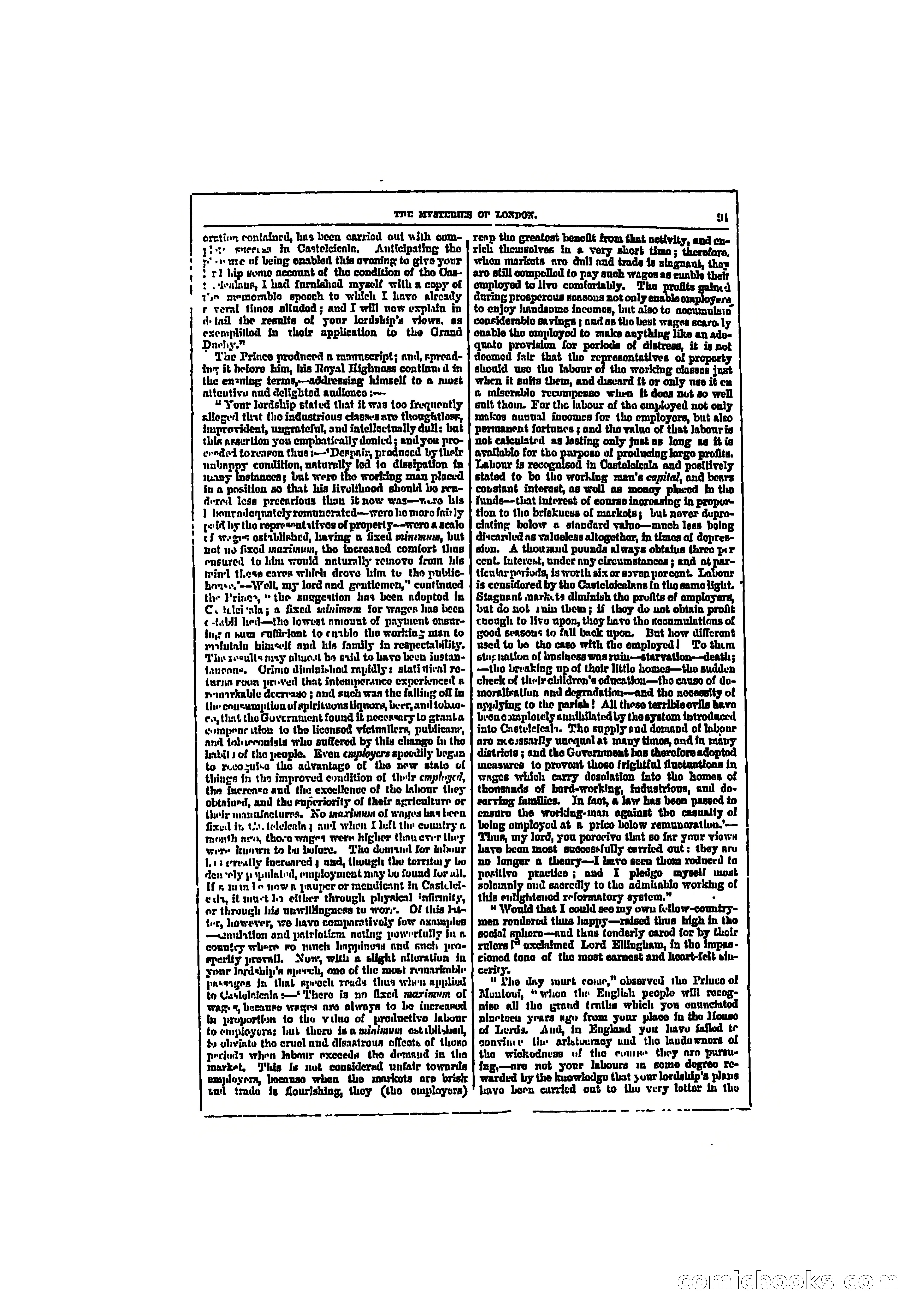
A restored page from Penny Dreadfuls, 1846. Page through the whole issue in the reader above.
📄 Transcribed text from this page (OCR, searchable)
Machine-transcribed from the original scan — historical spelling and the odd misread are preserved.
TG MYSTERIES OF LONDON. eration contained, has heen carricd out with oom- zie sutecuss in Castelcieala, Anticipating the ware of being onabled this cvening to give your : rl hip somo acconnt of tho condition of tho Cas- ¢ .dealans, I hod fornished myself with a copy of 12° memorable speech to which I have already ¢ veral times alluded; and I will now explain in tail the results of your lordship’s vicows, as exemplilled in their application to the Grand Dachy.” Tue Princo produced a manuscript; and, rpread- ine it before him, his Royal Highness continu d in the en:ning terme,—addressing himself to 2 must attentive and delighted audienco :— # Yonr lordship stated that it was too frequently alleced that the industrious classes aro thoughtless, improvident, ungrateful, and intellectually dull: but this assertion you emphatically denied; and you pro- ceeded torearon thus:—*Derpair, produced by their uubappy condition, unturally led fo dissipation in many instances; but wero tho working man placed in a position so that his livelihood should bo ren- derod less precarious than it now was—Vwero his 1 bonradeqnately remunerated —vero ho nioro fairly pd by tho repre=ontatives of proper! y~—wero a scalo cf weges estiblished, having a fixed minimum, but not no fixed maximum, tho incroascd comfort thus ensured to him would naturally remove from his inl tLeso cares which drove kim tv tho public- howes."——Well, my lord and gentlemen,” continued the Pines, © the suggestion has been adupted in Cu telefcalas a fixed minimum for wages has heen ¢-tabll hed—tho lowest nmount of payment onsur- ing a hum Fufficient to cnablo the worl:ins man to mintain himeelf aud hia family in respectability. The results may almest be iid to hayo been iustan- tancons, Crimo diminished rapidly: statistical re- durna roon proved that intemperance experienced a renmrkable dcervase ; and such was the falling off in the consunspliun of spirituous liquors, beer, and tobac- ce, that the Government found it neceseary to granta compene ition to tho licensed victunllers, publican, and tolieroufsis who suffered by this chango iu tho habits of the people. Even employers specdily begun to rucoznisa the advantago of the new stato of things in tho improved condition of their employed, the increase and the excellence of the Inbour they obtained, and the superiority of their agriculture or dhely manufactures. No maxima of wages has been fixed in Co. teleleala ; and when Cleft the country a month ace, tho.e wages were higher than ever they were Known to bo before. The demand for labour Liiereatly increared 5 aud, though the territe:y bo den ‘ely p pulated, employment may be found for all. If minie nown pauper or mendicant in Castclel- eva, it must b2 cither through physical ‘nfirmity, or through lig unwillingness to wor. Of this Iat- ter, however, wo have comparatively fuw oxamples —unlstion and patrioticm acting powerfully ino country where ro much happiness and sich pro- sperity prevail. Now, with o slight alteration in your Jordship’s sperch, ono of the most remarkable passages in tliat eproch reads thus when applied to Castelefeaia :-—* Thera is no fixed maximum of war 8, beeaure wages aro always to be increased in proportion to the viluo of productive Jabour to employers: but there is a minimum cotrblirhed, ty ubvinte tho crucl and disastrous offects of thoso periods when Inbour exceeds tho demand in tho market, This is not considered unfair towards employers, bocauso when tho markots aro brisk tu'l trade {fs flourishing, thoy (tho cmployors) aE PES as aa oon) eee ul erry renp the greatest bonofit from that activity, and en- rich themsclyes In s vory short time; therefore. when markots nro dull and trade {a stagnant, thor aro still compelled to pay such wages as eunble theit employed to live comfortably. Tho profits gained during prosperous scasons not only cnabloomployers to enjoy handsome incomes, but also to accumulsio considerable savings ; aud as tho best wares scare. ly enablo the employed to make anything like an ado- quato provision for periods of distress, it is not decmed fair that tho representatives of proporty should uso the Inbour of tho working classoa just when it suits them, and discard it or only uso it cn a infserablo recompenso when {it does nut so well suit them. For the labour of the ompluyed not only makes annual incomes for tho employers, but also permanent fortunes ; and tho valuo of that Iabouris not calculated as lasting only just ns long as it ia availablo for tho purposo of producing largo profits. Labour is recognised in Cnstelefcala and positively stated to bo tho working man’s capital, and bears coustant interest, as woll as monoy placed in tho fundse—that interest of conurso increasing in propor- tion to tho briskucss of markots; but novor depro- cinting bolow o standard yaluc—much less being discarded as valueless altogether, in times of depres- siun. A thouzand pounds always obtalus threo pur cenl. {uterent, under any circumstances ; and at par= ticular periods, is worth six or ssvon porcent. Labour is censidored by tho Casteloicalans in tho samo light. Stagnant mark. ts diminish tho profits ef emp but do not suin them; if thoy do uot obtain profit cnough to live upon, thoy Lavo tho ¢coumulations of good seasons to fall back upon. But how different used to bo tho cago with tho omployed! To thrm Stnc nation of business was ruin—starvation—death; —tho breaking up of thoir little homes—tho sudden check of their childron’s cducatfon—tho causo of de- moraliration and degradation—and tho necessity of applying to the parish! All theso terriblocvils havo bvoncamplotely annihilated by thesystom introduaccd into Castelcicals. Tho supply ond domand of labour aro ncczssarily unequal at many timos, and in many dietricts ; and the Governmont has thorefore ad measures to provent thoso frightful fluctuations in wages which carry dosolation into tho homes of thousands of hard-working, industrious, and do- serving familics. In fact, a law has beon passed to enstro the working-man egninst tho casurity of being omployod at a prico below remunoration.’-— Thus, my lord, you perccivo that so far your viows have bcon most succossfully carried out: they are no longer a thoory—I havo scen them reduced to porilivo practice; and I pledgo myself most solemnly and sacredly to the admiiablo working of this enlightened reformatory system.” : % Would that I could seo my own fellow-country- men rendered thus happy—raised thus high in the social sphero—nnd thus tenderly cared for by their rulers!" oxclafmed Lord Eltiugham, in tho impas- cioncd tone of tho most earnost and hoart-fclt sin- cerit e ° Tho day wurt cone,” observed tho Princo of Moutoui, “when the English people will recog- nise all the grand truths which you enunciated nineteen years ayo from your placo in tho Ifouse of Lerds. And, in England you havo faflod te convine the aristueracy and tho laudownors of he wickedness of the come they aro pursu- ing,—aro not your labours in some d re- warded by tho knuowledgo that 5 uur lordship’s plans Layo Loon carried out to the very lotter in the = ee (C(O) DOO (C(O)