
Penny Dreadfuls, 1854 · page 153 of 394
Joseph Wilmot, or, The Memoirs of a Man-Servant — page 153: what you’re looking at
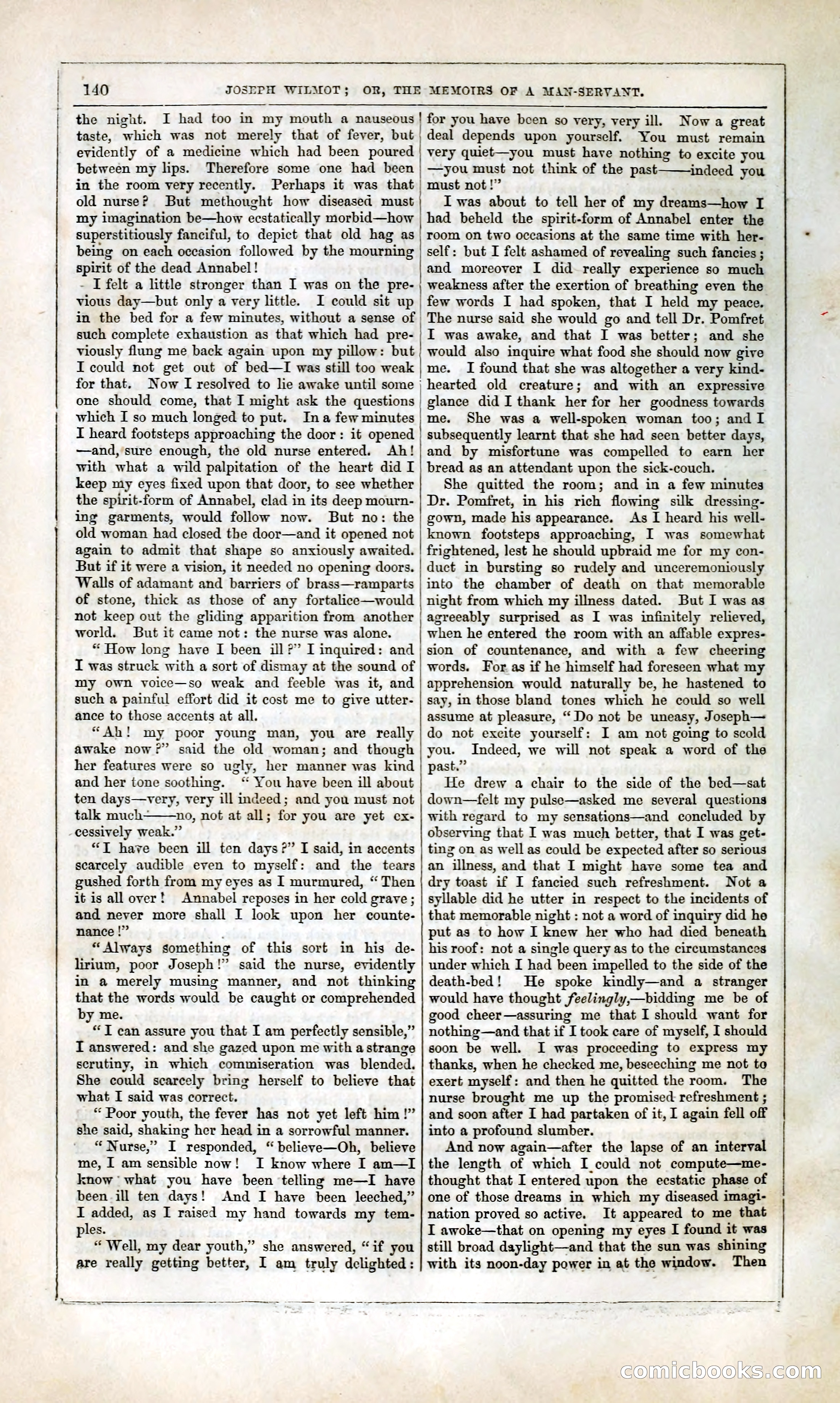
A restored page from Penny Dreadfuls, 1854. Page through the whole issue in the reader above.
📄 Transcribed text from this page (OCR, searchable)
Machine-transcribed from the original scan — historical spelling and the odd misread are preserved.
; —_————- -- -— —oo_—_-_--:-- eS ee ern or eee ewe we 140 JOSEPH WILMOT; the night. I had too in my mouth a nauseous! for you have been so very, very ill. taste, which was not merely that of fever, but evidently of a medicine which had been poured between my lips. Therefore some one had been in the room very recently. Perhaps it was that old nurse? But methought how diseased must my imagination be—how ecstatically morbid—how superstitiously fanciful, to depict that old hag as being on each occasion followed by the mourning spirit of the dead Annabel! - I felt a little stronger than I was on the pre- vious day—but only a very little. I could sit up | in the bed for a few minutes, without a sense of | such complete exhaustion as that which had pre- viously flung me back again upon my pillow: but I could not get out of bed—I was still too weak for that. Now I resolved to lie awake until some one should come, that I might ask the questions which I so much longed to put. Ina few minutes I heard footsteps approaching the door: it opened —and, sure enough, the old nurse entered. Ah! with what a wild palpitation of the heart did I keep my eyes fixed upon that door, to see whether the spirit-form of Annabel, clad in its deep mourn- ing garments, would follow now. But no: the old woman had closed the door—and it opened not again to admit that shape so anxiously awaited. But if it were a vision, it needed no opening doors. Walls of adamant and barriers of brass—ramparts of stone, thick as those of any fortalice—would not keep out the gliding apparition from another world. But it came not: the nurse was alone. *“ How long have I been ill ?” I inquired: and I was struck with a sort of dismay at the sound of my own voice—so weak and feeble was it, and such a painful effort did it cost me to give utter- ance to those accents at all. “Ah! my poor young man, you are really awake now?” said the old woman; and though her features were so ugly, her manner was kind and her tone soothing. ‘“ You have been ill about ten days—very, very ill indeed; and you musf not talk much———no, not at all; for you are yet cx- cessively weak.” “TIT have been ill ten days?” I said, in accents scarcely audible even to myself: and the tears gushed forth from my eyes as I murmured, “ Then it is all over! Annabel reposes in her cold grave ; and never more shall I look upon her counte- nance !” “Always something of this sort in his de- lirium, poor Joseph!” said the nurse, evidently in a merely musing manner, and not thinking that the words would be caught or comprehended by me. “IT can assure you that I am perfectly sensible,” I answered: and she gazed upon me with astrange scrutiny, in which commiseration was blended. She could scarcely bring herself to believe that what I said was correct. “ Poor youth, the fever has not yet left him!” she said, shaking her head in a sorrowful manner. “ Nurse,’ I responded, “ believe—Oh, believe me, I am sensible now! I know where I am—I know what you have been telling me—I have been.ill ten days! And I have been leeched,” I added, as I raised my hand towards my tem- ples. “ Well, my dear youth,” she answered, “if you are really getting better, I am truly delighted: —S Se ES ——_ | — en OR, THE MEMOIRS OF A MAN-SERVANT. Now a great deal depends upon yourself. You must remain very quiet—you must have nothing to excite you —you must not think of the past indeed you must not!” I was about to tell her of my dreams—how I had beheld the spirit-form of Annabel enter the room on two occasions at the same time with her- self: but I felt ashamed of revealing such fancies ; and moreover I did really experience so much weakness after the exertion of breathing even the few words I had spoken, that I held my peace. The nurse said she would go and tell Dr. Pomfret I was awake, and that I was better; and she would also inquire what food she should now give me. I found that she was altogether a very kind- hearted old creature; and with an expressive glance did I thank her for her goodness towards me. She was a well-spoken woman too; and I subsequently learnt that she had seen better days, and by misfortune was compelled to earn her bread as an attendant upon the sick-couch. She quitted the room; and in a few minutes Dr. Pomfret, in his rich flowing silk dressing- gown, made his appearance. As I heard his well- known footsteps approaching, I was somewhat frightened, lest he should upbraid me for my con- duct in bursting so rudely and unceremoniously into the chamber of death on that memorable night from which my illness dated. But I was as agreeably surprised as I was infinitely relieved, when he entered the room with an affable expres- sion of countenance, and with a few cheering words. For as if he himself had foreseen what my apprehension would naturally be, he hastened to say, in those bland tones which he could so well assume at pleasure, “Do not be uneasy, Joseph— do not excite yourself: I am not going to scold you. Indeed, we will not speak a word of the past.” He drew a chair to the side of the bed—sat down—felt my pulse—asked me several questions with regard to my sensations—and concluded by observing that I was much better, that I was get- ting on as well as could be expected after so serious an illness, and that I might have some tea and dry toast if I fancied such refreshment. Not a syllable did he utter in respect to the incidents of that memorable night : not a word of inquiry did he put as to how I knew her who had died beneath his roof: not a single query as to the circumstances under which I had been impelled to the side of the death-bed! He spoke kindly—and a stranger would have thought feelingly,—bidding me be of good cheer—assuring me that I should want for nothing—and that if I took care of myself, I should soon be well. I was proceeding to express my thanks, when he checked me, beseeching me not to exert myself: and then he quitted the room. The nurse brought me up the promised refreshment ; and soon after I had partaken of it, I again fell off into a profound slumber. And now again—after the lapse of an interval the length of which I could not compute—me- thought that I entered upon the ecstatic phase of one of those dreams in which my diseased imagi- nation proved so active. It appeared to me that I awoke—that on opening my eyes I found it was still broad daylight—and that the sun was shining with its noon-day power in at the window. Then $e ee DOOKS (c@) im