
Penny Dreadfuls, 1854 · page 154 of 394
Joseph Wilmot, or, The Memoirs of a Man-Servant — page 154: what you’re looking at
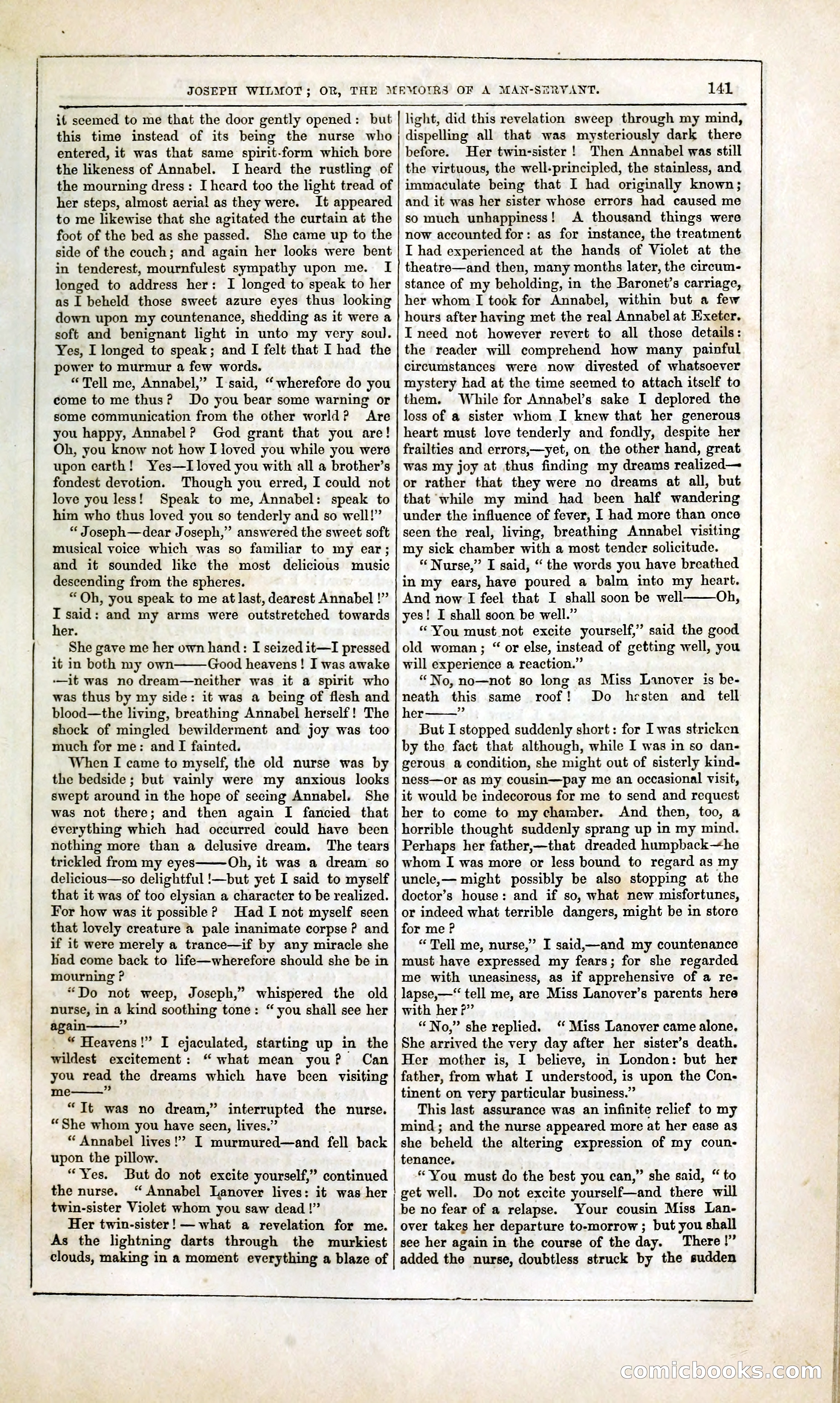
A restored page from Penny Dreadfuls, 1854. Page through the whole issue in the reader above.
📄 Transcribed text from this page (OCR, searchable)
Machine-transcribed from the original scan — historical spelling and the odd misread are preserved.
JOSEPH WILMOT; OR, THE MEMOIRS OF A MAN-SERVANT. it seemed to me that the door gently opened: but | light, did this revelation sweep through my mind, 141 this time instead of its being the nurse who} dispelling all that was mysteriously dark there entered, it was that same spirit-form which bore the likeness of Annabel. I heard the rustling of the mourning dress: I heard too the light tread of her steps, almost aerial as they were. It appeared to me likewise that she agitated the curtain at the foot of the bed as she passed. She came up to the side of the couch; and again her looks were bent in tenderest, mournfulest sympathy upon me. I longed to address her: I longed to speak to her as I beheld those sweet azure eyes thus looking down upon my countenance, shedding as it were a soft and benignant light in unto my very soul. Yes, I longed to speak; and I felt that I had the power to murmur a few words. “Tell me, Annabel,” I-said, “wherefore do you come to me thus? Do you bear some warning or some communication from the other world? Are you happy, Annabel? God grant that you are! Oh, you know not how I loved you while you were upon earth! Yes—I loved you with all a brother’s fondest devotion. Though you erred, I could not love you less! Speak to me, Annabel: speak to him who thus loved you so tenderly and so well!” “ Joseph—dear Joseph,” answered the sweet soft musical voice which was so familiar to my ear; and it sounded like the most delicious music descending from the spheres. “Oh, you speak to me at last, dearest Annabel !’ I said: and my arms were outstretched towards her. She gave me her own hand: I seized it—I pressed it in both my own Good heavens! I was awake -—it was no dream—neither was it a spirit who was thus by my side: it was a being of flesh and blood—the living, breathing Annabel herself! The shock of mingled bewilderment and joy was too much for me: and I fainted. When I came to myself, the old nurse was by the bedside ; but vainly were my anxious looks swept around in the hope of seeing Annabel. She was not there; and then again I fancied that everything which had occurred could have been nothing more than a delusive dream. The tears trickled from my eyes Oh, it was a dream so delicious—so delightful !—but yet I said to myself that it was of too elysian a character to be realized. For how was it possible? Had I not myself seen that lovely creature a pale inanimate corpse ? and if it were merely a trance—if by any miracle she had come back to life—wherefore should she be in mourning P “Do not weep, Joseph,” whispered the old nurse, in a kind soothing tone: “ you shall see her again 99 _ “ Heavens!” I ejaculated, starting up in the wildest excitement: “what mean you? Can you read the dreams which have been visiting me bP] “Tt was no dream,” interrupted the nurse. “She whom you have seen, lives.” | “ Annabel lives!’ I murmured—and fell back upon the pillow. “Yes. But do not excite yourself,” continued the nurse. “Annabel Lanover lives: it was her twin-sister Violet whom you saw dead !” Her twin-sister!— what a revelation for me. As the lightning darts through the murkiest clouds, making in a moment everything a blaze of ie 2 before. Her twin-sister ! Then Annabel was still the virtuous, the well-principled, the stainless, and immaculate being that I had originally known; and it was her sister whose errors had caused me so much unhappiness! A thousand things were now accounted for: as for instance, the treatment I had experienced at the hands of Violet at the theatre—and then, many months later, the circum- stance of my beholding, in the Baronet’s carriage, her whom I took for Annabel, within but a few hours after having met the real Annabel at Exeter, I need not however revert to all those details: the reader will comprehend how many painful circumstances were now divested of whatsoever mystery had at the time seemed to attach itsclf to them. While for Annabel’s sake I deplored the loss of a sister whom I knew that her generous heart must love tenderly and fondly, despite her frailties and errors,—yet, on the other hand, great was my joy at thus finding my dreams realized— or rather that they were no dreams at all, but that while my mind had been half wandering under the influence of fever, I had more than once seen the real, living, breathing Annabel visiting my sick chamber with a most tender solicitude. “ Nurse,” I said, “ the words you have breathed in my ears, have poured a balm into my heart. And now I feel that I shall soon be well Oh, yes! I shall soon be well.” “You must not excite yourself,” said the good old woman; “ or else, instead of getting well, you will experience a reaction.” “No, no—not so long as Miss Lanover is be- neath this same roof! Do hesten and tell her fs But I stopped suddenly short: for I was stricken by the fact that although, while I was in so dan- gerous a condition, she might out of sisterly kind- ness—or as my cousin—pay me an occasional visit, it would be indecorous for me to send and request her to come to my chamber. And then, too, a horrible thought suddenly sprang up in my mind. Perhaps her father,—that dreaded humpback~he whom I was more or less bound to regard as my uncle,— might possibly be also stopping at the doctor’s house: and if so, what new misfortunes, or indeed what terrible dangers, might be in store for me? “Tell me, nurse,” I said,—and my countenance must have expressed my fears; for she regarded me with uneasiness, as if apprehensive of a res lapse,—‘ tell me, are Miss Lanover’s parents here with her P” “No,” she replied. ‘ Miss Lanover came alone, She arrived the very day after her sister’s death. Her mother is, I believe, in London: but her father, from what I understood, is upon the Con- tinent on very particular business.” This last assurance was an infinite relief to my mind; and the nurse appeared more at her ease as she beheld the altering expression of my coun- tenance. “You must do the best you can,” she said, “ to get well. Do not excite yourself—and there will be no fear of a relapse. Your cousin Miss Lan- over takes her departure to-morrow ; but you shall see her again in the course of the day. There!’ added the nurse, doubtless struck by the sudden CORNICE OOO S Gon