
Penny Dreadfuls, 1854 · page 155 of 394
Joseph Wilmot, or, The Memoirs of a Man-Servant — page 155: what you’re looking at
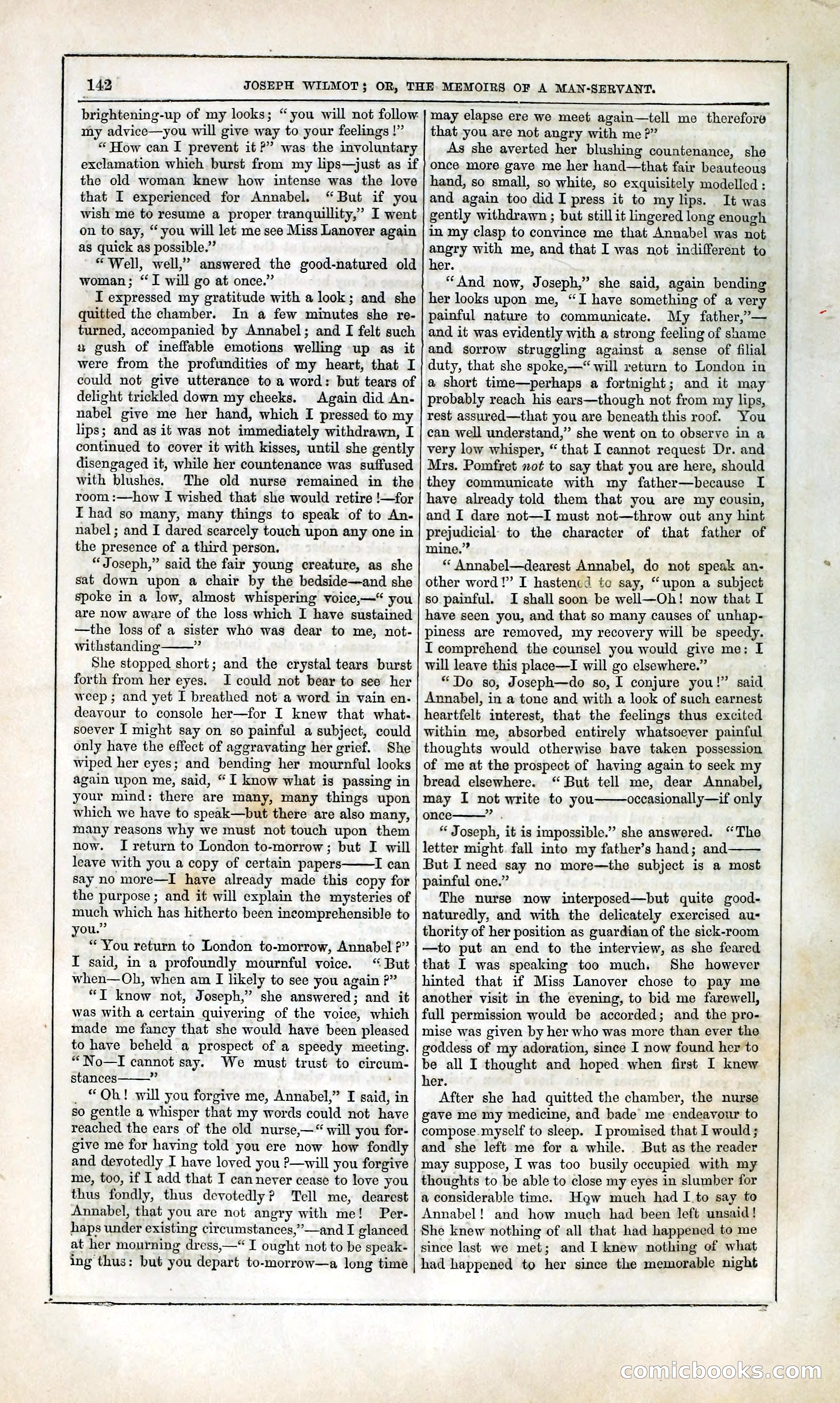
A restored page from Penny Dreadfuls, 1854. Page through the whole issue in the reader above.
📄 Transcribed text from this page (OCR, searchable)
Machine-transcribed from the original scan — historical spelling and the odd misread are preserved.
a 142 brightening-up of my looks; “you will not follow. my advice—you will give way to your feelings !” “ How can I prevent it ?” was the involuntary exclamation which burst from my lips—just as if the old woman knew how intense was the love that I experienced for Annabel. “But if you wish me to resume a proper tranquillity,’ I went on to say, “you will let me see Miss Lanover again as quick as possible.” “Well, well,” answered the good-natured old woman; “I will go at once.” I expressed my gratitude with a look; and she quitted the chamber. In a few minutes she re- turned, accompanied by Annabel; and I felt such gush of ineffable emotions welling up as it were from the profundities of my heart, that I could not give utterance toa word: but tears of delight trickled down my cheeks. Again did An- nabel give me her hand, which I pressed to my lips; and as it was not immediately withdrawn, I continued to cover it with kisses, until she gently disengaged it, while her countenance was suffused with blushes. The old nurse remained in the room :—how I wished that she would retire !—for I had so many, many things to speak of to An- nabel ; and I dared scarcely touch upon any one in the presence of a third person. “Joseph,” said the fair young creature, as she sat down upon a chair by the bedside—and she spoke in a low, almost whispering voice,—“ you are now aware of the loss which I have sustained —the loss of a sister who was dear to me, not- withstanding “a She stopped short; and the crystal tears burst forth from her eyes. I could not bear to see her weep ; and yet I breathed not a word in vain en. deavour to console her—for I knew that what- soever I might say on so painful a subject, could only haye the effect of aggravating her grief. She wiped her eyes; and bending her mournful looks again upon me, said, “I know what is passing in your mind: there are many, many things upon which we have to speak—but there are also many, many reasons why we must not touch upon them now. I return to London to-morrow; but I will leave with you a copy of certain papers IT can say no more—I have already made this copy for the purpose ; and it will explain the mysteries of much which has hitherto been incomprehensible to you.” } “You return to London to-morrow, Annabel ?” I said, in a profoundly mournful voice. “But when—Ohb, when am I likely to see you again P” “JT know not, Joseph,” she answered; and it was with a certain quivering of the voice, which made me fancy that she would have been pleased to have beheld a prospect of a speedy meeting. “No—I cannot say. We must trust to circum- stances te _ “Ob! will you forgive me, Annabel,” I said, in so gentle a whisper that my words could not have reached the ears of the old nurse,—* will you for- give me for having told you ere now how fondly and devotedly I have loved you P—will you forgive me, too, if I add that I can never cease to love you thus fondly, thus devotedly? ‘Tell me, dearest Annabel, that you are not angry with me! Per- haps under existing circumstances,”’—and I glanced at her mourning dress,—“ I ought not to be speak- ing thus: but you depart to-morrow—a long time JOSEPH WILMOT$ OR, THE: MEMOIRS OF A MAN-SERVANT. may elapse ere we meet again—tell me therefore that you are not angry with me ?” As she averted her blushing countenance, she once more gave me her hand—that fair beauteous hand, so small, so white, so exquisitely modelled : and again too did I press it to my lips. It was gently withdrawn ; but still it lingered long enough in my clasp to convince me that Anuabel was not angry with me, and that I was not indifferent to her. ‘“‘And now, Joseph,” she said, again bending her looks upon me, “I have something of a very painful nature to communicate. My father,”— and it was evidently with a strong feeling of shame and sorrow struggling against a sense of filial duty, that she spoke,—* will return to London in a short time—perhaps a fortnight; and it may probably reach his ears—though not from my lips, rest assured—that you are beneath this roof. You can well understand,” she went on to observe in a very low whisper, “that I cannot request Dr. and Mrs. Pomfret not to say that you are here, should they communicate with my father—because I have already told them that you are my cousin, and I dare not—I must not—throw out any hint prejudicial: to the character of that father of mine.” “ Annabel—dearest Annabel, do not speak an- other word!” I hastencd to say, “upon a subject so painful. I shall soon be well—Oh! now that I have seen you, and that so many causes of unhap- piness are removed, my recovery will be speedy. I comprehend the counsel you would give me: I will leave this place—I will go elsewhere.” * Do so, Joseph—do so, I conjure you!” said Annabel, in a tone and with a look of such earnest heartfelt interest, that the feelings thus excited Within me, absorbed entirely whatsoever painful thoughts would otherwise have taken possession of me at the prospect of having again to seek my bread elsewhere. “ But tell me, dear Annabel, may I not write to you occasionally—if only once sie “ Joseph, it is impossible.” she answered. “The letter might. fall into my father’s hand; and But I need say no more—the subject is a most painful one.” The nurse now interposed—but quite good- naturedly, and with the delicately exercised au- thority of her position as guardian of the sick-room —to put an end to the interview, as she feared that I was speaking too much. She however hinted that if Miss Lanover chose to pay me another visit in the evening, to bid me farewell, full permission would be accorded; and the pro- mise was given by her who was more than ever the goddess of my adoration, since I now found her to be all I thought and hoped when first I knew her. : | After she had quitted the chamber, the nurse gave me my medicine, and bade me endeavour to compose.myself to sleep. I promised that I would; and she left me for a while. But as the reader may suppose, I was too busily occupied with my thoughts to be able to close my eyes in slumber for a considerable time. Haw much had Ito say to Annabel! and how much had been left unsaid! She knew nothing of all that had happened to me since last we met; and I knew nothing of what had happened to her since the memorable night EloOOKKS (C@) } im