
Penny Dreadfuls, 1854 · page 179 of 394
Joseph Wilmot, or, The Memoirs of a Man-Servant — page 179: what you’re looking at
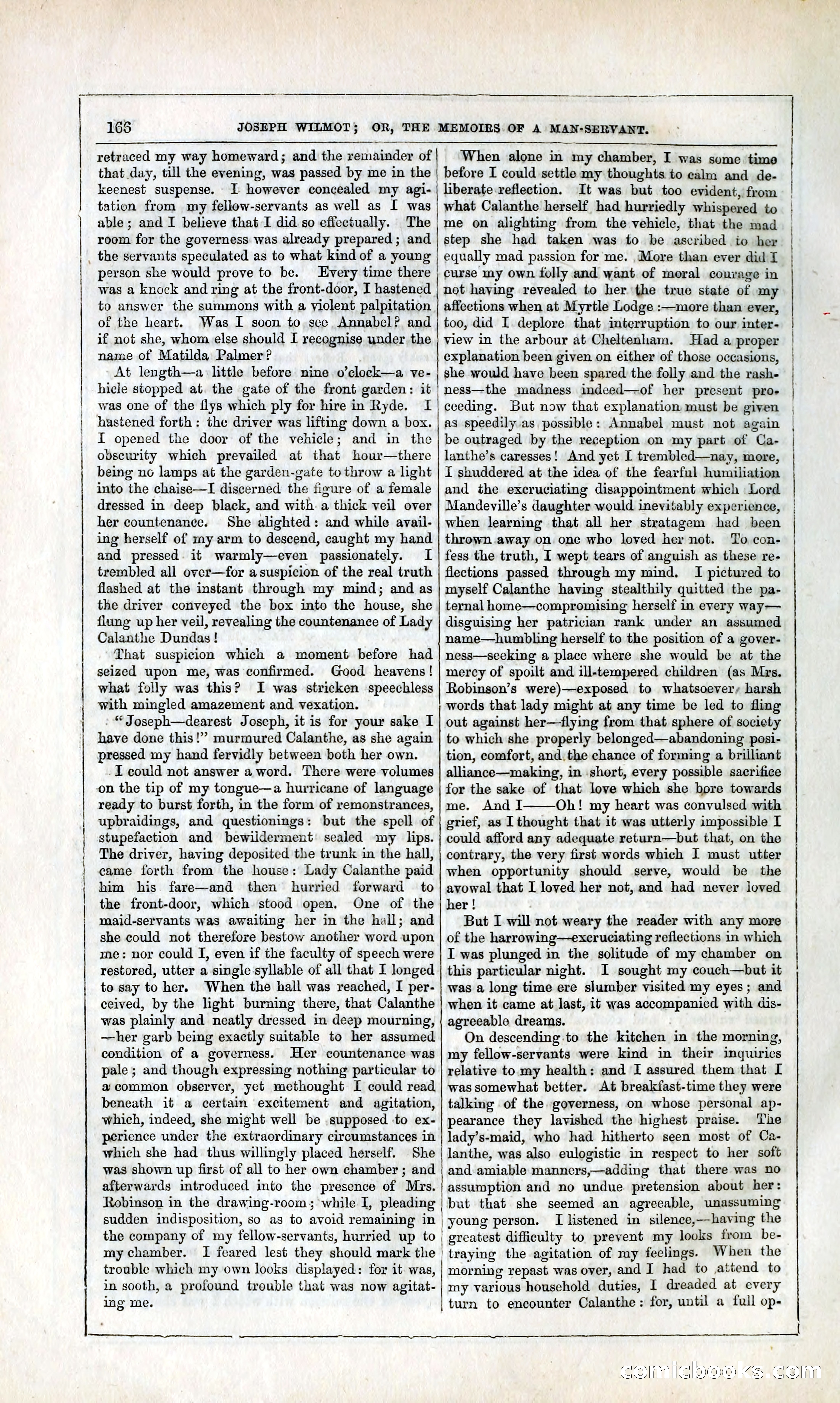
A restored page from Penny Dreadfuls, 1854. Page through the whole issue in the reader above.
📄 Transcribed text from this page (OCR, searchable)
Machine-transcribed from the original scan — historical spelling and the odd misread are preserved.
—— 168 JOSEPH WILMOT; OR, THE MEMOIRS OF A MAN-SERVANT. retraced my way homeward; and the remainder of that day, till the evening, was passed by me in the keenest suspense. I however concealed my agi- tation from my fellow-servants as well as I was able; and I believe that I did so effectually. The room for the governess was already prepared ; and _ the servants speculated as to what kind of a young person she would prove to be. Every time there was a knock and ring at the front-door, I hastened to answer the summons with a violent palpitation of the heart. Was I soon to see Annabel? and if not she, whom else should I recognise under the name of Matilda Palmer? At length—a little before nine o’clock—a ve- hicle stopped at. the gate of the front garden: it was one of the flys which ply for hire in Ryde. I hastened forth: the driver was lifting down a box. I opened the door of the vehicle; and in the obscurity which prevailed at that hour—there being no lamps at the garden-gate to throw a light into the chaise—I discerned the fieure of a female dressed in deep black, and with a thick veil over her countenance. She alighted: and while avail- ing herself of my arm to descend, caught my hand and pressed. it warmly—even passionately. LI trembled all over—for a suspicion of the real truth flashed at the instant through my mind; and as the driver conveyed the box into the house, she flung up her veil, revealing the countenance of Lady Calanthe Dundas! That suspicion which a moment before had seized upon me, was confirmed. Good heavens! what folly was this? I was stricken speechless with mingled amazement and vexation. : “ Joseph—dearest Joseph, it is for your sake I have done this!’ murmured Calanthe, as she again pressed my hand fervidly between both her own. -I could not answer a word. There were volumes on the tip of my tongue—a hurricane of language ready to burst forth, in the form of remonstrances, upbraidings, and questionings: but the spell of stupefaction and bewiiderment: sealed my lips. The driver, having deposited the trunk in the hall, came forth from the house: Lady Calanthe paid him his fare—and then hurried forward to the front-door, which stood open, One of the maid-servants was awaiting her in the hall; and she could not therefore bestow another word upon me: nor could I, even if the faculty of speech were restored, utter a single syllable of all that I longed to say to her. When the hall was reached, I per- ceived, by the light burning there, that Calanthe was plainly and neatly dressed in deep mourning, —her garb being exactly suitable to her assumed condition of a governess. Her countenance was pale ; and though expressing nothing particular to a# common observer, yet methought I could read beneath it a certain excitement and agitation, which, indeed, she might well be .supposed ‘to ex- perience under the extraordinary circumstances in which she had thus willingly placed herself. She was shown up first of all to her own chamber ; and afterwards introduced into the presence of Mrs. Robinson in the drawing-room; while I, pleading sudden indisposition, so as to avoid remaining in the company of my fellow-servants, hurried up to my chamber. I feared lest they should mark the trouble which my own looks displayed: for it was, in sooth, a profound trouble that was now agitat- ing me. When alone in my chamber, I was some time before I could settle my thoughts to calm and de- liberate.reflection. It was but too evident, from what Calanthe herself had hurriedly whispered to me on alighting from the vehicle, that the mad step she had taken was to be ascribed io her equally mad passion for me. More than ever did I curse my own folly and want of moral courage in not haying revealed to her the true state of my affections when at Myrtle Lodge :—more than ever, too, did I deplore that interruption to our inter- view in the arbour at Cheltenham. Had a proper explanation been given on either of those occasions, she would have been spared the folly and the rash- ness—the madness indeed—of her present pro- ceeding. But now that explanation must be given as speedily as possible: Annabel must not again be outraged by the reception on my part of Ca- lanthe’s caresses! And yet I trembled—nay, more, I shuddered at the idea of the fearful humiliation and the excruciating disappointment which Lord Mandeville’s daughter would inevitably experience, when learning that all her stratagem had been thrown away on one who loved her not. To con- fess the truth, I wept tears of anguish as these re- flections passed through my mind. I pictured to myself Calanthe having stealthily quitted the pa- ternal home—compromising herself in every way— disguising her patrician rank under an assumed name—humbling herself to the position of a gover- ness—seeking a place where she would be at the mercy of spoilt and ill-tempered children (as Mrs. Robinson’s were)—exposed to whatsoever, harsh words that lady might at any time be led to fling out against her—flying from that sphere of society to which she properly belonged—abandoning posi- tion, comfort, and. the chance of forming a brilliant alliance—making, in short, every possible sacrifice for the sake of that love which she hore towards me. And I Oh! my heart was convulsed with grief, as I thought that it was utterly impossible I could afford any adequate return—but that, on the contrary, the very first words which I must utter when opportunity should serve, would be the avowal that I loved her not, and had never loved her ! But I will not weary the reader with any more of the harrowing—excruciating reflections in which I was plunged in the solitude of my chamber on this particular night. I sought my couch—but it was a long time ere slumber visited my eyes ; and when it came at last, it was accompanied with dis- agreeable dreams. On descending to the kitchen in the morning, my fellow-servants were kind in their inquiries relative to my health: and I assured them that I was somewhat better. At breakfast-time they were talkine of the governess, on whose personal ap- pearance they lavished the highest praise. The lady’s-maid, who had hitherto seen most of Ca- lanthe, was also eulogistic in respect to her soft and amiable manners,—adding that there was no assumption and no undue pretension about her: but that she seemed an agreeable, unassuming young person. [I listened in silence,—having the greatest difficulty to prevent my looks from be- traying the agitation of my feclings. When the morning repast was over, and I had to attend to my various household duties, I dreaded at every turn to encounter Calanthe: for, until a full op- <cicicmneee t ai LLL LE OOO “S$ (C@ im