
Penny Dreadfuls, 1854 · page 180 of 394
Joseph Wilmot, or, The Memoirs of a Man-Servant — page 180: what you’re looking at
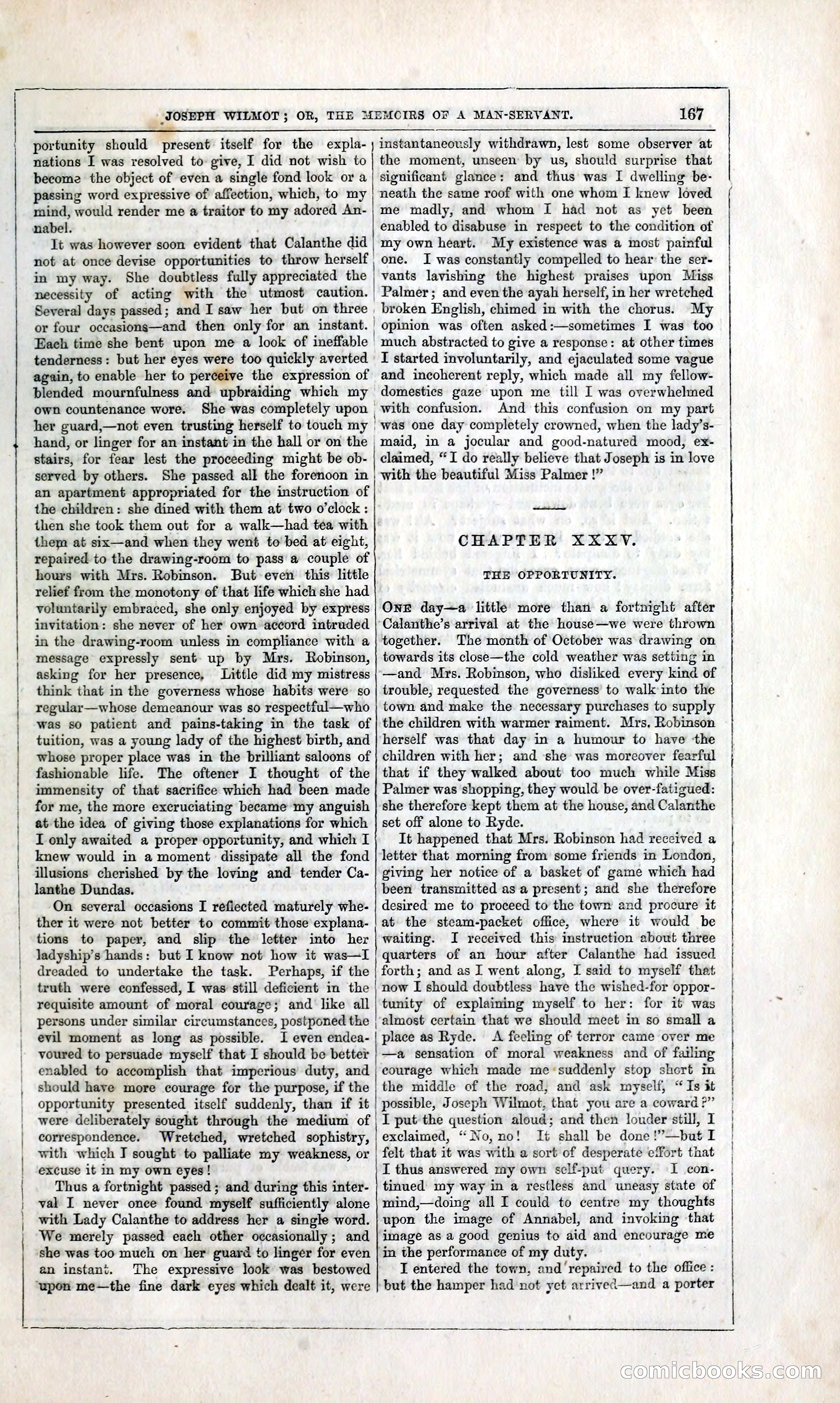
A restored page from Penny Dreadfuls, 1854. Page through the whole issue in the reader above.
📄 Transcribed text from this page (OCR, searchable)
Machine-transcribed from the original scan — historical spelling and the odd misread are preserved.
a a a iit ee ee ee ee ee oe ee JOSEPH WILMOT; OR, THE MEMCIRS OF A MAN-SERVANT. portunity should present itself for the expla-) instantaneously withdrawn, lest some observer at nations I was resolved to give, I did not wish to become the object of even a single fond look or a passing word expressive of affection, which, to my mind, would render me a traitor to my adored An- nabel. It was however soon evident that Calanthe did not at once devise opportunities to throw herself in my way. She doubtless fully appreciated the necessity of acting with the utmost caution. Several days passed; and I saw her but on three. or four occasions—and then only for an instant. Each time she bent upon me a look of ineffable | tenderness: but her eyes were too quickly averted again, to enable her to perceive the expression of blended mournfulness and upbraiding which my own countenance wore. She was completely upon her guard,—not even trusting herself to touch my hand, or linger for an instant in the hall or on the stairs, for fear lest the proceeding might be ob- served by others. She passed all the forenoon in an apartment appropriated for the instruction of the children: she dined with them at two o’clock : then she took them out for a walk—had tea with them at six—and when they went to bed at eight, repaired to the drawing-room to pass a couple of hours with Mrs. Robinson. But even this little relief from the monotony of that life which she had voluntarily embraced, she only enjoyed by express | invitation: she never of her own accord intruded in the drawing-room unless in compliance with a message expressly sent up by Mrs. Robinson, asking for her presence, Little did my mistress think that in the governess whose habits were so regular—whose demeanour was so respectful—who was so patient and pains-taking in the task of tuition, was a young lady of the highest birth, and whose proper place was in the brilliant saloons of fashionable life. The oftener I thought of the immensity of that sacrifice which had been made for me, the more excruciating became my anguish at the idea of giving those explanations for which I only awaited a proper opportunity, and which I knew would in a moment dissipate all the fond illusions cherished by the loving and tender Ca- lanthe Dundas. On several occasions I refiected maturely whe- ther it were not better to commit those explana- tions to paper, and slip the letter into her ladyship’s hands: but I know not how it was—I dreaded to undertake the task. Perhaps, if the truth were confessed, I was still deficient in the requisite amount of moral courage; and like all persons under similar circumstances, postponed the evil moment as long as possible. I even endea- voured to persuade myself that I should be better enabled to accomplish that imperious duty, and should have more courage for the purpose, if the opportunity presented itself suddenly, than if it were deliberately sought through the medium of correspondence. Wretched, wretched sophistry, with which I sought to palliate my weakness, or excuse it In my own eyes! Thus a fortnight passed ; and during this inter- val I never once found myself sufficiently alone with Lady Calanthe to address her a single word. We merely passed each other occasionally ; and she was too much on her guaré to linger for even an instant. The expressive look was bestowed ‘upon me—the fine dark eyes which dealt it, were ————— NN 167 the moment, unseen by us, should surprise that significant glance: and thus was I dwelling be- neath the same roof with one whom I knew loved me madly, and whom I had not as yet been enabled to disabuse in respeet to the condition of my own héart. My existence was a most painful one. I was constantly compelled to hear the ser- vants lavishing the highest praises upon Miss Palmer; and even the ayah herself, in her wretched broken English, chimed in with the chorus. My opinion was often asked :—sometimes I was too much abstracted to give a response: at other times I started involuntarily, and ejaculated some vague and incoherent reply, which made all my fellow- domestics gaze upon me till I was overwhelmed With confusion. And this confusion on my part 'was one day completely crowned, when the lady’s- maid, in a jocular and good-natured mood, ex- claimed, “I do really believe that Joseph is in love with the beautiful Miss Palmer !” ee 8 ee CHAPTER XXXV. THE OPPORTUNITY. OnE day—a little more than a fortmight after ‘Calanthe’s arrival at the house—we were thrown together. The month of October was drawing on towards its close—the cold weather was setting in —and Mrs. Robinson, who disliked every kind of trouble, requested the governess to walk into the town and make the necessary purchases to supply the children with warmer raiment. Mrs, Robinson herself was that day in a humour to have the children with her; and she was moreover fearful that if they walked about too much while Miss Palmer was shopping, they would be over-fatigued: she therefore kept them at the house, and Calanthe set off alone to Ryde. , It happened that Mrs. Robinson had received a letter that morning from some friends in London, giving her notice of a basket of game which had been transmitted as a present; and she therefore desired me to proceed to the town and procure it at the steam-packet office, where if would be waiting. I received this instruction about three quarters of an hour after Calanthe had issued forth; and as I went along, I said to myself that now I should doubtless have the wished-for oppor- tunity of explaining myself to her: for it was almost certain that we should meet in so small a place as Ryde. A feeling of terror came over me —a sensation of moral weakness and of failing courage which made me‘suddenly stop short in the middle of the road, and ask myself, “Is it possible, Joseph Wilmot, that you are a coward?” I put the question aloud; and then louder still, 1 exclaimed, “No,no! It shall be done !”’—but I felt that it was with a sort of desperate effort that I thus answered my own sclf-put query. I con- tinued my way in a restless and uneasy state of mind,—doing all I could to centre my thoughts upon the image of Annabel, and invoking that image as a good genius to aid and encourage me in the performance of my duty. I entered the town, and'repaired to the office : but the hamper had not yet arrived—and a porter ElN@QO) <S) (CO) im