
Penny Dreadfuls, 1854 · page 275 of 394
Joseph Wilmot, or, The Memoirs of a Man-Servant — page 275: what you’re looking at
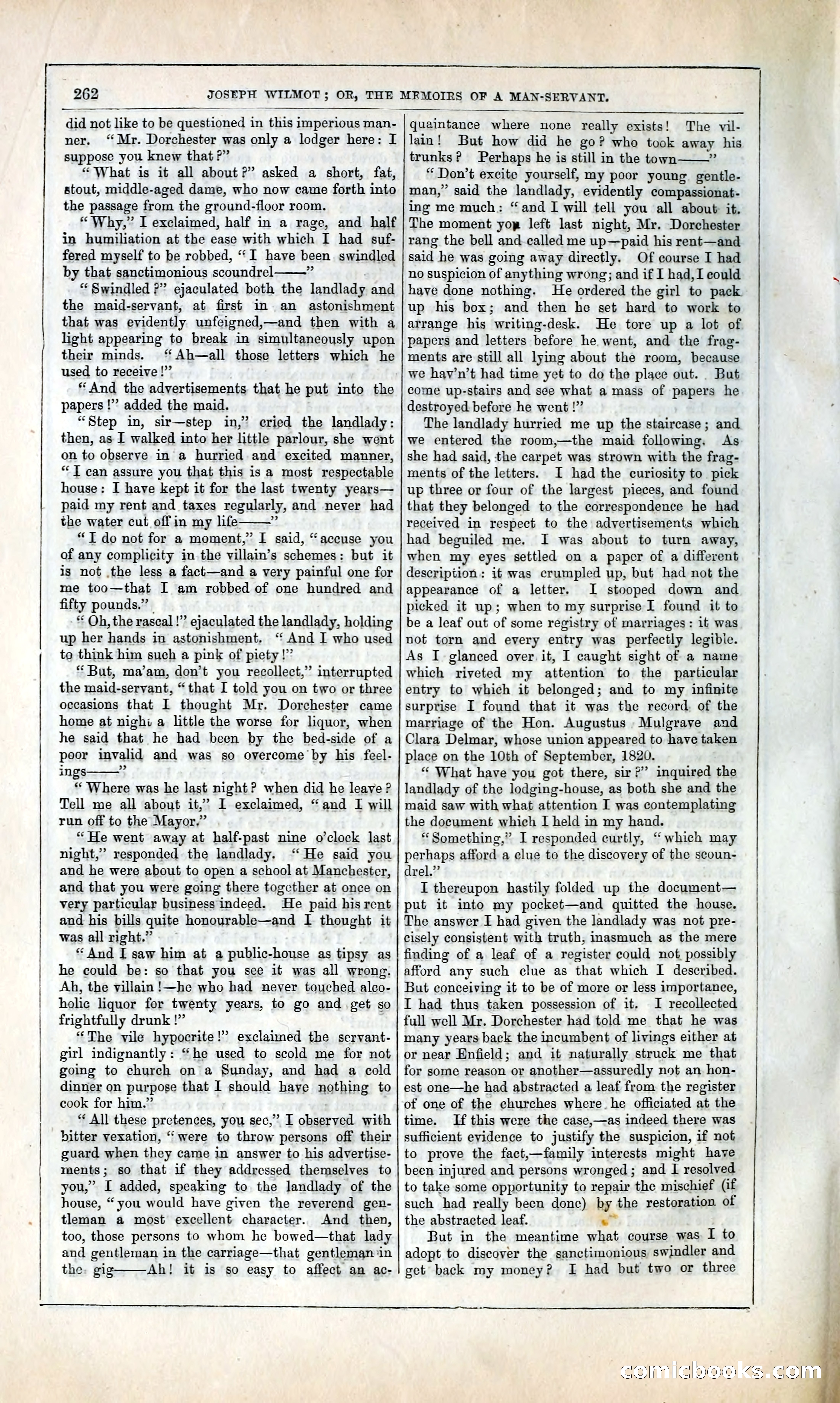
A restored page from Penny Dreadfuls, 1854. Page through the whole issue in the reader above.
📄 Transcribed text from this page (OCR, searchable)
Machine-transcribed from the original scan — historical spelling and the odd misread are preserved.
262 JOSEPH WILMOT; OR, THE MEMOIRS OF A MAN-SERVANT. SS a ee eee a ee eS el ee ee did not like to be questioned in this imperious man- ner. “Mr. Dorchester was only a lodger here: I suppose you knew that?” “What is it all about?” asked a short, fat, stout, middle-aged dame, who now came forth into the passage from the ground-floor room. “Why,” I exclaimed, half in a rage, and half in humiliation at the ease with which I had suf- fered myself to be robbed, “‘I have been swindled by that sanctimonious scoundrel ? “‘ Swindled ?” ejaculated both the landlady and the maid-servant, at first in an astonishment that was evidently unfeigned,—and then with a light appearing to break in simultaneously upon their minds. ‘ Ah—all those letters which he used to receive !”’ “And the advertisements that he put into the papers !”’ added the maid. “Step in, sir—step in,” cried the landlady: then, as I walked into her little parlour, she went on to observe in a hurried and excited manner, “‘T can assure you that this is a most respectable house: I have kept it for the last twenty years— paid my rent and taxes regularly, and never had the water cut off in my life 24 “T do not for a moment,’ I said, “accuse you of any complicity in the villain’s schemes: but it is not the less a fact—and a very painful one for me too—that I am robbed of one hundred and fifty pounds.” * Oh, the rascal !” ejaculated the landlady, holding up her hands in astonishment. ‘‘ And I who used to think him such a pink of piety!” “But, ma’am, don’t you recollect,” interrupted the maid-servant, “that I told you on two or three occasions that I thought Mr. Dorchester came home at nighi a little the worse for liquor, when he said that he had been by the bed-side of a poor invalid and was so overcome by his feel- ing's >> “Where was he last night? when did he leave? Tell me all about it,’ I exclaimed, “and I will run off to the Mayor,” “He went away at half-past nine o’clock last night,” responded the landlady. “‘He said you and he were about to open a school at Manchester, and that you were going there together at once on very particular business indeed. He paid his rent and his bills quite honourable—and I thought it was all right.” “And I saw him at a public-house as tipsy as he could be: so that you see it was all wrong. Ah, the villain !—he who had never touched alco- holic liquor for twenty years, to go and get so frightfully drunk !” ‘The vile hypocrite!” exclaimed the servant- girl indignantly: “he used to scold me for not going to church on a Sunday, and had a cold dinner on purpose that I should haye nothing to cook for him.” ** All these pretences, you see,” I observed with bitter vexation, “were to throw persons off their guard when they came in answer to his advertise- ments; so that if they addressed themselves to you,” I added, speaking to the landlady of the house, “ you would have given the reverend genr- tleman a most excellent character. And then, too, those persons to whom he bowed—that lady and gentleman in the carriage—that gentleman in the. gig Ah! it is so easy to affect an ac- quaintance where none really exists! The vil- lain! But how did he go? who took away his trunks? Perhaps he is still in the town ? “ Don’t excite yourself, my poor young gentle- man,” said the landlady, evidently compassionat- ing me much: “and I will tell you all about it. The moment yop left last night, Mr. Dorchester rang the bell and called me up—paid his rent—and said he was going away directly. Of course I had no suspicion of anything wrong; and if I had,I eould have done nothing. He ordered the girl to pack up his box; and then he set hard to work to arrange his writing-desk. He tore up a lot of papers and letters before he. went, and the frag- ments are still all lying about the room, because we hay’n’t had time yet to do the place out. But come up-stairs and see what a mass of papers he destroyed before he went!” The landlady hurried me up the staircase; and we entered the room,—the maid following, As she had said, the carpet was strown with the frag- ments of the letters. I had the curiosity to pick up three or four of the largest pieces, and found that they belonged to the correspondence he had received in respect to the advertisements which had beguiled me. I was about to turn away, when my eyes settled on a paper of a different description: it was crumpled up, but had not the appearance of a letter. IL stooped down and picked it up; when to my surprise I found it to be a leaf out of some registry of marriages : 1b was not torn and every entry was perfectly legibie. As I glanced over. it, I caught sight of a name which riveted my attention to the particular entry to which it belonged; and to my infinite surprise I found that it was the record. of the marriage of the Hon. Augustus Mulgrave and Clara Delmar, whose union appeared to have taken place on the 10th of September, 1820. “ What have you got there, sir?” inquired the landlady of the lodging-house, as both she and the maid saw with what attention I was contemplating the document which I held in my hand. “Something,” I responded curtly, “which may perhaps afford a clue to the discovery of the scoun- drel.” I thereupon hastily folded up the document— put it into my pocket—and quitted the house. The answer I had given the landlady was not pre- cisely consistent with truth, inasmuch as the mere finding of a leaf of a register could not possibly afford any such clue as that which I described. But conceiving it to be of more or less importance, I had thus taken possession of it. I recollected full well Mr. Dorchester had told me that he was many years back the incumbent of livings either at or near Enfield; and it naturally struck me that for some reason or another—assuredly not an hon- est one—he had abstracted a leaf from the register of one of the churches where. he officiated at the time. If this were the case,—as indeed there was sufficient evidence to justify the suspicion, if not to prove the fact,—family interests might have been injured and persons wronged; and I resolved to take some opportunity to repair the mischief (if such had really been done) by the restoration of the abstracted leaf. ai But in the meantime what course was I to adopt to discover the sanctimonious swindler and get back my money? I had but two or three GOMmIiIchdoo S (E(@)